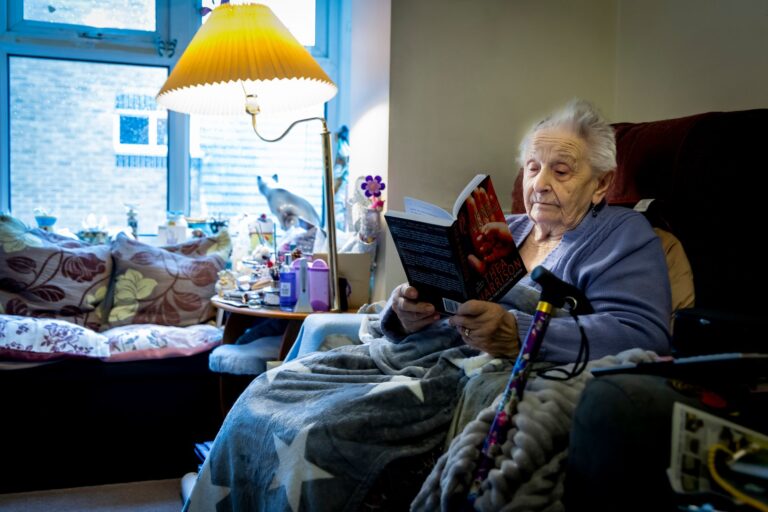
When a parent with Alzheimer's disease—a progressive brain disorder that damages memory and thinking—asks to go home, offer calm reassurance instead of arguing. Small moments matter because a warm voice, familiar cue, snack, or short walk can answer the immediate need for safety without demanding accurate memory. The request may sound simple, but its meaning is often unclear. Your task is not to prove where your parent lives; it is to understand the distress, meet the need you can identify, and watch for medical or safety concerns.
Medical information disclaimer: This article is for general educational purposes only and does not provide medical advice, diagnosis, or treatment. Always consult a physician or other qualified health professional about symptoms, medications, tests, or treatment decisions.
Table of Contents
- What Does "Home" Mean?
- How Should You Respond in the Moment?
- How Can the Surroundings Help?
- What Does the Evidence Say About Small Moments?
- When Does the Request Need More Than Reassurance?
What Does "Home" Mean?
"Home" may describe a feeling rather than an address. A parent might be seeking familiarity, comfort, a person from the past, or relief from a confusing situation. Alzheimer's can impair attention, understanding, language, and word-finding.
As speech becomes harder, tone, facial expression, movement, and other nonverbal signals may reveal sadness, anger, fear, or frustration. Wanting to go home—even while already home—is also a possible wandering-related sign. However, the phrase alone neither establishes Alzheimer's nor proves a literal wish to relocate, according to the Alzheimer's Association's wandering guidance.
How Should You Respond in the Moment?
Begin with the emotion rather than the facts. A response such as "You miss home" or "You want to feel safe" acknowledges the concern without confirming or challenging an inaccurate belief. Then pause.
Give your parent time to answer, and pay attention to gestures or changes in expression. The National Institute on Aging's communication guidance recommends a warm manner, careful listening, gentle touch when welcome, and redirection rather than arguing or using baby talk. A simple sequence can help:.
- Approach slowly and speak in a calm voice.
- Acknowledge the feeling: "It sounds as though you're worried."
- Offer reassurance: "You're safe. I'm staying with you."
- Allow time for a response.
- Redirect toward a favorite snack, familiar photograph, music, or short walk.
How Can the Surroundings Help?
The room may be adding to the problem. Noise, clutter, unfamiliar objects, or a disrupted routine can make an already confusing moment harder to manage. Reduce competing sights and sounds before asking more questions.
Move to a quieter room, turn off the television, or sit beside your parent without pressing for an explanation. Familiar photographs and a predictable routine may provide useful orientation without forcing a memory test. These adjustments are care strategies, not treatments for Alzheimer's. The National Institute on Aging's behavior guidance recommends reassurance, redirection, familiar cues, routine, and less noise or clutter when distressing behavior occurs.
What Does the Evidence Say About Small Moments?
The strongest related trial evidence supports person-centered care, which organizes care around the individual's needs, preferences, and relationships. In 69 UK nursing homes, the WHELD program combined staff training in person-centered care and social interaction with a review of antipsychotic medication. Among 553 people who completed the nine-month trial, the program produced small improvements in proxy-rated quality of life and agitation.
A proxy rating means another person assessed the resident's quality of life rather than the resident reporting it directly, as described in the WHELD trial published in PLOS Medicine. That result does not prove that one conversation, photograph, or snack will change a parent's symptoms. The trial examined a multi-part program delivered by trained care-home staff, not a single interaction or family care at home. It does support a broader lesson: regular, individualized social care can matter even when no single moment is curative.
When Does the Request Need More Than Reassurance?
Repeated requests for home should prompt a practical check. Pain, constipation, thirst, hunger, poor sleep, sensory difficulty, medication effects, infection, or stressful surroundings can all contribute to distress.
Look for immediate needs: A sudden change, rapid worsening, or behavior that fluctuates sharply requires prompt medical attention. Do not assume it is simply another stage of Alzheimer's, especially when the change appears alongside signs of illness or physical discomfort.
- Has your parent eaten and had something to drink?
- Do they appear uncomfortable or in pain?
- Have sleep or bowel habits changed?
- Could noise, crowding, poor lighting, or an unfamiliar routine be contributing?
- Is the behavior creating a risk of leaving unsafely?