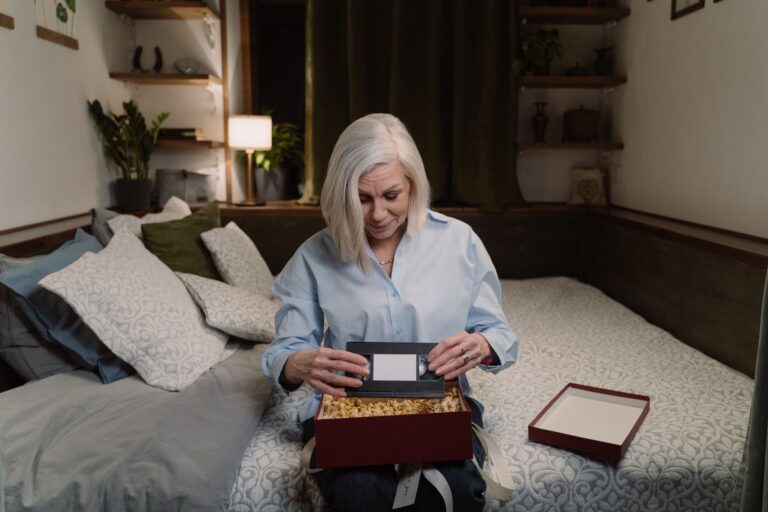
Letters from adult children can become treasured family keepsakes and gentle prompts for sharing familiar experiences as Alzheimer's changes communication. They cannot preserve memory, reverse decline, or guarantee a response, but they can express connection without demanding perfect recall. Alzheimer's is a progressive brain disorder that damages memory, thinking, and eventually daily functioning. It is the most common cause of dementia, and symptoms usually begin after age 65, according to the National Institute on Aging.
Medical information disclaimer: This article is for general educational purposes only and does not provide medical advice, diagnosis, or treatment. Always consult a physician or other qualified health professional about symptoms, medications, tests, or treatment decisions.
Table of Contents
- What can a family letter realistically do?
- Whose memories should the letter hold?
- How do you write a letter that is easy to follow?
- How should you share it as communication changes?
- What if the letter receives little response?
What can a family letter realistically do?
A letter can hold a story, feeling, or family detail in a form that relatives can revisit. It may also serve as a reminiscence prompt: an object used to invite discussion about past experiences. Research has examined reminiscence therapy rather than letters from adult children specifically.
A review of 22 trials involving 1,972 participants found small, inconsistent effects, although group approaches were associated with better communication in some settings, according to the research review indexed by PubMed. That evidence does not prove that letters preserve memories or reliably improve communication. No authoritative evidence establishes them as an approved Alzheimer's treatment. Their clearest value is personal: they record affection and shared history while leaving room for whatever response is possible.
Whose memories should the letter hold?
Adult children often have years of family material to draw from, but they are not the only meaningful contributors. More than half of dementia caregivers assist a parent or parent-in-law, according to the Alzheimer's Association's 2026 report. Spouses, siblings, grandchildren, friends, and other caregivers may hold different parts of the person's story.
Choose memories that support connection rather than demand accuracy. A small, concrete scene is often easier to follow than a long family history: "I remember us planting tomatoes beside the porch" is clearer than a detailed account spanning several decades. Avoid using the letter to settle disputed events or establish whose version is correct. If a memory could cause shame, conflict, or distress, select a warmer and less complicated moment.
How do you write a letter that is easy to follow?
Build the letter around one person, place, or event. use familiar names and direct sentences instead of expecting the reader to infer who or what you mean. A simple structure can help: For example: "Dad, I was thinking about the Saturday mornings when we washed the blue car together.
I remember the radio playing while you worked. I still treasure that time with you. I love you. —Maya, your daughter.".
- Begin with the person's preferred name and a warm statement.
- Describe one specific memory in a few short sentences.
- Add a sensory detail, such as a song, meal, color, or place.
- State what the moment means to you now.
- End with reassurance, not a memory question or test.
How should you share it as communication changes?
Match the letter to the person's current comfort and attention. You might offer the page, read a short passage aloud, or pair it with a related photograph. Stop or change course if the person appears uncomfortable. The National Institute on Aging recommends calm speech, simple sentences, one question at a time, enough time for a response, and attention to body language.
Its practical communication guidance also advises against testing or correcting the person. Use invitations instead of quizzes. "I was remembering our garden" allows many kinds of response; "Do you remember what we planted in 1986?" places the person under pressure. A smile, gesture, brief comment, or quiet attention can be accepted without asking for more.
What if the letter receives little response?
Silence does not tell you exactly what the person understood or felt. Do not treat a missing response as proof that the letter failed, and do not repeatedly press for recognition. The letter may still matter to other relatives as a record of shared life.
Date it, identify the people and places mentioned, and keep a copy where the family can find it. If several relatives contribute, label each writer's relationship to the person rather than assuming future readers will know. Communication interventions may help in some circumstances, but family benefits are not guaranteed. If a letter creates distress, put it aside and return to a calm, familiar interaction without asking the person to explain or correct the reaction.