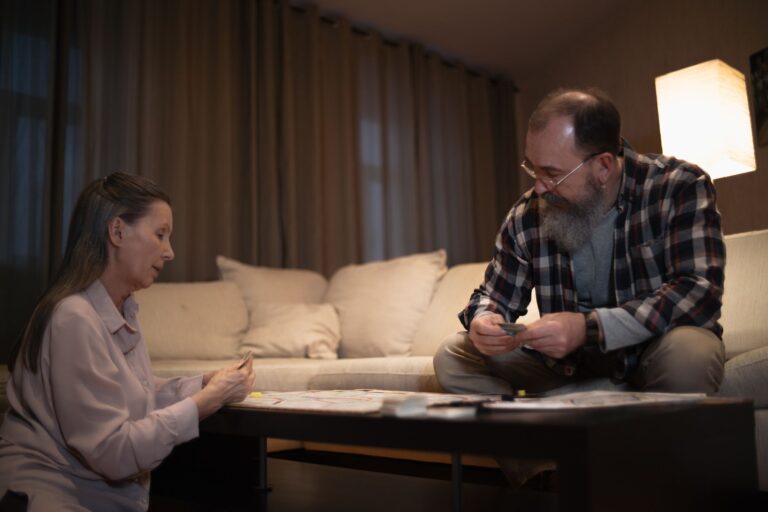
Yes, calm and familiar Christmas games can be safe for aged care residents with Lewy body dementia when they are short, simple and played in daylight. Fast, noisy, competitive or flashing-light games are not safe because they can cause confusion, agitation, fear or withdrawal.
Lewy body dementia is a brain disorder with shifting alertness and attention, detailed visual hallucinations, and stiffness with little spontaneous movement. Safety depends on the person's state that day. Symptoms can shift over hours, so staff should choose the activity, timing, room setup and group size to fit the resident.
Medical information disclaimer: This article is for general educational purposes only and does not provide medical advice, diagnosis, or treatment. Always consult a physician or other qualified health professional about symptoms, medications, tests, or treatment decisions.
Table of Contents
- Which Christmas games suit residents best?
- Why do Christmas setups cause problems?
- How does Lewy body dementia change game safety?
- How should staff plan the session?
Which Christmas games suit residents best?
Simple, familiar activities work best when each has one clear step. Looking at old photos and cards, handling sturdy ornaments, listening to known festive music, doing a small craft, and large-piece matching or sorting remain inclusive when broken into one short step at a time.
Keep sessions brief and daytime. Stop while the resident still shows interest, then offer rest rather than another round.
Why do Christmas setups cause problems?
Christmas flashing or flickering lights, loud music, heavy decoration and disrupted routines can overstimulate people with dementia, according to Age Scotland in festive-season guidance for dementia. The result is confusion, agitation, fear or withdrawal rather than enjoyment.
Dementia-friendly holiday guidance advises keeping decorations few, simple and familiar, says the Alzheimer's Foundation of America in holiday-season dos and don'ts. It also advises phasing decorations in gradually and avoiding blinking lights, noisy items, fragile ornaments, cord trip hazards, burning candles and food-lookalike decorations.
How does Lewy body dementia change game safety?
Alertness may rise and fall across the day. A resident who joins in during the morning may stare, doze, missee objects or hallucinate in the afternoon.
Vision and balance add risk. People with Lewy body dementia commonly have impaired visual perception and postural instability, so plain floors reduce tripping risk while patterned carpets, rugs, mirrors and clutter increase confusion, hallucinations and falls. Choose a plain-floor room, clear cords and clutter, keep lighting steady and even, and avoid mirrors near the table.
How should staff plan the session?
Because Lewy body symptoms fluctuate over hours to days, safety depends on scheduling games in daytime around normal meals, sleep and medication, according to Johns Hopkins Medicine and Alzheimer's Foundation of America guidance in Lewy body dementia information and holiday-season dos and don'ts. The same guidance points to small groups and a quiet retreat room if overstimulation occurs.
Agitation from a loud party should not be treated as a behavior to sedate. An estimated 25 to 50 percent of people with Lewy body dementia develop severe reactions to usual antipsychotic doses, including worse cognition, irreversible parkinsonism, sedation and potentially fatal neuroleptic malignant syndrome. Prevent overstimulation first, then seek medical advice promptly if distress continues.
- Play in daylight after meals, sleep and medication, not in the evening.
- Keep groups small, with one leader and one step at a time.
- Offer sturdy, large, non-fragile items and familiar music at low volume.
- Keep a quiet, plain retreat room ready and move there at the first sign of distress.
- Do not press a tired or hallucinating resident to continue; try again another day.