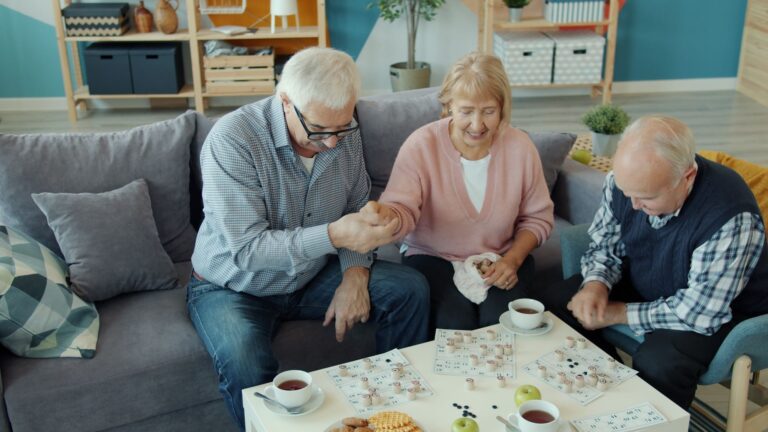
Crosswords, Scrabble-style word building, word-association games, and familiar card and board games best support language skills in memory care. Memory care is residential or day support for people living with dementia.
In more than 19,000 adults age 50 and older, frequent word and number puzzles were linked to better attention, reasoning, and memory scores, according to the Alzheimer's Society summarizing PROTECT research PROTECT summary. For families and staff, the practical choice is familiar activities that prompt recall, word finding, and talk. Short, social sessions work better than difficult solo drills.
Medical information disclaimer: This article is for general educational purposes only and does not provide medical advice, diagnosis, or treatment. Always consult a physician or other qualified health professional about symptoms, medications, tests, or treatment decisions.
Table of Contents
- Why crosswords stand out for word finding
- Do social table games help thinking skills?
- What changes with more advanced dementia?
- How to run word games in memory care
Why crosswords stand out for word finding
Researchers tested 107 adults averaging age 71 with mild cognitive impairment for 78 weeks. Web-based crossword training produced greater cognitive improvement and less brain shrinkage than computerized cognitive games, according to the NewYork-Presbyterian/Columbia Psychiatry report psychiatry research report.
Crosswords directly practice word retrieval, clues, spelling, and meaning. Among 101 initially non-demented adults who later developed dementia, baseline crossword players showed delayed onset of accelerated memory decline by 2.54 years versus non-players, Albert Einstein College of Medicine researchers found. Decline was faster once it began, so the benefit was delay rather than lasting protection.
Do social table games help thinking skills?
In more than 1,000 Scots tested at age 70 and retested to age 79, regular non-digital play of cards, chess, bingo, or crosswords was linked to less decline in memory and thinking speed, according to the University of Edinburgh via EurekAlert! university research news. The link held after accounting for age-11 IQ and education.
These games support everyday language because players must follow rules, take turns, name plays, and chat. Useful choices for memory care include: Pick games the person already knows. Familiar rules lower stress and leave more energy for speaking and listening.
- Large-print crosswords and word searches done together aloud
- Scrabble-style tile play focused on making words, not score
- Simple card games, bingo, chess, and dominoes with talk
- Word-association, naming, and category games in small groups
What changes with more advanced dementia?
A 2022 systematic review and meta-analysis of 14-16 studies found serious and cognitive-training games improved verbal and working memory in mild cognitive impairment, according to the JMIR Serious Games review via NIH/PMC systematic review. In dementia, the same review found no significant advantage over controls for memory, executive function, language, or visuospatial skills.
That means games can still prompt talk and enjoyment without restoring language skill. In a small pilot with elderly dementia patients, repeated Shiritori Japanese word-chain sessions with a dialogue robot temporarily improved cognitive and behavioral scores, Frontiers in Robotics and AI researchers reported. The sessions worked by activating word retrieval and social interaction.
How to run word games in memory care
Favor low-cost, familiar word activities for language stimulation and engagement, consistent with National Institute on Aging cognitive-health guidance. They remain engagement tools, not proven prevention or treatment for Alzheimer's.
Keep groups small, lighting bright, and print large. Make each session easy to join and easy to leave: End while interest is high and write down which clues, tiles, or topics sparked the most speech.
- Offer two or three word choices instead of open questions
- Read clues aloud and accept partial answers
- Let players team up rather than compete alone
- Use ten- to twenty-minute rounds with breaks for talk