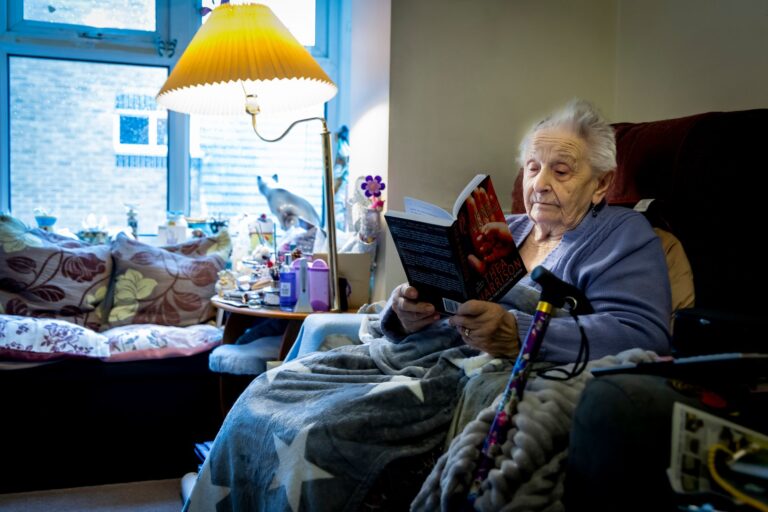
Answering the same question with kindness matters because Alzheimer's can prevent a person from retaining the answer. A calm reply treats repetition as a symptom of impaired memory and communication, not deliberate behavior. The goal is not to make the answer "stick." It is to reduce strain in that moment, address the concern behind the question, and preserve the person's dignity.
Medical information disclaimer: This article is for general educational purposes only and does not provide medical advice, diagnosis, or treatment. Always consult a physician or other qualified health professional about symptoms, medications, tests, or treatment decisions.
Table of Contents
- Why does the question keep returning?
- What does kindness accomplish?
- How should you answer in the moment?
- How can you make questions easier?
- What does the evidence not show?
Why does the question keep returning?
Alzheimer's can impair the ability to learn, retain, and recall new information. Attention problems and distractions may make this worse, according to a 2018 case analysis indexed by the National Library of Medicine. A person may therefore ask, "When is lunch?" moments after hearing the answer.
from that person's perspective, the question may feel new because the earlier exchange is no longer available to recall. Alzheimer's can also affect word-finding, comprehension, attention, and the ability to follow a train of thought. The National Institute on Aging's communication guidance supports viewing repetition as a communication symptom rather than willful behavior.
What does kindness accomplish?
A warm response lowers the interpersonal pressure of the exchange. It also acknowledges that the person may be expressing a concern—such as uncertainty about what happens next—even when the words remain unchanged. Kindness does not require a long explanation. It can mean making eye contact, using the person's name, answering without visible tension, and allowing extra response time.
Avoid arguing, interrupting, or testing whether the person remembers. Communication style can affect care interactions. In a cluster randomized trial across 13 nursing homes, staff training reduced patronizing "elderspeak" by 13.6 percentage points and resistiveness to care by 15.3 points immediately after the intervention, according to the University of Iowa-led trial. The results concern trained nursing-home staff, so they do not prove that one kind reply will produce the same effect at home.
How should you answer in the moment?
Keep the answer short, concrete, and emotionally steady. Then respond to any concern that appears to sit beneath the question.
For example: If the question returns, repeat the answer or rephrase it gently. Correcting the person's memory, demanding that they "think," or pointing out how many times they have asked adds a task they may be unable to complete.
- "Your appointment is at three. We have plenty of time."
- "Anna will be here after lunch. You're not waiting alone."
- "We're going home soon. First, we'll finish our tea."
- "Your coat is in the closet. It's safe."
How can you make questions easier?
Reduce the memory and language work required. Ask yes-or-no questions or offer one or two clear choices instead of broad, open-ended questions.
Try these substitutions: A small observational study of 18 spouse-caregiver pairs found fewer communication breakdowns with yes-or-no questions and questions using general knowledge rather than memory of personal events. The study was small and nonrandomized, and it did not test repeated answers directly.
- Instead of "What do you want to do today?" ask, "Would you like music or a walk?"
- Instead of "What did you eat?" ask, "Did you have oatmeal?"
- Instead of "Where do you think your shoes are?" say, "Your shoes are by the door."
- If the person looks confused, use different words rather than repeating the same sentence more loudly.
What does the evidence not show?
Kind repetition is humane and consistent with established communication guidance, but it is not a treatment for Alzheimer's. No evidence provided here shows that it changes the disease's progression. Broader person-centred care—care organized around the individual's needs and preferences—has produced modest benefits in residential settings.
Yet bundled programs combine several practices, so researchers cannot isolate kindness or any single conversational technique as the cause. The practical burden remains substantial: about 80% of U.S. adults with Alzheimer's or related dementias receive care at home, and more than 11 million adults provided 18.4 billion hours of unpaid dementia care in 2023, according to the CDC's caregiving overview. When patience is thin, the immediate task is still concrete: pause, soften your voice, and answer the question in one simple sentence.