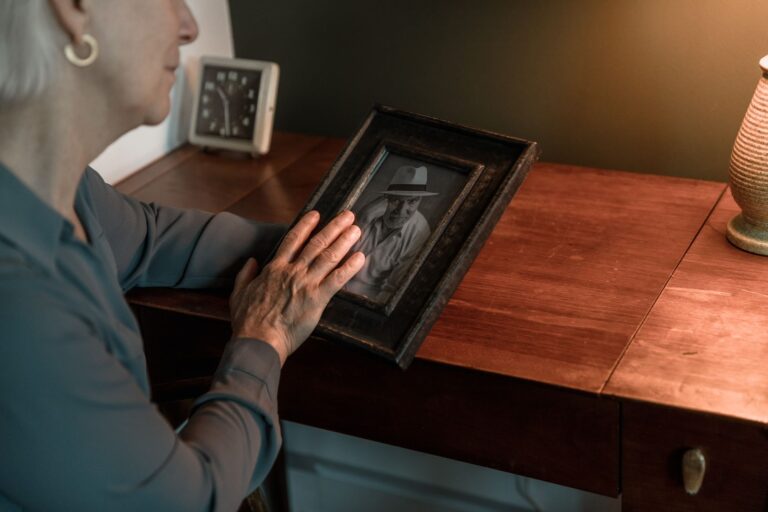
Smiling at an old wedding photograph can create a gentle opening for connection with a person who has dementia. Treat the photograph as an invitation to share a moment, not as a test of whether the person remembers the wedding. Dementia is a general term for memory, thinking, or decision-making problems that interfere with daily activities; Alzheimer's disease is its most common type, according to the CDC. A warm response to a photograph can matter even when names, dates, and stories remain unclear.
Medical information disclaimer: This article is for general educational purposes only and does not provide medical advice, diagnosis, or treatment. Always consult a physician or other qualified health professional about symptoms, medications, tests, or treatment decisions.
Table of Contents
- What can a wedding photograph offer?
- What does the evidence show?
- Invite memory without testing it
- How to make the moment easier
- What a smile does—and does not—mean
What can a wedding photograph offer?
Looking at personal photographs resembles informal reminiscence. Reminiscence uses prompts, including photographs or music, to encourage memories and conversation. A family member sharing an album is usually offering an everyday activity, not formal therapy. The value may lie in the interaction rather than accurate recall.
A person might smile, study the clothing, comment on a face, or simply enjoy sitting beside someone. None of these responses proves that a specific memory has returned, but each can support a shared moment. The photograph can also give conversation a concrete focus. This may feel easier than a broad question such as, "What did you do today?".
What does the evidence show?
Research does not show that reminiscence reliably produces large improvements. A Cochrane review examined 22 randomized trials involving 1,972 people, mostly with mild or moderate dementia. Effects on quality of life, cognition, communication, and mood were small and varied by setting and format. Across eight trials with 1,060 participants, reminiscence had no important immediate overall effect on quality of life.
Care-home studies showed a small benefit, suggesting that context may influence the result. Evidence specifically about photographs is even less certain. A 2023 BMC Geriatrics systematic review found eight controlled studies using generic photographs; methods varied, and only two studies were rated high quality. Because the review did not establish an effect for personal wedding photographs, caregivers should avoid treating one as a proven intervention.
Invite memory without testing it
questions such as "Who is that?" or "Don't you remember your wedding?" can turn a pleasant activity into a quiz. Try observations and open invitations instead: Accept the response without correcting every detail.
If the person identifies someone differently, focus on the feeling or subject they introduced unless clarification is necessary for safety. Allow silence. The NIH's communication guidance for Alzheimer's caregivers recommends eye contact, a warm manner, two-way conversation when possible, and enough time for the person to respond.
- "You look happy in this picture."
- "That is a beautiful dress."
- "I wonder what the music was like."
- "Would you like to tell me anything about this?"
- "We can just look together."
How to make the moment easier
Choose a calm time and reduce competing noise. Sit where both people can see the photograph without requiring the person to hold it or explain it.
Begin with one clear image rather than a crowded album. Offer brief context if it seems welcome: "This is a photograph from your wedding." Then pause and follow whatever attracts the person's attention. Keep the exchange flexible:.
- Continue if the person appears interested or comfortable.
- Change the subject if the photograph causes confusion.
- Put it away if the person becomes distressed.
- Return another day only if that seems welcome.
- Let quiet companionship count as participation.
What a smile does—and does not—mean
A smile may be enough reason to stay with the moment, but it is not evidence that memory or thinking has improved. Avoid asking the person to repeat details later to see whether the activity "worked." The photograph also need not produce a story. Connection may consist of a smile, a few words, or several peaceful minutes looking together.