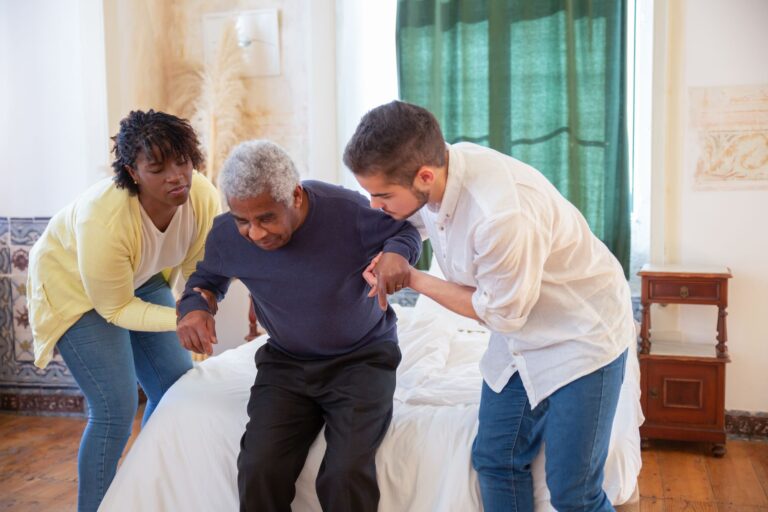
Recorded bedtime stories can preserve a familiar voice and make shared memories easier to revisit as Alzheimer's changes conversation. They may offer comfort or engagement, but evidence does not show that they preserve communication or slow the disease. A recording can become part of a calming routine without testing memory or demanding a response. Its value depends on the individual's reaction, not on whether they remember the story accurately.
Medical information disclaimer: This article is for general educational purposes only and does not provide medical advice, diagnosis, or treatment. Always consult a physician or other qualified health professional about symptoms, medications, tests, or treatment decisions.
Table of Contents
- Why recordings may help when conversation becomes harder
- What does the research actually show?
- How to create a recording that feels supportive
- How to introduce and adjust the recording
Why recordings may help when conversation becomes harder
Alzheimer's can affect word-finding, comprehension, attention during long conversations, logical organization, and the ability to maintain a train of thought, according to the National Institute on Aging's communication guide. A recording reduces some of that pressure. The listener does not need to organize a reply or keep a conversation moving. The clinical term "simulated presence therapy" describes personalized family audio or video recordings played for someone with dementia.
Recordings often feature reassuring messages or positive shared memories. This is a caregiving approach, not an approved drug or device treatment. A bedtime recording can serve a simpler purpose than therapy: preserving a parent's voice, a grandparent's favorite tale, or the family version of a familiar event. What counts as a treasured memory is personal and cannot be measured clinically.
What does the research actually show?
The evidence remains limited. A 2017 Cochrane review found three nursing-home trials involving 144 participants. Results for behavioral symptoms were mixed, evidence certainty was very low, and the studies did not report quality of life or caregiver burden. A newer randomized study involved 107 nursing-home residents with Alzheimer's.
Family recordings combined with usual care or education were associated with lower post-intervention depression scores and better sleep, while cognition declined in the control group, according to the 2025 Journal of Gerontological Nursing study. that study did not measure whether recordings preserved communication. Its abstract also omitted effect sizes, the recording protocol, and intervention duration. Because participants lived in nursing homes, the findings cannot establish the same benefits for people living at home.
How to create a recording that feels supportive
Choose stories connected to warmth, belonging, or routine. A family might record a childhood bedtime tale, the story behind a holiday tradition, or a gentle account of how the listener met someone important. Keep the language easy to follow: A useful closing might be, "You do not need to remember anything.
I love you, and I'm thinking of you." If a response is invited, a simple yes-or-no question places less demand on the listener than an open-ended memory prompt. Recordings do not need polished narration. Familiar pacing, affectionate phrases, and the speaker's natural voice may matter more to the family than production quality.
- Say the person's name and identify the speaker.
- Tell one clear story at a time.
- Use familiar words and a warm, unhurried voice.
- Avoid questions that test dates, names, or relationships.
- End with reassurance rather than a request for recall.
How to introduce and adjust the recording
Play the recording when the person is relatively settled, at a comfortable volume, with a caregiver nearby the first few times. Introduce it plainly: "This is a story recorded by Maya." Watch facial expression, posture, speech, and attempts to turn away. Do not correct the listener if they identify the speaker or event differently. Allow time for a response, rephrase when needed, and use warm nonverbal cues. These practices follow the NIA's guidance for reducing communication pressure.
More audio is not automatically better. In one study of 30 adults with moderate Alzheimer's using a communication device, brief digitized voice output reduced utterances, elaborations, and initiations compared with no voice output, according to the 2009 study. That device was different from a family story, but the finding shows why recordings should not crowd out live interaction. Stop or change the recording if the person appears frightened, agitated, confused, or repeatedly asks for an absent relative. Try another voice, a different memory, or quiet companionship instead. Persistent or sudden communication changes warrant clinical evaluation rather than relying on recordings alone.