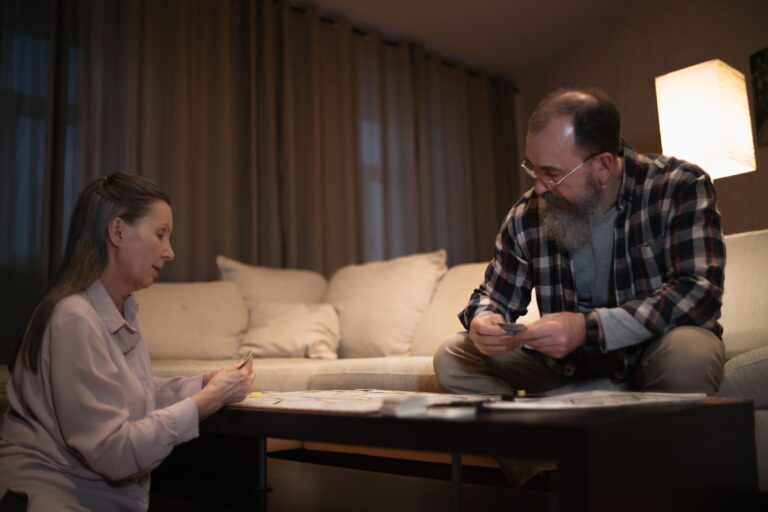
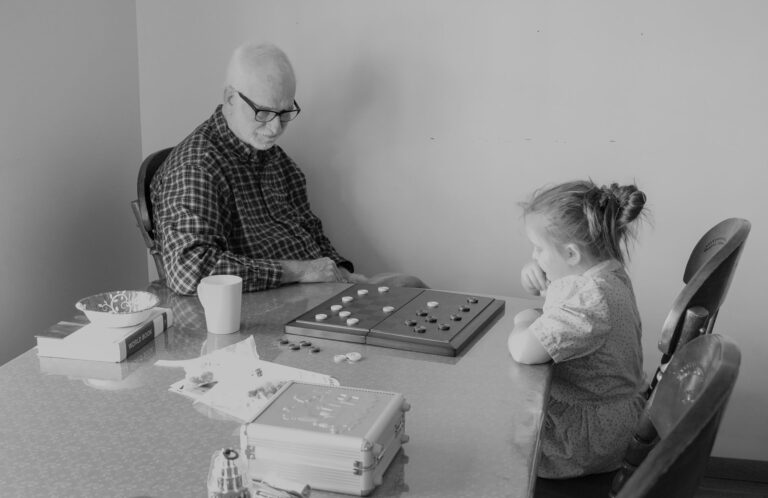
Caregivers pick games for early stage memory loss by starting from what the person already loves, not from what a product claims to train. The Alzheimer's Association's daily care activities guidance is direct about this: in the early stages a person often pulls back from activities they once enjoyed, and the right response is to keep those familiar activities and adjust them to current abilities rather than introduce something unfamiliar.
The second half of the decision is mechanical. When a game falls flat, the two variables to change first are the time of day and the complexity — not the game itself. That single habit turns "he doesn't like games anymore" into a problem with two adjustable dials.
Medical information disclaimer: This article is for general educational purposes only and does not provide medical advice, diagnosis, or treatment. Always consult a physician or other qualified health professional about symptoms, medications, tests, or treatment decisions.
Table of Contents
- Start with the games already in the house
- What does the evidence actually show?
- Where the evidence stops short of your living room
- Running a session so it works
- Who is making these choices
- Frequently Asked Questions
Start with the games already in the house
Early stage memory loss means the person still holds most of their skills, their preferences and their sense of themselves. A new game arrives with no emotional pull and a learning curve, which is exactly the wrong combination. A lifelong bridge player will stay with a simplified card game far longer than with a brain-training app bought last week. The Alzheimer's Association guidance frames withdrawal from enjoyed activities as a feature of the early stages, not a verdict on the activity. So a father who has stopped doing the crossword has not necessarily stopped liking crosswords.
He may be avoiding the part where he gets stuck in front of someone. Adjusting to match current ability is the move. That might mean the easier Monday puzzle instead of Saturday's, dominoes instead of a long card game, or doing the crossword together so no clue is a dead end. Monica Moreno, the Alzheimer's Association's senior director of care and support, has said that in the early stages of dementia word games, video games and even AI technology can all help stimulate the brain and keep the person engaged, as reported in a Being Patient interview. The format matters much less than whether the person actually wants to play it.
What does the evidence actually show?
The strongest evidence for game-like mental activity comes from the 2023 Cochrane review of cognitive stimulation, which pooled 37 studies and 2,766 people with mild-to-moderate dementia, mean age 79, in programmes typically running about ten weeks. Its conclusion was that cognitive stimulation probably produces small benefits in cognition. The size is worth knowing precisely.
Across the 25 trials that used the Mini-Mental State Examination — a 30-point screening test of memory, attention and orientation — participants attending sessions averaged a 1.99-point advantage. Benefits were largest with two or more group sessions a week and in people with milder disease, and no study in the review reported any harm. A 2025 meta-analysis in *Neuropsychiatric Disease and Treatment* points the same direction for people a step earlier in the process. Comparing leisure activities such as mahjong, card games and VR against traditional cognitive rehabilitation in mild cognitive impairment, it reported improvements in overall cognition on both the MoCA and the MMSE.
Where the evidence stops short of your living room
The Cochrane authors found a high level of inconsistency between studies on both cognition and quality of life, and specifically called for research on one-to-one stimulation and on the best session frequency. Read that carefully and it describes a gap rather than a result: the trials tested structured group programmes, and a caregiver's home game night with one person has weaker evidence behind it than the thing that was measured. This is not a reason to skip games.
Nothing in the review suggests harm, the measured effect went in a good direction, and enjoyment is a legitimate goal on its own. It is a reason to be honest about scale — a 1.99-point MMSE difference is a real but small effect, and no game slows the underlying disease. It also argues for the group option where one exists. Memory cafés, day programmes and structured cognitive stimulation groups running twice a week or more are closest to what the trials actually tested.
Running a session so it works
The National Institute on Aging's guidance on adapting activities for people with Alzheimer's disease sets out the practical decisions before you deal the cards: The NIA also advises scheduling activities for the time of day when the person is at their best, keeping them short enough to avoid fatigue, and choosing quiet settings at off-peak hours. Applied to games, that means a short session in a low-noise room at the person's good hour, not a two-hour tournament with the television on.
When something does not work, the Alzheimer's Association guidance says to consider that it was the wrong time of day or too complicated, then retry later or simplify it. Two attempts at different hours, and one stripped-down version, before you write a game off.
- Match the game to what the person can still do, rather than to what they could do last year.
- Decide in advance whether they can play alone or need help, so assistance does not arrive as a correction mid-game.
- Watch for signs of frustration and stop before it builds.
- Accept watching instead of playing if that is what they prefer — spectating is a valid form of taking part.
Who is making these choices
The decision sits with family far more often than with professionals. Alzheimer's Association 2025 Facts and Figures puts the number of unpaid family caregivers at nearly 12 million, providing an estimated 19.2 billion hours of dementia care in 2024, valued at $413.5 billion — with fewer caregivers each carrying more care than a decade earlier.
That context should lower the bar for what counts as a good choice. A caregiver stretched across meals, medication and appointments does not need a researched curriculum of cognitive exercises. Pulling out the deck of cards the person has used for forty years, at four in the afternoon when they are sharpest, for twenty minutes, is the intervention.
Frequently Asked Questions
Are commercial brain-training apps better than ordinary card games?
The 2025 meta-analysis found that leisure activities including mahjong, card games and VR improved overall cognition on the MoCA and MMSE in mild cognitive impairment when compared against traditional cognitive rehabilitation. Familiarity and willingness to play matter more than the format.
How often should we play?
In the Cochrane review, benefits were greatest at two or more group sessions per week, and the programmes studied ran about ten weeks. The authors noted that the best frequency for one-to-one sessions has not been established.
What if they refuse to play at all?
The NIA says to accept watching instead of playing when the person prefers it. The Alzheimer's Association adds that a failed attempt may simply be the wrong hour or too complex, so try again later at their best time of day with a simplified version.