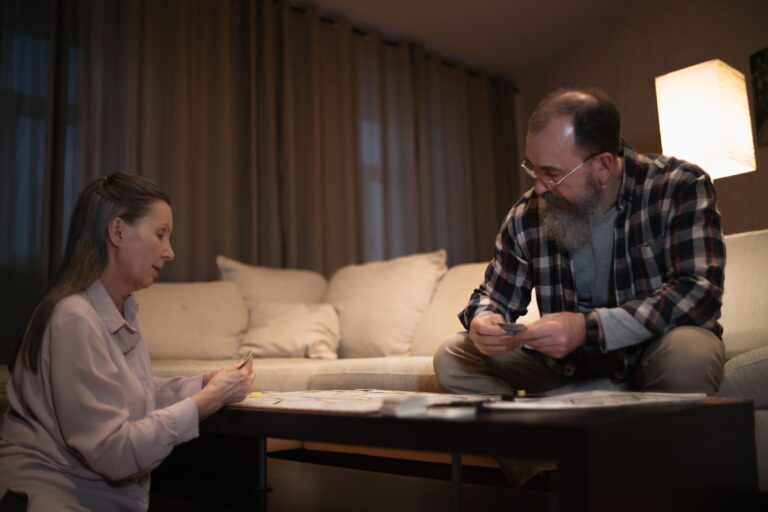
Caregivers introduce a new game by showing it instead of explaining it, breaking it into single steps, and choosing a moment when the person is at their best. The Alzheimer's Association's activities guidance is direct about the method: demonstrate the activity, present it in pieces, and "focus on one step at a time," because "too many directions at once can be overwhelming." Confusion during a new game is usually a sign that the delivery was too fast, too verbal, or badly timed — not that the person cannot play. The rest of this page covers the demonstration method, the timing that decides most outcomes, how to design a game that cannot be lost, how to tell afterwards whether to repeat it, and what the research does and does not support for one-to-one play at home.
Medical information disclaimer: This article is for general educational purposes only and does not provide medical advice, diagnosis, or treatment. Always consult a physician or other qualified health professional about symptoms, medications, tests, or treatment decisions.
Table of Contents
- Show the game, don't explain it
- Does the timing matter more than the game?
- Build a game nobody can lose
- Keep the frame familiar and let only the game be new
- Judging afterwards whether to play it again
- What the evidence supports, and where it thins
- Frequently Asked Questions
Show the game, don't explain it
Verbal instructions are the hardest part of a new game for someone with memory loss, because following them requires holding several items in working memory at once. The Alzheimer's Association tells caregivers to demonstrate the activity rather than describe it, and to offer one step at a time rather than the whole sequence. In practice that means sitting beside the person, placing the first tile or card yourself, and then handing them the next one without commentary. If they hesitate, repeat the physical demonstration rather than rephrasing the rule.
A second explanation adds load; a second demonstration does not. Keep the setup visible and minimal. One deck on the table, not three boxes stacked beside it. What is in view is effectively the instruction sheet, so remove anything the game does not need.
Does the timing matter more than the game?
Often, yes. The National Institute on Aging's brochure Adapting Activities for People With Alzheimer's Disease advises families not to plan too many activities, to schedule them "for the time of day when the person with Alzheimer's is at his or her best," and to keep outings from running long. That single scheduling rule resolves a lot of apparent failures. A game that produced frustration at 5 p.m.
may land easily at 10 a.m. with nothing about the game changed. If you only get one attempt a day, spend it in the person's strongest window. The Association makes the same point about abandoning an attempt gracefully: when something does not work, "it may just be the wrong time of day or the activity may be too complicated." The instruction is to try again later or adapt it — not to push through the session.
Build a game nobody can lose
A new game is easier to learn when mistakes are engineered out of it. Errorless learning is a teaching method that uses feed-forward instruction — giving the answer or action before the person can get it wrong — and explicitly tells them not to guess. A review in Clinical Interventions in Aging by de Werd and colleagues concluded that people with dementia can still acquire meaningful skills this way, and that doing so may reduce caregiver burden.
Montessori-based dementia activity design applies the same logic to leisure. As described in this overview of the Montessori approach for aging, tasks run from simple to complex, cues are supplied so the task is completed successfully, repetition is encouraged, and the activity is matched to the person's own interests and competence. That is the opposite of a competitive game with winners and losers. Concrete adjustments that follow from both approaches:.
- Remove scoring, or score cooperatively so the two of you play against the board
- Pre-sort pieces by colour or shape so the first move is obvious
- Model the correct move before the person's turn instead of letting a wrong one happen
- Choose content from a lifelong interest — gardening, football, hymns, cars
- Keep the same game for several sessions; repetition is the learning, not a lack of variety
Keep the frame familiar and let only the game be new
Group cognitive stimulation programmes solve the novelty problem structurally. NHS England's summary of Cognitive Stimulation Therapy describes 14 sessions of 45 minutes, twice weekly over seven weeks, each opening with the same warm-up, the same group song and the same reality-orientation board — so that only the main activity changes. Home caregivers can copy that shape cheaply.
Play at the same table, at the same hour, with the same opening ritual — tea poured, the same piece of music, the same two sentences about the day. The ritual carries the recognition, which frees the person's attention for the unfamiliar part. It also makes a refusal easier to read. If the routine is stable and the person still disengages, the game itself is the variable to change.
Judging afterwards whether to play it again
The Alzheimer's Association's Daily Care Plan asks caregivers to review, after the fact, whether spontaneous activities "were enjoyable or did they create anxiety and confusion." That review is the decision point for whether a new game earns a second outing. Write down two things while it is fresh: the time of day, and the moment enjoyment turned — because that moment usually names the step to simplify. A jigsaw that worked for twenty minutes and then frayed is a twenty-minute jigsaw, not a failed one.
Plan the simplification before you need it. In the Tailored Activity Program trial, reported in this VA home-based study, caregivers were trained to match activities to the person's existing interests and abilities, to use them daily, and in later sessions to simplify the activity as abilities declined. Adaptation was scheduled, not improvised.
What the evidence supports, and where it thins
Cognitive stimulation has real but modest support. The 2023 Cochrane review by Woods and colleagues, Cognitive stimulation to improve cognitive functioning in people with dementia, found a small-to-moderate benefit to cognition across 34 trials and 2,340 participants (SMD 0.40, 95% CI 0.25–0.55, moderate-quality evidence), with a larger effect in mild dementia (0.71) than moderate dementia (0.21). The limit matters for families. In that same review, removing the one trial that delivered sessions individually rather than in a group dropped the estimate to SMD 0.15 (95% CI −0.14 to 0.43) on low-quality evidence — so the one-to-one setting most caregivers actually work in is the least evidenced part of the picture.
Read that as a reason to set expectations, not to stop. The introduction method itself — demonstrate, one step, right time of day, review afterwards — costs nothing and is what the Association and the NIA guidance ask for regardless of how much cognitive benefit a given game delivers. If a game produces an enjoyable 20 minutes at 10 a.m. and anxiety at 4 p.m., the usable conclusion is to keep the game and move the hour.
Frequently Asked Questions
How many new games should I introduce in a week?
Fewer than you expect. The National Institute on Aging advises against planning too many activities, and cognitive stimulation programmes run just two sessions a week. Repeating one game across several sessions is part of how it is learned.
Should I correct a wrong move?
Errorless learning suggests preventing the wrong move instead — demonstrate the correct one before their turn, and tell them not to guess. Correction after the fact teaches the error alongside the rule.
Does it matter which game I pick?
Mainly that it connects to a long-standing interest and can be completed successfully. Montessori-based activity design matches the task to the person's own interests and competence and supplies cues that guarantee completion.
What if they refuse to start at all?
The Alzheimer's Association's advice is to try again later or adapt the activity rather than persist, since a refusal often reflects the wrong time of day or a game that is too complicated.