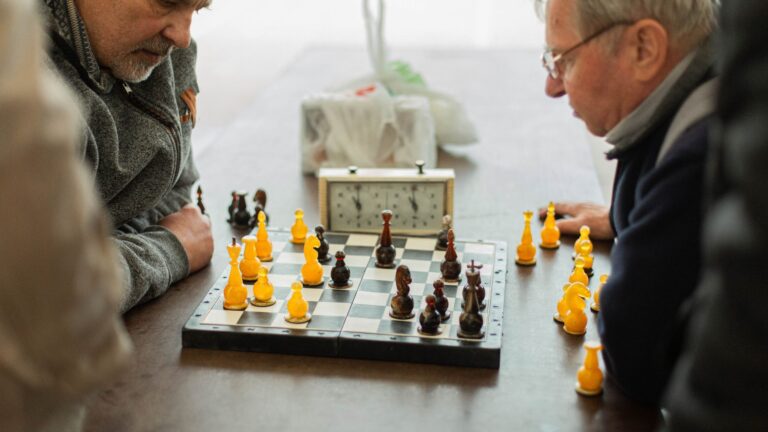
Caregivers avoid timed games because a clock measures speed, and dementia slows speed before it touches enjoyment or skill. A person who can still match pairs, name a photo, or finish a crossword clue may simply need twenty seconds to do it — and a timer turns that extra time into a visible loss. The result is an activity that produces failure on purpose, which is the opposite of what activity is for. Both the National Institute on Aging's guidance on adapting activities and the Alzheimer's Association frame the goal as feeling successful and having fun, matched to what the person can still do — not as a score.
Medical information disclaimer: This article is for general educational purposes only and does not provide medical advice, diagnosis, or treatment. Always consult a physician or other qualified health professional about symptoms, medications, tests, or treatment decisions.
Table of Contents
- The clock measures the disease, not the player
- What a timer does to the moment
- Removing the timer is not the same as removing the challenge
- How to convert a timed game into a usable one
- Don't replace the clock with a schedule
- Frequently Asked Questions
The clock measures the disease, not the player
Response speed is one of the most reliably affected abilities in dementia, and it is affected unevenly. A meta-analysis of reaction-time studies found that people with Alzheimer's disease were both slower than matched controls and far more variable from trial to trial. Variability matters as much as the average: a person may beat the timer three times and miss the fourth for no reason either of you can see. Slowness also is not always thinking.
A 2012 study of a simple odd/even sorting task found that people with mild Alzheimer's answered accurately, with reaction times similar to controls, while their *movement* times were slower — the authors concluded the group differences should not be attributed solely to differences in cognitive processing. On a tablet game, a hand that reaches the tile late looks identical to a mind that did not know the answer. In Lewy body dementia, slowed thinking — bradyphrenia — is a core symptom rather than a side effect, and response latency grows further on harder trials. That means a timed game does not stay equally hard through a session for this group; it gets harder as the questions do.
What a timer does to the moment
Pleasant, structured activity is recommended partly to reduce agitation. NIA's guidance on coping with agitation has caregivers stay calm, avoid arguing, and step away to settle themselves if they get upset. An activity that reliably generates visible failure works against that purpose, and it puts the caregiver in the position of enforcing the loss. A timer also contradicts the single most repeated piece of communication advice in dementia care.
NIA's dos and don'ts for communicating tell caregivers to allow extra time for a response, be patient, and avoid interrupting. A game clock interrupts by design, every round. Worth being precise about the evidence here: the idea that reducing failure reduces distress is practice wisdom rather than a proven trial result. Errorless-learning reviews show error-reducing instruction helps people with mild-to-moderate dementia relearn daily tasks, but the largest randomized trial, REDALI-DEM, found no added benefit over trial-and-error learning — and those trials measured task performance, not frustration.
Removing the timer is not the same as removing the challenge
This is where caregivers commonly overcorrect. In Alzheimer's Society's own testing of games with people living with dementia, some members found the simplest designs too basic, the group preferred the hardest maze, and one member said it was better when you have to think a bit. So the thing to cut is the clock, not the content. Alzheimer's Society says puzzles and games suit people with dementia providing they are not too difficult, and its Dementia Connect guidance points carers toward adapted versions as ability changes: larger jigsaw pieces, fewer matching pairs, simplified rules.
The demand is adjusted; the activity stays. The practical test is whether a wrong answer or a slow answer ends the turn. A crossword with no deadline can be genuinely hard and still be safe. The same crossword on a sixty-second clock punishes a hand tremor and a hesitation identically.
How to convert a timed game into a usable one
Most commercial games can be salvaged. Check the settings menu before deciding a game is unsuitable — many puzzle and trivia apps have an untimed or practice mode buried in options.
Watch for the early signals that the demand is wrong rather than waiting for a refusal: hands withdrawing from the board, repeating the instruction back, looking at you instead of the game, or a sudden shift to a different subject. NIA's activity guidance specifically tells caregivers to watch for signs of frustration and adjust.
- Turn off the timer, countdown, streak and "lives" features; keep the puzzle itself.
- Remove sudden sounds or a flashing display that fire on a wrong answer.
- Switch competitive scoring for a shared goal — finish the picture, fill the grid together.
- Drop the piece count or the number of pairs rather than switching to a simpler kind of game.
- Play alongside rather than opposite, so a pause looks like thinking, not losing.
Don't replace the clock with a schedule
The impulse after a bad session is to organize the day more tightly. The Alzheimer's Association's Activities at Home sheet advises the opposite, saying directly: avoid filling every minute with an activity. It also recommends simplifying instructions and choosing activities that build on current skills.
A full schedule reintroduces the same pressure the timer created, just stretched over a day instead of a round. Leaving room for rest and spontaneity is part of the recommendation, not a failure to plan. If the person stops halfway through a jigsaw and does not return to it, the unfinished puzzle on the table is an acceptable outcome.
Frequently Asked Questions
Are competitive games always a bad idea?
Competition is not the problem on its own; a deadline is. If scoring is turned off and nobody is racing, a game can stay demanding — Alzheimer's Society's testers actively preferred the harder puzzles.
What if the person asks for a timer or used to enjoy speed games?
Follow the request and watch what happens. If the clock produces frustration rather than fun, change the setting rather than the game, since the familiar activity is usually what they wanted.
Does slow play mean the dementia is getting worse?
Not necessarily. Research on mild Alzheimer's found accurate answers at near-normal reaction times but slower movement, so a late tap can reflect motor slowing rather than declining thinking.