The seven exercises that doctors most commonly recommend for lower back strength are bird dogs, planks, bridges, supermans, dead bugs, cat-cow stretches, and quadruped leg raises. These exercises target the deep abdominal muscles, erector spinae, and stabilizing muscles around the spine that collectively bear the weight of your upper body and protect against injury. Starting with just 10-15 minutes of these exercises three times per week can significantly improve your lower back’s ability to support daily activities without pain or strain.
For adults over 60, particularly those managing cognitive health, maintaining lower back strength is critically important because a strong spine supports better posture, more confident movement, improved balance, and reduced risk of falls—complications that can trigger serious health setbacks and interfere with cognitive function and independence. This article walks through each of the seven doctor-recommended exercises, explains how they strengthen your back, details modifications for different fitness levels, and describes what real improvements you might expect over time. We’ll also cover why lower back strength becomes increasingly important as we age and how to safely progress your routine without overtraining.
Table of Contents
- Which Seven Exercises Do Doctors Recommend for Lower Back Strength?
- How Back Strength Connects to Brain Health and Fall Prevention in Aging
- Bird Dogs—Building Contralateral Strength and Core Activation
- Planks and Modified Planks—Sustaining Core Tension Under Load
- Bridges and Glute Activation—The Often-Neglected Stabilizer Muscle
- Dead Bugs and Supermans—Safely Strengthening Spinal Extensors
- Progressive Training—How to Build Sustainable Back Strength Over Months
- Conclusion
Which Seven Exercises Do Doctors Recommend for Lower Back Strength?
The seven exercises recommended most often by physicians and physical therapists form a progression that targets multiple layers of spinal support. Bird dogs—where you extend your opposite arm and leg while on hands and knees—engage the deep stabilizer muscles without placing heavy load on the spine. Planks build endurance in the entire core by requiring your abdominal muscles to hold your body rigid for 20-60 seconds, and this creates the anterior support that prevents your back from sagging forward. Bridges activate your glutes and lower back extensors equally, which is essential because weak glutes force your lower back to compensate and overwork. Dead bugs—lying on your back and moving opposite arm and leg—teach your spine to stay neutral under movement, a skill you use constantly in daily life. Supermans gently strengthen the erector spinae and posterior chain.
Cat-cow stretches mobilize your spine through flexion and extension while warming up spinal ligaments. Quadruped leg raises strengthen hip extensors and glute medius, muscles that stabilize your pelvis during walking and standing. What distinguishes these seven from countless other back exercises is that each addresses a different component of spinal stability without creating excessive compression on the vertebrae themselves. Higher-impact exercises like heavy barbell squats or deadlifts—while effective for strength—can aggravate existing back pain or lead to injury if core stability isn’t sufficient first. These seven are the foundation that doctors typically prescribe before advancing to heavier or more complex movements. For someone starting from zero fitness, completing just these seven consistently will produce noticeable improvements in 4-6 weeks, though deeper strength gains continue building for months.
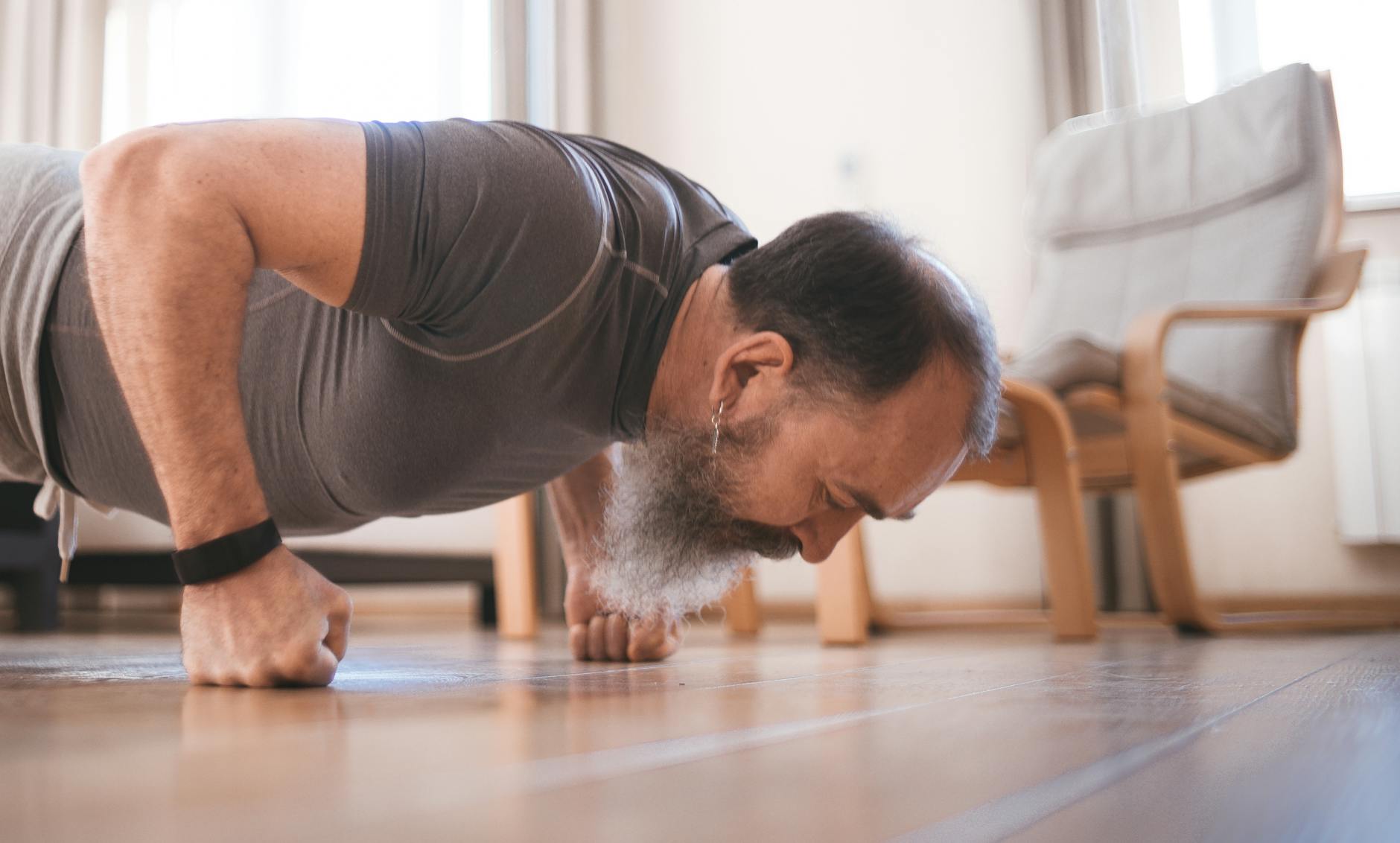
How Back Strength Connects to Brain Health and Fall Prevention in Aging
lower back strength might seem like a purely physical concern, but it has unexpected links to cognitive health and brain protection. When your back is weak, you adopt a forward-bent posture to protect against pain, which compresses your chest and reduces oxygen intake. Your brain consumes about 20% of your body’s oxygen, so anything that reduces respiratory efficiency can impair concentration, memory, and cognitive processing. A weaker back also makes you hesitant about movement, leading to reduced physical activity—and regular movement is one of the most robust defenses against cognitive decline.
Falls, which weak backs and poor posture make more likely, can cause traumatic brain injuries or lead to hospitalization and immobility, both of which accelerate cognitive decline in older adults. However, if you have acute back pain, herniated discs, or osteoporosis, not all of these exercises are appropriate for you without modification or physical therapy supervision. Someone with a herniated disc, for example, should avoid full planks initially and instead do wall planks or modified versions. Osteoporosis increases vertebral fracture risk, so exercises involving spinal flexion (like dead bugs and cat-cow) need to be done with careful form and lower range of motion. The upside is that a physical therapist can modify each of these seven exercises to be safe for your specific condition while still building strength over time.
Bird Dogs—Building Contralateral Strength and Core Activation
Bird dogs begin on hands and knees, then you extend your right arm forward while simultaneously extending your left leg backward, pause for 1-2 seconds, and return to start. The slow, controlled movement forces your deep core muscles (transversus abdominis) to stabilize your spine against the rotational forces your limbs create. This exercise is especially effective because it mimics real-world movement—when you walk, you’re doing something similar, with opposite arm and leg extending. Many people do bird dogs too quickly, turning the movement into a momentum-based swing that defeats the purpose. Done slowly and deliberately, holding the extended position for 2-3 seconds, bird dogs activate stabilizer muscles that planks alone won’t reach.
A common mistake is allowing your hips to rotate as your leg extends backward. Keep your hips level and parallel to the floor throughout. If you can’t maintain that neutral position, you’re moving too fast or need to reduce your range of motion. For beginners, just extending the arm might be enough; add the leg extension once you can control hip rotation. As you get stronger, you can make bird dogs harder by pausing longer in the extended position (5+ seconds) or adding a slight arm circle or leg pulse in the extended position. Over time, this exercise significantly improves proprioception—your body’s sense of where it is in space—which is a critical fall-prevention factor.

Planks and Modified Planks—Sustaining Core Tension Under Load
A standard plank is deceptively simple: forearms on the ground, elbows directly under shoulders, body in a straight line from head to heels, holding position without sagging. The difficulty is maintaining that alignment as fatigue sets in. Most people can do 20-second planks but fail at form after 30-40 seconds, so it’s better to do three 20-second planks with perfect form than one exhausted 60-second plank where your hips drop and your spine sags. That sagging position—where your lower back dips downward—actually trains your back muscles to work inefficiently and can reinforce poor patterns. If a standard plank is too challenging, wall planks are an excellent starting point: stand arm’s-length from a wall, place your forearms against the wall, and walk your feet backward until your body is at an angle.
This reduces the percentage of your body weight going through your core. Once you can hold that comfortably, you can gradually move your feet farther from the wall, increasing the angle and difficulty. The progression is straightforward: wall plank → incline plank (hands on a bench) → knee plank (knees on floor) → full plank. Spending two weeks at each level is perfectly normal and necessary. Many people try to progress too quickly and then become frustrated when form breaks down.
Bridges and Glute Activation—The Often-Neglected Stabilizer Muscle
A bridge exercise is performed lying on your back, knees bent, feet flat on the floor hip-width apart, then pressing through your heels to lift your hips toward the ceiling until your knees, hips, and shoulders form a straight line. The glute maximus is one of the largest and strongest muscles in your body, but in people who sit most of the day, it becomes inhibited and weak. When your glutes don’t activate properly, your lower back extensors overcompensate, leading to back pain and fatigue. Bridges directly address this imbalance by forcing your glutes to do the work they’re supposed to do. A warning: many people perform bridges with their glutes but their lower back does most of the extension work, which defeats the purpose.
To activate your glutes properly, take a moment before you start each rep to tighten your glutes intentionally, as if you’re squeezing a coin between your buttocks. Then perform the bridge while maintaining that contraction. You should feel the work in your glutes and buttocks, not in your lower back. A second progression is single-leg bridges: once you can do 15-20 two-legged bridges with good glute activation, try extending one leg while holding the bridge position with the other leg. This variation is significantly harder and provides a bigger challenge to your stabilizer muscles.

Dead Bugs and Supermans—Safely Strengthening Spinal Extensors
Dead bugs are performed lying on your back, arms extended straight up toward the ceiling, knees bent 90 degrees with shins parallel to the floor. From this position, you slowly lower your right arm to the floor behind your head while straightening your left leg and lowering it toward the floor, never actually touching down. You return to start and repeat on the other side. The movement teaches your spine to stay neutral (neither arched nor flexed) while your limbs move, which is crucial training for daily functional movement. Unlike planks, which are static, dead bugs are dynamic and challenge your stability through motion—more realistic for real life.
Supermans involve lying face-down, arms at your sides or extended overhead, then lifting your arms, chest, and legs off the ground simultaneously, creating a gentle arch through your entire body. Hold for 1-2 seconds and lower. This exercise directly activates the erector spinae and posterior chain muscles. A key difference between dead bugs and supermans is that dead bugs prevent your back from hyperextending (arching too much), while supermans intentionally create a mild backbend. For people with severe lower back pain or stenosis, supermans might aggravate symptoms; dead bugs are safer in those cases. For most people, both exercises complement each other in a balanced routine.
Progressive Training—How to Build Sustainable Back Strength Over Months
Starting back strength training, consistency matters far more than intensity. Doing all seven exercises once per week will produce minimal progress; doing them three times per week, every other day, will produce noticeable results. A realistic timeline is: weeks 1-2 (learning proper form, starting with easiest variations), weeks 3-6 (noticeable improvements in pain levels and endurance), weeks 8-12 (measurable strength gains and improved functional movement), and months 4-6 (plateaus where you need to increase difficulty to continue progressing).
After six months of consistent work, many people report that their back pain has diminished significantly, they stand taller with less slouching, and everyday activities feel easier. As you progress, the goal is to increase either duration (holding planks longer), volume (more reps of each exercise), or difficulty (progressions like single-leg bridges or wall planks transitioning to full planks). Avoid the trap of doing the same exercises at the same intensity month after month; your muscles adapt and stop improving. Adding just one small progression every 2-3 weeks keeps your nervous system engaged and drives continued strength gains.
Conclusion
The seven exercises doctors recommend for lower back strength—bird dogs, planks, bridges, dead bugs, supermans, cat-cow stretches, and quadruped leg raises—work because they target multiple components of spinal stability without excessive load on vertebrae. Consistency over three months produces measurable strength gains, reduced pain, improved posture, and better balance. For older adults and anyone managing cognitive health, these improvements translate directly to greater independence, lower fall risk, and better overall quality of life.
Starting today, commit to these seven exercises three times per week, using the easiest variations that allow you to maintain perfect form. Progress slowly, add one small difficulty increase every few weeks, and expect noticeable improvements by week 6. If you experience sharp pain during any exercise, stop immediately and modify or skip that exercise until you can work with a physical therapist to assess the issue. Your back supports everything you do—it’s worth the 15 minutes, three times per week.