Caregivers judge a toy as too advanced by watching the person use it, not by reading the box or matching it to a dementia stage. The working test is frustration: if the person turns away, repeats a step without progress, gets agitated, or needs constant correction, the demand is too high — and the National Institute on Aging's caregiving guidance puts exactly that test first, telling caregivers to watch to see if the person gets frustrated and to aim for an activity where they feel successful and have fun.
The second half of the judgment is that "too advanced" is a conclusion you reach only after trying to simplify. A toy that fails when handed over whole may work when it is handed over one piece at a time, with the first move demonstrated. Dropping it before that step throws away activities the person can still do.
Medical information disclaimer: This article is for general educational purposes only and does not provide medical advice, diagnosis, or treatment. Always consult a physician or other qualified health professional about symptoms, medications, tests, or treatment decisions.
Table of Contents
- The frustration test, and what to watch for
- Simplify before you judge
- Too easy is also a mistake
- Dolls and soft toys need their own rules
- When to get a professional opinion
- How strong is the evidence for getting the match right?
- Frequently Asked Questions
The frustration test, and what to watch for
Signs of excess difficulty are behavioural rather than verbal. Most people with moderate or severe dementia will not say "this is too hard"; they will put the item down, push it away, hand it back, become restless, or start on something else entirely.
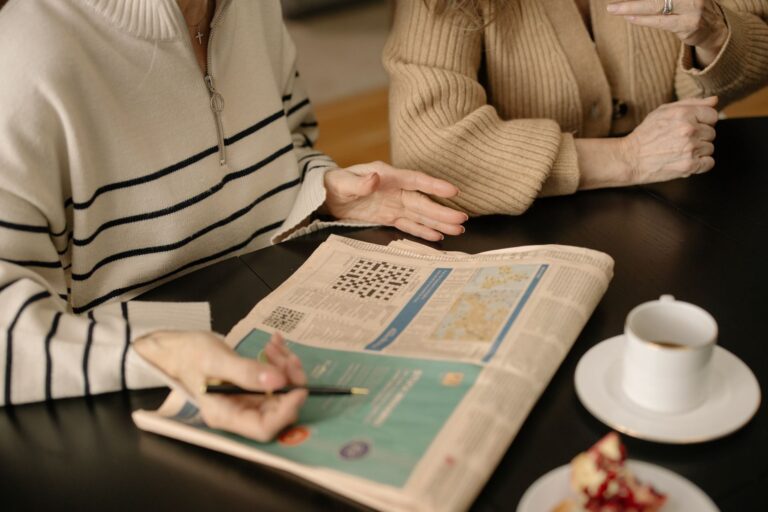
Look for these during the first few minutes: The NIA also notes that watching may be the enjoyable part. If the person is content to hold the pieces or watch you sort them, that counts as the activity succeeding, not failing.
- Repeating one action with no advance toward the goal
- Looking to you after every move for the next instruction
- Rising voice, fidgeting, standing up, leaving the table
- Taking the toy apart or mouthing it rather than using it
- Flat disengagement — holding it without acting on it
Simplify before you judge
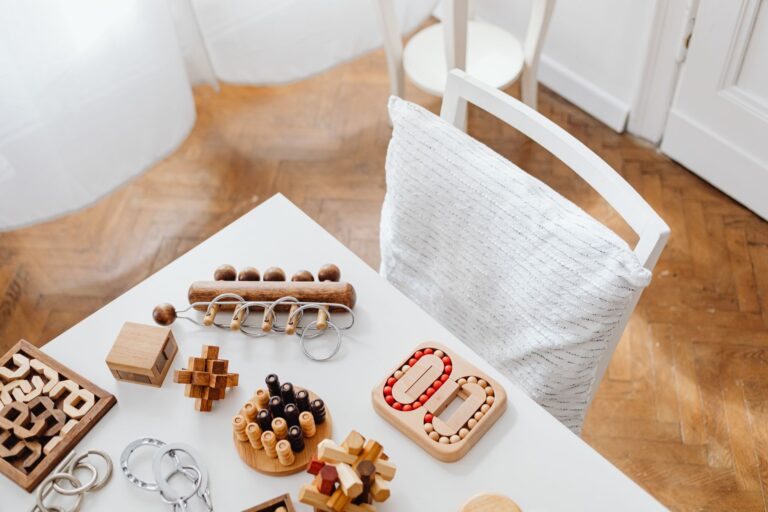
The first fix is sequencing, not substitution. The NIA's step-by-step method for daily tasks — hand the person one item at a time, tell them what to do step by step, demonstrate the action, or guide their hand — transfers directly to a toy or puzzle. A nine-piece shape sorter that overwhelms as a tray of nine becomes workable as one shape, offered, named, placed once by you, then offered again. Alzheimer's Society UK's Activities Handbook gives the same instruction for leisure activities: break the activity down into straightforward steps rather than abandoning it.
So a toy earns the label "too advanced" only when it still fails at one step at a time, with demonstration. Choice volume is part of difficulty too. Alzheimer's Society warns that offering too many choices can overwhelm a person with dementia while still advising you involve them in picking an activity. Two options held up is a choice; a shelf of twelve boxes is a demand.
Too easy is also a mistake
The difficulty judgment cuts both ways. The Alzheimer's Association's Dementia Care Practice Recommendations state that matching activities to a person's abilities and strengths preserves dignity, prevents excessive stress-inducing demands, and prevents excess dependency, boredom and learned helplessness. Under-pitching has named costs, not just wasted time.
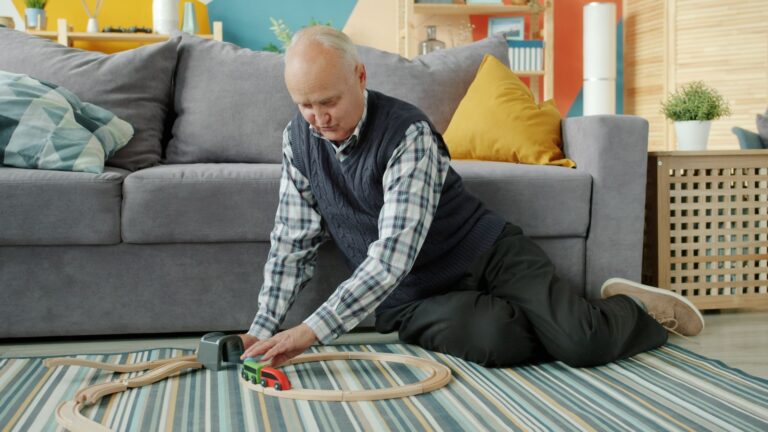
Dignity is a separate test from difficulty, and the same item can pass one and fail the other. Alzheimer's Society advises avoiding resources that are just for children and choosing items aimed at an older audience — adult mindful colouring books instead of a children's colouring book, for instance. A toddler's stacking toy may be pitched perfectly for the hands and attention involved and still be the wrong object to put in front of an adult, particularly in front of visitors. A practical middle route is an adult version of the same motion: sorting buttons, coins or playing cards, folding laundry, winding wool, or a tactile fidget item sold for adults.
Dolls and soft toys need their own rules
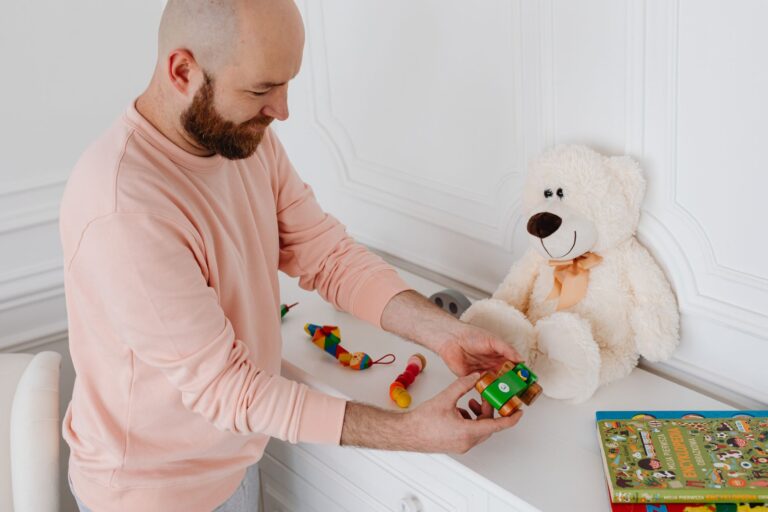
Dolls and plush animals are a common and often effective choice, and the judgment for them is about response rather than difficulty. A November 2024 review of doll therapy from UNSW Sydney advises that caregivers be guided by the person's own response and not force interaction, and that all family and care staff be told about any attachment so nobody causes distress by moving or taking the doll. The same review flags that dolls may be unsuitable for someone with a history of child loss or birth trauma.
That is a reason to know the person's history before offering one, and to withdraw the item quietly if it produces grief rather than comfort. Physical safety becomes the limiting factor in severe dementia, where mouthing objects that are not food is common. That makes small, detachable or hard parts a choking risk. UK NHS-aligned guidance tells carers to contact the GP for a speech and language assessment when a person with dementia coughs or chokes often — and in the meantime, to choose one-piece items with nothing small enough to come loose.
When to get a professional opinion
Where family trial-and-error is not settling the question, occupational therapy has formal grading tools. The Allen Cognitive Disabilities Model, developed by occupational therapist Claudia Allen, grades tasks against six cumulative cognitive levels, and the Allen Cognitive Level Screen is a standardized assessment that gives a quick estimate of overall functional cognitive capacity. An OT can translate that into which activities are pitched correctly.
There is also a trained-family version. The Tailored Activity Program, a home-based OT intervention, identifies preserved capabilities, prior roles and interests, then trains the family in how to use the chosen activity. In a 60-family wait-list-controlled pilot by Gitlin and colleagues, caregivers reported significant reductions in behavioural occurrences (p=.010, d=0.72) and in agitation specifically (p=.014, d=0.75).
How strong is the evidence for getting the match right?
Modest, and worth knowing before you invest heavily in it. A 2020 Cochrane review of personally tailored activities for people with dementia living in the community found they may be one approach for reducing challenging behaviour and may slightly improve quality of life, but found no clear benefit for the person's depression or for caregiver burden.
So the honest expectation is narrow: pitching a toy correctly is most likely to help with agitation and restlessness in the moment, and is not a treatment for low mood or a solution to how much work caregiving is. Judge each item on whether this person, today, engages with it without distress — and re-judge it in a few months, because the level that fits will change.
Frequently Asked Questions
Does a toy that worked last month mean it still fits?
Not reliably. Cognitive capacity changes, so an item that was pitched correctly can become too demanding — or too easy and boring, which the Alzheimer's Association links to learned helplessness. Re-test the same way you tested it originally.
What if the person refuses everything offered?
Reduce the number of options to two, hand over one piece rather than the whole item, and demonstrate the first move. If refusal continues, sitting and watching you do the activity is a legitimate outcome under the NIA's guidance.
Is it wrong to give an adult a children's toy?
It is a dignity issue rather than a safety one. Alzheimer's Society UK advises choosing resources aimed at an older audience where an equivalent exists — the same hand movements are usually available in an adult-marketed item.