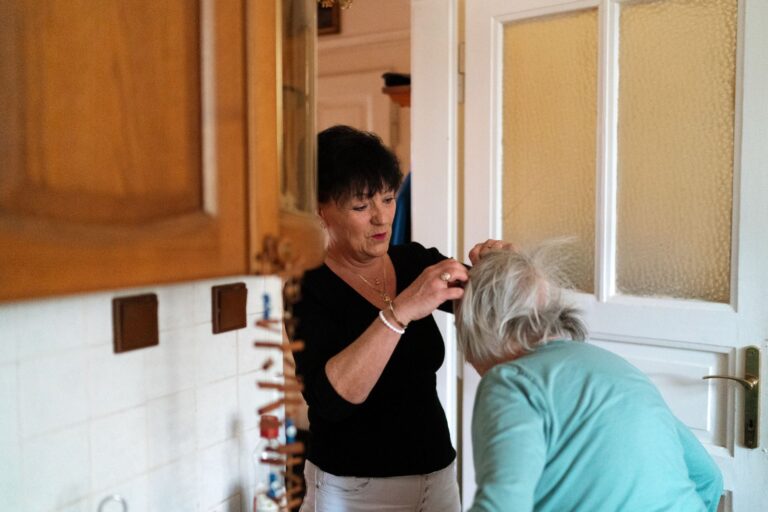
The FDA’s April 30, 2026 approval of Auvelity gives families a new prescription option for agitation associated specifically with dementia due to Alzheimer’s disease. It is the first FDA-approved non-antipsychotic drug for this purpose, but it does not treat Alzheimer’s disease itself, apply to every form of dementia, or serve as an “as needed” calming medication. For example, a person with Alzheimer’s who repeatedly paces, shouts, resists care, or becomes physically aggressive despite efforts to address pain and environmental triggers may now be evaluated for a scheduled course of Auvelity. For families, the approval means there is clinical-trial evidence and an FDA-reviewed dosing framework for another treatment choice when agitation is moderate to severe and drug therapy is considered necessary.
It does not mean medication should automatically replace a careful search for causes such as infection, constipation, medication effects, fear, overstimulation, or an unfamiliar caregiver. The benefit measured in the acute pivotal trial was statistically significant but modest on average, so response must be judged person by person. Auvelity combines dextromethorphan and bupropion in an extended-release tablet. It was originally approved in 2022 for major depressive disorder in adults; the 2026 action expanded its approved uses to include adults with agitation associated with dementia due to Alzheimer’s disease. The FDA’s corrected supplemental approval letter confirms that the action remained effective April 30, 2026, and that the correction did not change the approval date.
Medical information disclaimer: This article is for general educational purposes only and does not provide medical advice, diagnosis, or treatment. Always consult a physician or other qualified health professional about symptoms, medications, tests, or treatment decisions.
Table of Contents
- What Does the FDA’s 2026 Auvelity Approval Mean for Families Managing Alzheimer’s Agitation?
- How Auvelity Works and How the Alzheimer’s-Agitation Dose Is Taken
- What the Auvelity Clinical Trials Actually Found
- How Families Can Evaluate Auvelity With the Prescribing Clinician
- Limitations, Medication Reviews, and Safety Concerns
- What the Maintenance Study Says About Continuing Treatment
- Building a Useful Agitation Record During Treatment
- Frequently Asked Questions
What Does the FDA’s 2026 Auvelity Approval Mean for Families Managing Alzheimer’s Agitation?
The approval establishes that Auvelity may be prescribed to adults for agitation associated with dementia due to Alzheimer’s disease. The indication matters because “agitation” is not simply ordinary frustration or an occasional bad day. It can involve frequent pacing, yelling, verbal hostility, hitting, grabbing, throwing objects, resisting necessary care, or other behaviors that create distress or safety concerns. The wording also sets clear boundaries. Auvelity was not approved to slow cognitive decline, preserve memory, reverse brain changes, or cure Alzheimer’s disease.
It was not approved broadly for agitation caused by vascular dementia, Lewy body dementia, frontotemporal dementia, delirium, or an unidentified condition. A resident with sudden aggression during a urinary infection, for example, needs assessment for delirium and the underlying illness rather than an assumption that the behavior represents chronic Alzheimer’s agitation. Unlike a sedative given only during a crisis, Auvelity is not indicated as a PRN, or “as needed,” treatment. It follows a scheduled titration and was studied as continuing therapy. Families expecting a tablet that can be administered at the first sign of an outburst should discuss that distinction with the prescriber before treatment begins.
How Auvelity Works and How the Alzheimer’s-Agitation Dose Is Taken
Auvelity is an oral combination of dextromethorphan hydrobromide and bupropion hydrochloride. The FDA-approved label describes dextromethorphan as an NMDA-receptor antagonist and sigma-1 receptor agonist. Bupropion is an aminoketone and a CYP2D6 inhibitor; inhibiting CYP2D6 helps alter dextromethorphan metabolism and also creates an important reason to review other medications for possible interactions. For Alzheimer’s agitation, treatment begins with a 30 mg/105 mg tablet once each morning. If tolerated, the dose increases on day 8 to 30 mg/105 mg twice daily.
On day 15, it increases to 45 mg/105 mg twice daily if tolerated, with doses separated by at least eight hours. The extended-release tablets must be swallowed whole rather than crushed, divided, or chewed. That last requirement can be a practical limitation in dementia care. If a person routinely pockets tablets, chews medications, or needs pills crushed into food, the prescribed formulation may not be workable. A caregiver should not alter the tablet to solve the problem independently; the prescriber or pharmacist needs to reassess whether Auvelity is appropriate and how medicines can be administered safely.
What the Auvelity Clinical Trials Actually Found
The five-week randomized, double-blind, placebo-controlled study, NCT03226522, included 152 participants assigned to Auvelity and 156 assigned to placebo. Agitation was measured using the Cohen-Mansfield Agitation Inventory, or CMAI, a 29-item clinician-rated and caregiver-informed scale that records how frequently agitated behaviors occur. Scores can range from 29, indicating no symptoms, to 203, representing the worst score; a negative change indicates improvement. The mean CMAI score fell by 14.9 points in the Auvelity group and by 11.6 points in the placebo group. after statistical adjustment, the treatment difference was −3.3 points, with a 95% confidence interval from −5.8 to −0.8.
This means both groups improved, while the Auvelity group improved more on average. It does not mean every treated participant improved by 14.9 points or that a 3.3-point difference will look dramatic in every household. Consider a caregiver tracking twelve daily episodes of pacing, shouting, and care resistance. A meaningful personal response might involve fewer episodes, shorter episodes, safer bathing, or less distress even if agitation does not disappear. Another person may show little observable change. Trial averages help establish efficacy, but they cannot predict either individual outcome in advance.
How Families Can Evaluate Auvelity With the Prescribing Clinician
Before starting treatment, families can bring a written description of the behaviors, their frequency, their timing, and what happens immediately beforehand. “Agitated every evening” is less useful than “paces and shouts for 45 minutes around 6 p.m., especially when the television is loud and personal care begins.” A short record can also document sleep, pain, bowel patterns, recent illnesses, medication changes, and whether redirection or a quieter setting helps. The practical tradeoff is between the burden and danger of ongoing agitation and the uncertainties of adding another scheduled medication. Severe aggression may make bathing impossible or place the person, family members, and care staff at risk.
On the other hand, intermittent restlessness caused by noise or boredom may respond better to changes in routine, activity, communication, or surroundings than to medication. Families should ask what improvement would justify continued treatment and when it will be assessed. Concrete goals might include reducing physical aggression during morning care, cutting the number of prolonged shouting episodes, or allowing the person to remain safely at home. Because the dose changes on days 8 and 15 only if tolerated, caregivers should also know whom to contact if new symptoms emerge during titration rather than proceeding automatically to the next dose.
Limitations, Medication Reviews, and Safety Concerns
The pivotal studies did not enroll every person who might be described as having dementia-related agitation. Participants had probable Alzheimer’s disease, moderate-to-severe agitation requiring drug treatment, Mini-Mental State Examination scores of 10 to 24, and a Neuropsychiatric Inventory agitation/aggression score of at least 4. The results therefore should not be casually extended to mild, occasional irritability; agitation from another dementia; acute delirium; or behavior caused primarily by an untreated medical problem. A complete medication review is especially important because Auvelity contains two active drugs and bupropion inhibits CYP2D6, an enzyme involved in processing various medicines.
Families should give the clinician and pharmacist an accurate list of prescriptions, over-the-counter products, supplements, and recently discontinued drugs. Using an old bottle of cough medicine or another medication containing dextromethorphan without checking the ingredients is one example of an avoidable complication. Caregivers should also resist judging the medicine only by whether the person appears quieter. Reduced agitation can be valuable, but excessive sleepiness, poorer walking, diminished participation, or a sudden functional decline would require clinical attention rather than being accepted as the price of treatment. Sudden behavioral worsening still calls for assessment of pain, infection, dehydration, constipation, injury, medication changes, and delirium even after Auvelity has been prescribed.
What the Maintenance Study Says About Continuing Treatment
The second randomized trial, NCT04947553, used a withdrawal design. Participants first received Auvelity, and only those who achieved a sustained response moved into the randomized phase. They then either continued Auvelity or switched to placebo during as long as six months of double-blind follow-up.
Continuing Auvelity significantly prolonged the time to relapse. This design provides evidence about maintaining a response once one has occurred; it does not establish that every new patient will respond. For example, a person whose aggression and repetitive shouting clearly improve and remain controlled during initial treatment resembles the population that entered the randomized withdrawal phase more closely than someone who has shown no improvement after starting the drug.
Building a Useful Agitation Record During Treatment
A simple daily record can help separate impressions from observable change. Caregivers can note the Auvelity dose and time, the number and duration of agitation episodes, specific behaviors, likely triggers, non-drug strategies attempted, sleep, mobility, and any new symptoms.
Entries such as “two five-minute shouting episodes during dressing, redirected with music” are more informative than “better today.” The record should follow the approved schedule accurately: 30 mg/105 mg once each morning at first, 30 mg/105 mg twice daily beginning on day 8 if tolerated, and 45 mg/105 mg twice daily beginning on day 15 if tolerated, with doses at least eight hours apart. A missed, refused, chewed, or vomited dose should be documented and handled according to instructions from the prescriber or pharmacist rather than replaced with an improvised extra dose.
Frequently Asked Questions
Was Auvelity actually approved for Alzheimer’s agitation in 2026?
Yes. The FDA approved the expanded indication on April 30, 2026. The corrected supplemental approval letter confirms that effective date and identifies the indication as agitation associated with dementia due to Alzheimer’s disease.
Does Auvelity treat Alzheimer’s disease?
No. It treats agitation associated with dementia due to Alzheimer’s disease. The approval does not establish that Auvelity slows cognitive decline, reverses Alzheimer’s changes, or cures the disease.
Can Auvelity be given only when agitation becomes severe?
No. The FDA-approved labeling states that it is not indicated as an as-needed treatment. It uses a scheduled dosing and titration plan.
Is Auvelity approved for agitation in all types of dementia?
No. The indication is specifically for agitation associated with dementia due to Alzheimer’s disease. Agitation linked to another dementia, delirium, medication effects, or an acute illness requires its own clinical evaluation.
How quickly is the dose increased?
Treatment starts with 30 mg/105 mg each morning. If tolerated, it increases to that dose twice daily on day 8 and then to 45 mg/105 mg twice daily on day 15, with doses at least eight hours apart.
Does the maintenance trial prove that most people will respond?
No. The withdrawal study randomized people who had already achieved a sustained response on Auvelity. It showed that continuing treatment prolonged time to relapse in responders, not that every person beginning treatment will benefit.