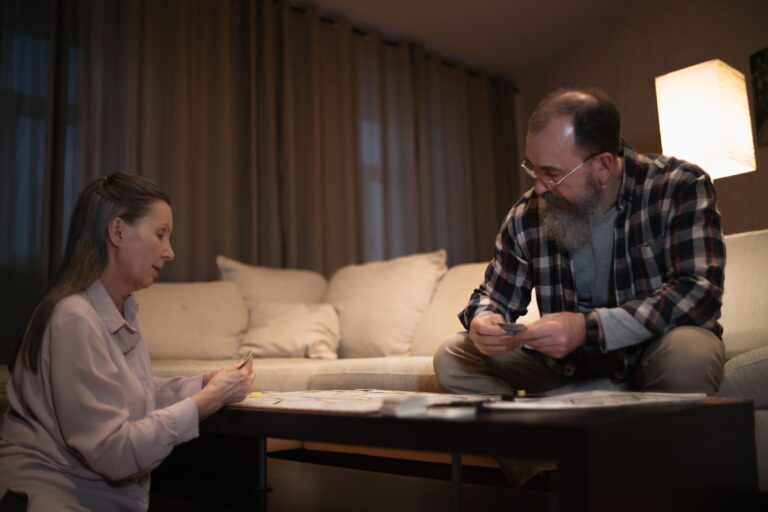
Introduce a new game the way you would teach any new task: one step at a time, in the morning, with the caregiver demonstrating rather than explaining. The Alzheimer's Association's activities guidance tells caregivers to simplify instructions and break an activity into small steps, focusing on one step at a time, because several directions at once overwhelm the person.
Confusion usually comes from the setup, not the game. A person with memory loss who cannot recall the rules can still play well if the board is pre-arranged, the next move is obvious, and someone is sitting alongside them. The goal is a pleasant hour, not a learned rulebook.
Medical information disclaimer: This article is for general educational purposes only and does not provide medical advice, diagnosis, or treatment. Always consult a physician or other qualified health professional about symptoms, medications, tests, or treatment decisions.
Table of Contents
- Why the rules are the wrong thing to teach
- The introduction itself, step by step
- Timing: morning, short, and repeated
- Choosing and bending a game so it fits
- What games realistically do, and do not, deliver
- Frequently Asked Questions
Why the rules are the wrong thing to teach
Explaining rules asks the person to hold several abstract conditions in working memory and retrieve them later — exactly what dementia erodes. Teaching the physical actions instead works better, because procedural memory survives longer than explicit memory for facts. Errorless learning is the relevant technique: you prompt so closely that the person never guesses wrong. An Aberystwyth University meta-analysis found errorless learning outperformed trial-and-error teaching of everyday tasks and skills in people with mild cognitive impairment and dementia, with a pooled effect size of about 0.65 and gains generally maintained at follow-up.
The reasoning is that people with explicit-memory deficits do not recognise their own mistakes, so a wrong guess gets consolidated as if it were correct. Know the limit before you rely on it. The benefit is strongest in early-stage dementia and for procedural skills, and a study in moderate-to-severe Alzheimer's published in Aging Clinical and Experimental Research found no significant advantage over errorful learning on a face–name task after only a ten-minute delay. Demonstration will help someone play a game; it will not reliably make them remember how it works next week.
The introduction itself, step by step
The National Institute on Aging's method for teaching daily tasks transfers directly to a game. Its caregiving guidance advises stating one step at a time, demonstrating the action or guiding the person's hand, and pre-arranging materials in the order they are used — clothes laid out in dressing order, or in this case a board already open with the pieces at each player's place.
A workable sequence: NIA's checklist for adapting activities adds the decision to make first: whether the person can do this alone or needs help. It also tells caregivers to help them get started and to watch for frustration, because people with Alzheimer's often have trouble deciding what to do or beginning a task at all. A blank stare at a set-up board is usually an initiation problem, not a comprehension one.
- Set the game up completely before the person sits down, so no part of it looks like a task.
- Say what it is in one sentence and name it by sight: "This is dominoes — we match the dots."
- Take the first turn yourself, slowly, so they see a move before they make one.
- Hand them a piece that already fits, or guide their hand to the spot, rather than asking them to find one.
- Keep narrating one action at a time; drop the scoring entirely on the first session.
Timing: morning, short, and repeated
Introduce anything new early in the day. NIA links agitation that begins or worsens in the late afternoon or early evening to sundowning, and advises scheduling activities that take more energy early and keeping the evening quiet, low-lit and low-noise. A first game after dinner is a first game during the hardest hours of the day. Keep the session short.
The Alzheimer's Association advises short sessions because sustained attention is limited, and says a favourite activity should be adapted to current ability rather than dropped — moving from reading a book to looking at its pictures. Ten good minutes beats a forty-minute session that ends badly. Repeat the same game at the same time rather than rotating through new ones. Familiar routine is part of the same guidance, and a game that is reintroduced identically each day stops being new after a few sittings even when the person cannot say they have played it before.
Choosing and bending a game so it fits
Pick games that lean on abilities the person still has. The Alzheimer's Society's indoor games guidance names dominoes, Connect 4, shove ha'penny and Jenga, which turn on matching, placing and a steady hand rather than on strategy or recall. When a loved game no longer fits, change the game rather than retire it.
The same guidance suggests simplifying the rules or having a partner play alongside the person — and for Monopoly, agreeing a fixed number of notes per action and ignoring denominations altogether. That removes the arithmetic while keeping the board, the pieces and the company. Watch what the modification is protecting. Playing alongside someone as a partner is not a demotion if it keeps them at the table; correcting their moves, or pointing out that they have forgotten the rules, usually ends the session.
What games realistically do, and do not, deliver
Structured mental activity has measurable benefit, and it is modest. The 2023 Cochrane review of cognitive stimulation in dementia by Woods and colleagues found a small-to-moderate improvement in cognition immediately after a course of sessions — a standardised mean difference of 0.40, 95% confidence interval 0.25 to 0.55, moderate-certainty evidence, roughly equivalent to delaying expected decline by about six months. Two patterns in that review matter for how you schedule games.
Gains were larger when group sessions ran twice weekly or more often, and larger when dementia was mild rather than moderate. So frequency does more work than novelty, and an earlier start does more than an intensive one later. The review reported no adverse effects. A game that goes badly costs an afternoon's mood, not the person's cognition, so the practical risk of trying one in the morning and abandoning it after ten minutes is close to zero.
Frequently Asked Questions
Should I remind the person that we played this game yesterday?
Reintroduce it the same way each time instead. A reminder invites them to search for a memory they may not have, and failing that search is what sours the session.
What if they make a move that breaks the rules?
Let it stand unless it stops play. Errorless learning works by preventing wrong moves in advance — by handing over a piece that fits — not by correcting them afterwards.
Is a group game better than playing one-to-one?
The Cochrane review's larger gains came from group sessions run twice weekly or more, so a regular group is worth pursuing. One-to-one play at home is still the easier place to introduce something new, because you control the pace and the interruptions.