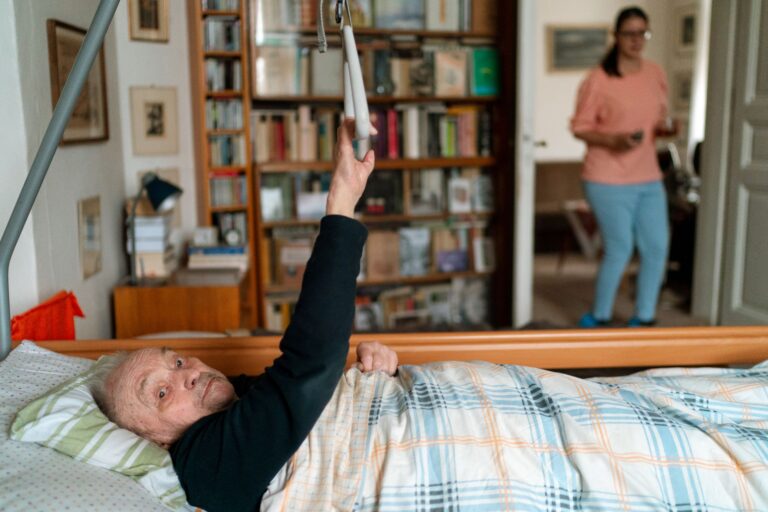
Alzheimer’s patients refuse help primarily because of anosognosia—a neurological condition where up to 81% of Alzheimer’s disease patients lose the ability to recognize their own cognitive decline. Unlike psychological denial, anosognosia is a direct result of brain changes caused by the disease itself. When a patient cannot perceive that they have memory loss, confusion, or functional impairment, they genuinely do not understand why they need assistance. From their perspective, they are fine; the caregiver is the problem. A daughter might spend 20 minutes coaxing her father to shower, only to have him refuse because in his mind, he showered yesterday—even though his memory loss prevents him from knowing it’s been a week.
The refusal behavior caregivers interpret as stubbornness or defiance is often the result of multiple intersecting causes: damaged brain regions that prevent self-awareness, behavioral changes tied to sundowning that emerge in late afternoon, caregiver communication styles that inadvertently increase resistance, undiagnosed pain or physical discomfort, and emotional triggers like fear, shame, or loss of control. Understanding these causes transforms how families and care professionals approach the patient, shifting from confrontation to compassion-informed strategy. Approximately 9 to 9.7% of nursing home residents with dementia demonstrate active resistance-to-care behaviors including pulling away, stiffening the body, refusing to weight-bear, and verbal objection. Yet the statistics on how caregivers respond to this resistance reveal a troubling gap: when residents showed resistance, caregivers provided person-centered, effective care behaviors only 34.4% of the time. In more than 65% of cases, caregivers used task-centered or ineffective approaches, missing the opportunity to de-escalate the situation.
Table of Contents
- How Brain Damage Destroys the Ability to Recognize Decline
- Sundowning and Behavioral Escalation in Late Afternoon
- Why Caregiver Communication Style Shapes Whether Patients Refuse Care
- Hidden Physical Pain and Unmet Needs Masked as Behavioral Refusal
- Bathing Resistance as the Most Prevalent Form of Care Refusal
- The Caregiver Response Gap: Why Resistance Persists
- Emotional Triggers—Fear, Shame, Loss of Control, and Confusion
How Brain Damage Destroys the Ability to Recognize Decline
Anosognosia affects 60% of patients with mild cognitive impairment and 81% of those with Alzheimer’s disease. It is not a psychological defense mechanism where patients “refuse to accept” their condition. Rather, it is a specific neurological deficit—damage to brain regions responsible for self-awareness and the ability to compare one’s own abilities to objective reality. The patient literally cannot perceive the mismatch between what they think they can do and what they actually can do. When a patient with anosognosia is asked why they refuse to take medication, bathe, or eat, they often respond that they don’t need help because they’re fine.
They may become agitated when a caregiver insists they have a problem, because from the patient’s intact perspective, they are being contradicted or criticized for no reason. A man who can no longer safely manage his finances may refuse to stop paying bills or giving away money, not because he is being obstinate, but because his damaged brain does not register that his judgment has declined. He experiences the caregiver’s intervention as an unprovoked attack on his competence. Research published in Scientific Reports in 2026 further clarified that anosognosia (poor awareness of one’s deficits) combined with theory-of-mind deficit (difficulty understanding others’ perspectives) significantly increases caregiver distress. Caregivers struggle not only with the patient’s refusal but with the impossibility of explaining the problem to someone who cannot perceive it exists.
Sundowning and Behavioral Escalation in Late Afternoon
The Alzheimer’s Association reports that sundowning—a cluster of behavioral symptoms that emerge during late afternoon and evening—affects up to two out of every three Alzheimer’s disease patients at some point. Sundowning is a specific, predictable neurological phenomenon, not the patient’s personality deteriorating. Symptoms include agitation, combativeness, anxiety, hallucinations, confusion, and refusal of care or food. A patient who cooperates with morning hygiene routines may become combative and refuse assistance at 4 PM. A man who is calm and engaged at lunch may refuse dinner and accuse staff of trying to poison him by evening.
This is not the patient being difficult; this is the patient’s brain entering a state of heightened agitation and impaired judgment triggered by reduced daylight, fatigue, or circadian disruption. A warning for families: sundowning is predictable. If your parent resists care at certain times of day, sundowning may be the cause, and adjusting the timing of care activities or the environment (increasing light, reducing stimulation) may reduce resistance. The challenge is that sundowning interacts with anosognosia. A patient experiencing both lacks awareness of their cognitive decline and is simultaneously in a state of heightened agitation and fear. This combination makes care refusal particularly pronounced and emotionally charged in the evening hours.
Why Caregiver Communication Style Shapes Whether Patients Refuse Care
Research from WebMD and clinical practice shows that rejection of care is directly associated with the caregiver’s communication style, facial expression, tone of voice, and body language. dementia patients lose the ability to process complex verbal instructions but retain heightened sensitivity to emotional tone and nonverbal cues. A caregiver who approaches with frustration, even if the words are gentle, triggers resistance. A caregiver who approaches calmly, speaking slowly and with genuine warmth, reduces resistance. Patients also respond negatively to pressure. Being pushed to perform an activity they cannot execute—such as bathing when they cannot remember why they need to bathe, or remembering recent events when their memory loss makes it impossible—causes agitation and combativeness. A caregiver who says, “You need to shower because you’re dirty” is creating pressure and implicitly criticizing the patient.
A caregiver who says, “Let’s go get refreshed,” moving the patient gently and avoiding the word “dirty,” reduces the perceived threat. A comparison: two caregivers, same patient. The first arrives at 9 AM with a tense jaw and says, “We need to get you washed up—you look terrible.” The patient refuses and becomes angry. The second caregiver arrives with a calm expression and says, “I’ve run a nice warm bath for you. Let’s go together.” The patient accepts. The difference is not the patient’s willingness or defiance; it is the caregiver’s approach. Yet many caregivers receive no training in how communication style affects dementia behavior. The result is higher rates of resistance and increased caregiver stress.
Hidden Physical Pain and Unmet Needs Masked as Behavioral Refusal
When a dementia patient refuses care, the immediate assumption is often behavioral—the patient is being difficult, resisting change, or acting out. However, clinical assessment reveals that what appears to be behavioral refusal is frequently the patient’s way of communicating unmet physical needs. Health problems including pain, lack of sleep, problems seeing or hearing, constipation, hunger, and thirst all contribute to refusal behavior. A woman who refuses to get out of bed may not be lazy; she may have undiagnosed arthritis pain that makes movement excruciating. A man who refuses meals may not be rejecting food; he may have dental pain, swallowing difficulty, or a urinary tract infection causing systemic discomfort.
A patient who refuses a shower may fear falling on slippery surfaces because their vision has declined without anyone noticing. One study noted that caregivers often misinterpret pain-driven resistance as obstinacy, leading them to increase pressure on the patient rather than investigate the underlying cause. The limitation here is that dementia patients cannot reliably report pain. They may not remember where it hurts, may not have the words to describe it, or may not connect their discomfort to the refusal behavior. A patient experiencing pain from an infection may simply say “no” to care without explanation. Caregivers must become investigators, looking for physical causes of behavioral change: Is the patient eating less? Sleeping poorly? Showing signs of infection? Making new sounds or facial expressions of discomfort? Addressing the underlying pain often resolves the refusal behavior without any conflict.
Bathing Resistance as the Most Prevalent Form of Care Refusal
Bathing and personal hygiene resistance is the most common form of care refusal in moderate-to-late stage dementia, with studies showing that up to 80% of dementia patients resist bathing routines at some point. Bathing is intimate, requires vulnerability, involves removal of clothing, and exposes the body to sensations—water temperature, pressure, slipperiness—that the patient cannot control. For a patient with anosognosia who does not believe they are dirty, bathing makes no sense and feels like an invasion. Sensory sensitivities intensify during dementia. Water pressure that feels refreshing to a healthy person may feel painful or distressing to a dementia patient. Water temperature that seems warm to a caregiver may feel scalding to the patient.
The sound of running water, the echo in the bathroom, the smell of soap—all become sources of anxiety or agitation. A patient with compromised proprioception (sense of body position) may fear falling on slippery surfaces, even if the bathroom is equipped with grab bars and non-slip mats. The embarrassment and loss of independence that accompany needing help with intimate hygiene can trigger shame-driven refusal, where the patient refuses to be seen in a vulnerable state. A practical example: a man in his 80s begins refusing showers after his cognitive decline accelerates. His daughter assumes he is being stubborn. In reality, he has developed heightened sensitivity to water temperature and is experiencing urinary incontinence that causes him embarrassment. Addressing the sensory issue (adjusting water temperature, using a handheld showerhead to give him more control) and the emotional issue (reassuring him about the incontinence in private) may resolve the resistance without confrontation.
The Caregiver Response Gap: Why Resistance Persists
Research examining how caregivers respond to resistance-to-care behaviors reveals a critical gap. When dementia residents demonstrated resistance—pulling away, stiffening their body, refusing to weight-bear, or verbally objecting—caregivers provided person-centered care behaviors (individualized, compassionate approaches) only 34.4% of the time. Task-centered behaviors (task-focused, efficiency-driven approaches) were used 35.8% of the time. In 29.8% of cases, caregivers did nothing in response to the resistance, essentially accepting the refusal without attempting any strategy. In other words, caregivers used ineffective or neutral approaches in more than 65% of cases where residents resisted.
This is not a judgment on caregivers; most receive minimal training in de-escalation or dementia-specific behavioral strategies. A caregiver working a 12-hour shift with multiple patients does not have time for lengthy individualized approaches. Yet the statistics show that when caregivers lack training or support, resistance increases, behavioral incidents multiply, and both patient and caregiver experience more distress. A comparison: In facilities where staff received training in person-centered dementia care (using calm tone, offering choices, respecting the patient’s dignity, investigating underlying needs), resistance-to-care incidents decreased and patient cooperation improved. The caregiver’s approach directly shaped the patient’s behavior, yet this relationship is often invisible to families who simply see their loved one as “difficult” or “uncooperative.”.
Emotional Triggers—Fear, Shame, Loss of Control, and Confusion
Emotions such as sadness, fear, stress, confusion, and anxiety trigger refusal behaviors in Alzheimer’s patients. Many patients experience profound fear—fear of the unknown, fear of being hurt, fear of strangers (even familiar family members may be perceived as strangers due to memory loss), fear of losing control. Shame is another powerful trigger. A patient who has wet themselves feels shame and resists help, not because help is unwanted, but because the vulnerability is unbearable. A patient who cannot remember their own name may refuse interaction to avoid the discomfort of exposure. Confusion itself is a trigger. A patient asked to “get ready for bed” may not understand what is being asked, may not remember where the bedroom is, may feel disoriented and frightened by the unknown activity being forced upon them.
They refuse not because they don’t want to sleep, but because the request makes no sense in their disordered mental state. A patient offered food may refuse because they do not recognize it as food, or because they fear it is poisoned (a common delusion in advanced Alzheimer’s). The patient is not being difficult; they are responding logically to their own perceptions, which are distorted by brain damage. Loss of control is perhaps the deepest emotional driver of refusal. Healthy adults make choices about their bodies, their schedules, their privacy. A dementia patient has lost the ability to make these choices, and resistance to care is often the only remaining expression of autonomy. A patient who refuses to be washed is asserting, “I still have power over my own body.” Recognizing this allows caregivers to offer small choices—”Would you like a bath or a shower?” “Do you want to use the blue soap or the white soap?”—that restore a sense of agency without compromising care. When patients feel they have a choice, refusal often decreases.