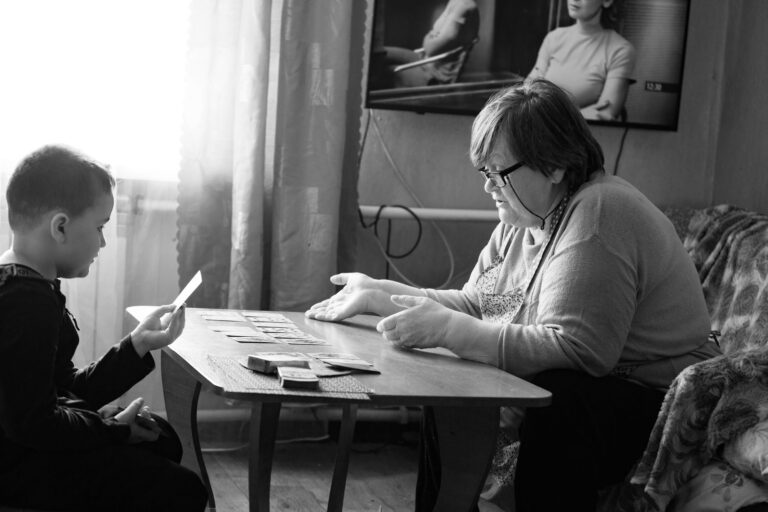
The two card games with actual research behind them as cognitive-tracking tools are FreeCell and Klondike Solitaire, both standard solitaire variants, along with the matching game Memory Match that works the same way. Researchers have instrumented these games to capture how a person plays — speed, error rate, consistency, and whether difficulty choices change over time — rather than simply whether they win. For a caregiver, the practical value is not a score but a pattern. The signal that separated people with mild cognitive impairment from their peers in recent studies was flatness: the same difficulty level chosen week after week, and wide swings in performance from one session to the next.
Medical information disclaimer: This article is for general educational purposes only and does not provide medical advice, diagnosis, or treatment. Always consult a physician or other qualified health professional about symptoms, medications, tests, or treatment decisions.
Table of Contents
- Why solitaire became the game researchers instrumented
- What the home-play studies actually measured
- Sessions tell you less than a month of them
- What to watch for at the kitchen table
- Turning what you see into something a clinician can use
- Frequently Asked Questions
Why solitaire became the game researchers instrumented
Solitaire is everywhere, already familiar to most older adults, and played alone — so it produces a long, uninterrupted stream of decisions without a testing session. A study of Klondike Solitaire published in JMIR Serious Games had 11 experts in cognitive impairment rate 21 distinct player actions against 11 cognitive functions, deriving 23 candidate digital biomarkers and concluding that commercial card games could complement standard screening and monitoring tools for mild cognitive impairment. Mild cognitive impairment, or MCI, is the stage where thinking changes are noticeable and measurable but daily independence is largely intact.
It is the window caregivers most want to see clearly, because change there is easiest to miss and most useful to catch. The expert agreement in that work was strong — the study record reports all intraclass correlations above 0.75, meaning good-to-excellent reliability, with every player action linked to at least one moderately or strongly associated cognitive function. It is worth being precise about what that is: an exploratory, expert-rating methodology paper, not a validation in diagnosed patients. It establishes no diagnostic accuracy at all.
What the home-play studies actually measured
A Mass General-affiliated study reported in Alzheimer's & Dementia followed 60 older adults — 26 cognitively intact, 11 with subjective cognitive decline, 23 with MCI or mild dementia — playing four iPad games for at least five minutes a day, five days a week, over four months. The four games were Memory Match, Word Scramble, FreeCell and Block Drop. The separating signal was the shape of the learning curve, not any single score.
Participants with MCI or mild dementia were more likely to fall into the flat-curve group that kept choosing the same difficulty level throughout, with an odds ratio of 1.98 and a p-value of .01. Within individual games, FreeCell's informative metric was the percentage of incorrect moves and Memory Match's was card-matching accuracy. That is a different thing from "losing at cards." A person can keep winning and still stop advancing — and the stall is the part that carried information.
Sessions tell you less than a month of them
The companion feasibility trial of the same four-game pack, reported in Frontiers in Neurology, followed 26 cognitively unimpaired adults with a mean age of 71.9 and found play was sustained across four months. It also found that each one-point rise in a participant's self-rated daily memory and thinking predicted roughly two more minutes of play — which is the case for repeated measurement across good days and bad ones. The same paper names the limitation that matters most to a caregiver: performance plateaued after roughly 22 to 39 days, depending on the game. Early improvement is learning the game, not improving cognition.
A baseline worth comparing anything against needs about a month of regular play first. The oldest version of this idea had the same warning attached. Work presented in July 2006 by Holly Jimison and Misha Pavel at OHSU's ORCATECH, described in a release from the university, instrumented FreeCell for nine regular computer users averaging age 80, three of whom had MCI — and found the impaired players were markedly more inconsistent game to game. Nine people, all already comfortable with computers, is a preliminary sample, not evidence of a working test.
What to watch for at the kitchen table
None of this requires an instrumented tablet. The everyday version is the Alzheimer's Association's warning sign three, difficulty completing familiar tasks, which specifically includes trouble remembering the rules of a favorite game. The organization contrasts this with typical aging, such as occasionally needing help with microwave settings.
Things worth noting over weeks, not days: Record dates and short specifics rather than impressions. "Asked twice which suit was trump, Nov. 4 and Nov. 9" survives a clinic visit; "seemed off lately" does not.
- Rules of a long-played game needing re-explanation mid-hand
- Wide session-to-session swings — a sharp game followed by a confused one
- Difficulty level never moving up after the first month of play
- Rising error rates in games the person used to finish cleanly
- A game that used to be enjoyed being quietly abandoned
Turning what you see into something a clinician can use
Caregiver observation is a recognized clinical input, not a soft one. CMS instructs clinicians to assess cognitive function at the Medicare Annual Wellness Visit "by direct observation or reported observations from the patient, family, friends, caregivers, and others." A pattern noticed over a card table is exactly the sort of report that language covers.
Bring the pattern and let the clinician interpret it. No commercial card game is a diagnostic test, and the research above does not claim otherwise — what it supports is noticing consistency, error rate, and stalled progression, then handing that to someone who can order real screening.
Frequently Asked Questions
Does a phone solitaire app track any of this for me?
Standard commercial apps report wins and times, not the error-rate and difficulty-progression metrics the research instrumented. You can still log session dates and rough error counts yourself.
How long before game-play changes mean anything?
The Frontiers in Neurology feasibility trial found performance plateaued after roughly 22 to 39 days depending on the game, so allow about a month of regular play before treating any change as meaningful.
Is getting worse at cards enough to suspect dementia?
No. The Alzheimer's Association lists trouble with the rules of a familiar game under difficulty completing familiar tasks, which is one of ten signs — it points toward a clinical evaluation, not a conclusion.