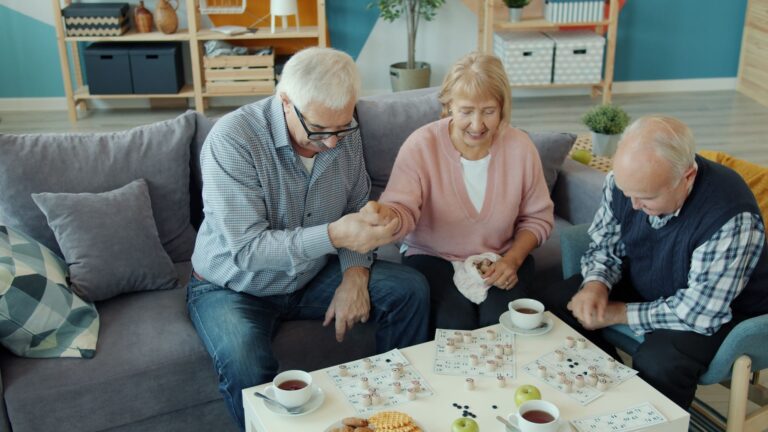
The safest board games for Lewy Body Dementia patients are simple, familiar, failure-free games like bingo, dominoes, matching-pair games, simplified Uno or rummy, simplified checkers, and large-piece jigsaws. Lewy Body Dementia (LBD) is a brain disorder that affects thinking, movement, sleep, and behavior, so safe choices use simple rules, little memory demand, large easy-to-handle pieces, and seated, supervised play. The Lewy Body Dementia Association symptoms guide reports fluctuating attention, slowed thinking, visuospatial problems, and movement changes that shape these choices. Dementia-care guidance from HelpDementia.com recommends matching the game to current ability, interests, and mood, with low pressure rather than testing or winning.
Medical information disclaimer: This article is for general educational purposes only and does not provide medical advice, diagnosis, or treatment. Always consult a physician or other qualified health professional about symptoms, medications, tests, or treatment decisions.
Table of Contents
- Why does LBD make game choice different?
- Which games are safest to start with?
- What should pieces, boards, and seating look like?
- When and how long should you play?
Why does LBD make game choice different?
Attention and concentration in LBD can fluctuate over minutes to hours. Thinking may slow, and executive function often weakens, so multi-step strategy and fast play become frustrating. Depth perception and hand-eye coordination can also decline. Recurrent, detailed visual hallucinations affect up to 80% of people with LBD, often involving people, animals, or insects.
Delusions, anxiety, depression, and strong sensitivity to antipsychotic drugs are also common. Games with dark themes, small creepy figures, or ambiguous images can feed confusion or distress. Movement brings another limit. Northwestern Medicine's LBD guide reports slowed movement, rigidity, stooped posture, unsteady shuffling gait, and tendency to fall. Seated play with supervision lowers fall and injury risk, especially late in the course when swallowing problems may also appear.
Which games are safest to start with?
The National Institute on Aging activity guide lists playing a board or card game among mind-engaging activities. Dementia activity resources consistently name bingo, dominoes, matching-pair games, simplified Uno or rummy, simplified checkers, and large-piece jigsaws as safest starting points. These games work because they are familiar, visual, and cooperative. Bingo needs only number or picture recognition.
Dominoes and matching pairs use pattern sorting, not recall. Simplified Uno, rummy, and checkers drop complex scoring and keep turns short. Choose failure-free versions matched to today, not last year. Use large print, high contrast, and one clear action per turn. Let the patient sort tiles, call numbers, match pictures, or place large puzzle pieces without keeping score.
What should pieces, boards, and seating look like?
Safe physical design uses large, high-contrast, easy-to-grip pieces with rounded edges and sturdy nontoxic materials. HelpDementia.com warns against small detachable parts because U.S. Consumer Product Safety Commission guidance treats pieces that fit entirely inside its small-parts cylinder as fatal choking hazards.
Set up for stability and calm. Use a sturdy table, a plain mat, good light, and a chair with arms and back support. Keep the board centered, remove extra pieces, and stay within arm's reach to guide hands if tremor or stiffness appears.
- Play seated, with supervision, on a stable chair.
- Offer one game with few pieces and clear contrast.
- Allow touching, sorting, and pausing without penalty.
- Stop if fatigue, agitation, hallucinations, or unsteadiness rise.
When and how long should you play?
Schedule demanding play for the patient's best time of day. Keep sessions short, cooperative, and stoppable. End while the mood is still good, not after a win or loss. A French Paquid cohort published in BMJ Open found board-game players had 15% lower dementia risk than non-players, possibly linked to less cognitive decline and depression.
That result applied to older adults generally, not LBD specifically. It shows association, not proof that games prevent or treat LBD. The National Institute on Aging on LBD treatment and management notes LBD has no cure, so care focuses on comfort, safety, and daily function. Offer short, seated, cooperative play, follow the patient's lead, and stop anytime distress appears.