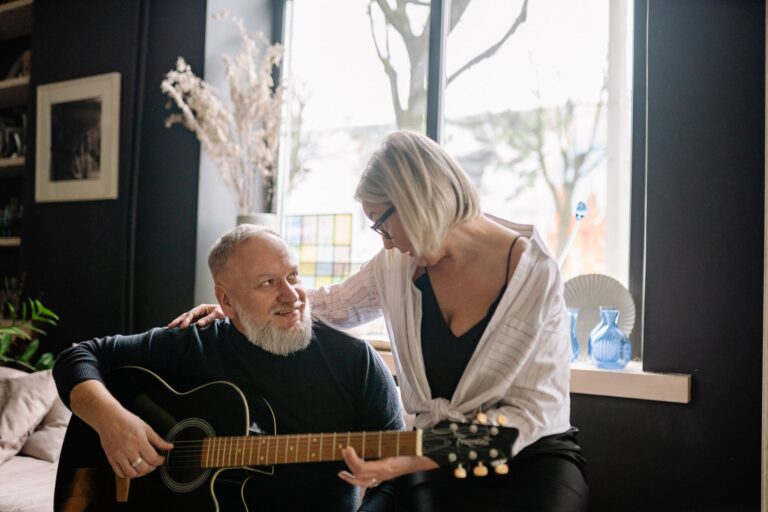
A familiar-music session works best as a short, structured one-on-one routine: pick songs tied to the person's late teens and early twenties, play them from an uninterrupted source, and watch their reactions to guide what comes next. This approach is built on guidance from the Alzheimer's Association and practical steps from caregiver programs that have been tested in thousands of care settings. The sections below walk through building a playlist, running the session itself, reading the person's response, and understanding why this works at a biological level — so a caregiver or family member can start today without guesswork.
Medical information disclaimer: This article is for general educational purposes only and does not provide medical advice, diagnosis, or treatment. Always consult a physician or other qualified health professional about symptoms, medications, tests, or treatment decisions.
Table of Contents
- How do you choose the right songs?
- Setting up the session
- What to watch for during the session
- Does this actually help, or is it just a nice moment?
- Building a lasting playlist
- Frequently Asked Questions
How do you choose the right songs?
Start with music from when the person was roughly 18 to 25 years old. Emory University's Healthy Aging program identifies this age range as the most vibrant period for cognitive memory encoding, meaning songs from those years are more likely to be stored deeply and recalled even as other memory fades. Build an initial list from top-song charts for that decade, then narrow it down one song at a time. A WRAL "Aging Well" guide recommends pulling candidates from year-by-year or decade-by-decade song lists, then testing each one individually through streaming services, YouTube, CDs, or records rather than guessing from memory alone.
Match the tempo to what the moment needs. The Alzheimer's Association notes that a calm piece can settle a restless room, while an upbeat childhood song can lift spirit and bring back happy memories. Emory's program echoes this: use upbeat tracks to encourage movement, quiet ones to calm. When possible, let the person pick. The Alzheimer's Association specifically advises involving the individual in selecting music whenever they're able to, since personal choice itself can increase engagement before a single note plays.
Setting up the session
Play from an uninterrupted source — a dedicated playlist, CD, or record, not commercial radio. WRAL's guide points out that ads, DJ chatter, and unpredictable song changes can confuse someone who is already working hard to process their environment. Keep the volume moderate and cut other noise.
Turn off the television and close doors to competing sound. A one-on-one session depends on the person being able to focus on one thing, and background noise competes directly for that attention. Sit close enough to watch facial expressions and body language, and give the first song time to land before judging whether it's working. Some reactions take a few bars to surface.
What to watch for during the session
Signs a song is landing include singing along, tapping a foot, swaying, smiling, or even crying. WRAL's guide lists these as the markers caregivers should watch for while testing each track, since they show the music is reaching the person even when words don't come easily. Treat the list as a working draft, not a finished product.
A song that falls flat isn't necessarily wrong for the person — it may be the wrong tempo for that moment, or simply not as personally significant as another choice from the same era. Set it aside and keep testing; strong reactions to even two or three songs are enough to build a session around. Track which songs work and when. A song that calms someone in the evening might not have the same effect in the morning, and noting these patterns turns a one-time test into a repeatable routine.
Does this actually help, or is it just a nice moment?
The evidence goes beyond anecdote. A Brown University-led national study comparing nursing homes that adopted the MUSIC & MEMORY personalized-playlist program against similar homes that hadn't found real behavioral improvements, including residents who were more likely to discontinue antianxiety medication. Brain imaging backs this up. University of Utah researchers used MRI scans on 17 people with Alzheimer's-related dementia and found that personalized playlist clips activated brain regions typically spared by the disease — a response generic background music didn't produce. The team noted it's still unknown how long this effect lasts after a session ends.
Smaller studies point the same direction. A Wichita State University pilot of six older adults with dementia found personalized playlists linked to improved mood and reduced disruptive behavior, though the sample was too small to generalize broadly. One nuance matters: effectiveness isn't just about song choice. Researcher Sandra Garrido and colleagues, in a randomized trial of 99 people with probable dementia, found that a one-on-one music intervention's success depends on accounting for the person's mental health history and current psychological symptoms — not musical preference alone. If a session isn't landing, the reason may be unrelated to the playlist itself.
Building a lasting playlist
Music & Memory, the nonprofit behind the certified personalized-music program now used in more than 5,800 health care sites across all 50 states, offers a music-assessment questionnaire that families can use at home to build an individualized playlist systematically rather than through trial and error alone. You don't need formal training to run these sessions.
Research cited through Wichita State and AARP coverage found convincing evidence that structured music listening reduces behavioral and psychological symptoms of dementia even when delivered by family caregivers or health care workers without music-therapy credentials, not just by certified music therapists. Once you have three or four songs that reliably produce a positive response, keep them as a dependable opening sequence for future sessions. Add new candidates gradually rather than replacing the whole list, so the routine stays recognizable session to session.
Frequently Asked Questions
How long should a one-on-one music session last?
The research packet doesn't specify an ideal length; instead, let the person's engagement guide the session — continue while they respond positively and stop when attention fades.
What if the person doesn't react to any of the songs I try?
Garrido's research found that a listener's current psychological symptoms and mental health history can affect how well a music session works, so a flat response may reflect the moment rather than the playlist itself.
Can a caregiver with no music therapy background run these sessions effectively?
Yes — research cited through Wichita State and AARP found structured music listening reduces behavioral and psychological symptoms of dementia even when delivered by family caregivers without formal training.