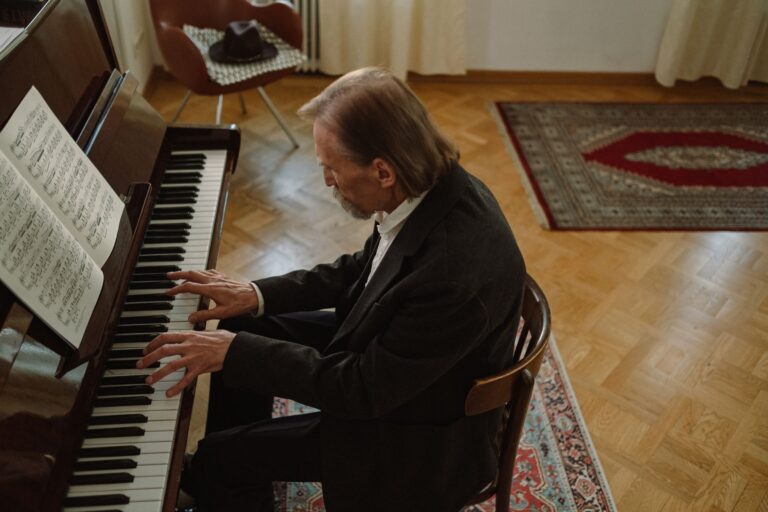
Starting music slowly in later life is linked to lower dementia risk when practice continues for years. The benefit comes from steady continuation, not fast mastery.
Dementia means memory and thinking loss that disrupts daily life. Cognitive impairment-no dementia means test scores slip but independence remains. Recent studies tie regular listening and playing to better outcomes, with important limits.
Medical information disclaimer: This article is for general educational purposes only and does not provide medical advice, diagnosis, or treatment. Always consult a physician or other qualified health professional about symptoms, medications, tests, or treatment decisions.
Table of Contents
- What does starting slowly mean
- What are listening and playing linked to
- Why do these results not prove prevention
- How can slow starters stay with it
What does starting slowly mean
Starting slowly means brief lessons plus short daily practice. In Kyoto research, adults averaging age 73 first learned an instrument for four months. Verbal working memory means holding words and numbers in mind to use them. Those who kept practicing maintained that memory skill and right putamen volume.
Those who stopped declined. Kyoto University reported the contrast in the university research news. Continuation, not talent or speed, separated the groups. For slow starters, that points to short regular sessions sustained over years rather than intense short-term mastery.
What are listening and playing linked to
Among 10,893 initially cognitively healthy Australians aged 70 and older, always listening to music was linked to 39% lower dementia risk and 17% lower risk of cognitive impairment-no dementia. The Monash University cohort compared always listeners with never, rarely or sometimes listeners in the PubMed record. Participants who often or always played an instrument had 35% lower dementia risk.
Monash University researchers reported no significant link to cognitive impairment-no dementia in the university publication record. Among 1,107 UK PROTECT participants aged 40 and older, playing an instrument was linked to better working memory and executive function. Singing was linked to better executive function. The University of Exeter and PROTECT-UK team reported the links in February 2024.
Why do these results not prove prevention
The Australian findings are observational and cannot prove music prevents dementia. Healthier, more educated or socially active listeners and players may already carry lower risk. The Fisher Center for Alzheimer's Research Foundation summary notes this alternative. A 2025 Cochrane review of 30 randomized trials with 1,720 mostly care-home residents found music-based therapy probably slightly reduces depressive symptoms.
It showed little effect on cognition or agitation. The Cochrane Library published the review on March 7, 2025. Therapy for symptoms differs from years of leisure practice. One eases mood now, the other tracks with long-term brain health.
How can slow starters stay with it
Continuation appears decisive for slow starters. Kyoto continuers preserved memory and brain volume over four years.
That supports short regular practice sustained over years rather than intense mastery. Keep the same time five days a week and add minutes only after three steady months.
- Pick one easy instrument and one 20-minute daily slot.
- Practice scales, one short song, and review.
- Keep the instrument visible and mark each session on a calendar.
- Ask a teacher for simple pieces that fit your hands and hearing.