Simplify life story books for memory care groups by creating short, flexible modules instead of complete biographies. Cover one meaningful topic at a time, use clear photographs and text, and let each person choose what to discuss. A life story book is a collection of personal memories, images, preferences, and experiences used to support conversation and person-centered care. For groups, the book should serve as an invitation to connect—not a test of memory or a record that everyone must complete.
Medical information disclaimer: This article is for general educational purposes only and does not provide medical advice, diagnosis, or treatment. Always consult a physician or other qualified health professional about symptoms, medications, tests, or treatment decisions.
Table of Contents
- Choose short modules over full biographies
- Make every page easier to process
- Adapt the activity to each participant
- Reduce demands during group sessions
- Handle sensitive memories without pressure
Choose short modules over full biographies
Build separate pages or cards around important people, places, jobs, interests, routines, and preferences. A session might focus only on favorite music, a familiar neighborhood, or work someone enjoyed. Do not require a chronological account.
Dementia UK advises following the participant's pace, covering one topic at a time, allowing breaks, and recording the person's own words. A life story does not need to be comprehensive to be useful in its life-story guidance. A simple module might include:.
- One topic, such as "My garden"
- One or two labeled photographs
- A short caption in the participant's words
- One easy prompt, such as "What did you like to grow?"
- Space for a preference, such as "I enjoy sitting outdoors"
Make every page easier to process
Use a consistent page design so participants do not need to relearn the layout. Place one main idea on each page, leave generous empty space, and remove decorative patterns that compete with the content. Dementia UK recommends clear text and photographs, one consistent font and size, and no more than two contrasting colors. Multiple colors and patterns may cause confusion according to its guidance.
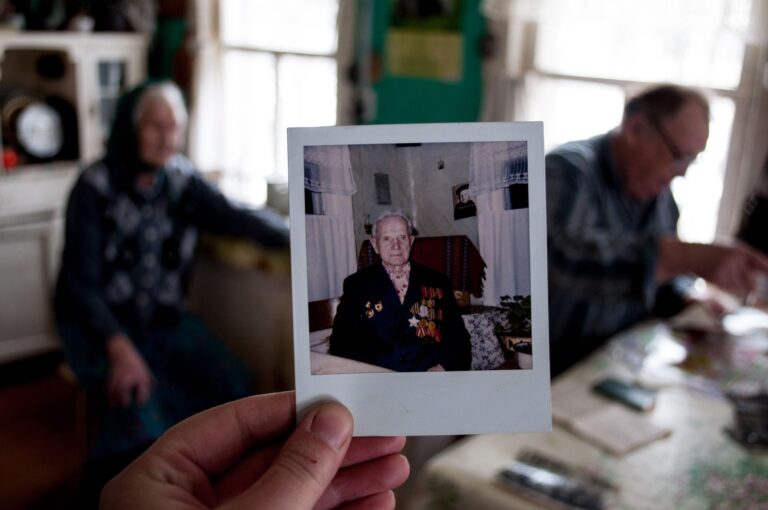
Keep captions brief and concrete. "Jean and David at the seaside" is more useful than an unlabeled photograph or a long paragraph. Labeling people and places can prevent embarrassment when someone recognizes an image but cannot retrieve a name. Use copies of treasured photographs rather than originals that could be lost or damaged. If reading has become difficult, replace text-heavy pages with a collage or memory board containing a few large, familiar images.
Adapt the activity to each participant
Use the same broad theme across the group, but do not require identical pages. One person may write a sentence, another may select a photograph, and another may simply talk while a facilitator records a few words. Research does not support one fixed life-story-book format for everyone. A 2023 review found books ranging from two to 70 pages, wide variation in session length, and limited quantitative evidence about communication outcomes in PLOS One. That variation favors individualized books over a rigid group template.
Learn each participant's communication needs before the session. Give people extra time to answer, invite quieter members without putting them under pressure, and offer one-to-one or small-group participation when speaking to the full group is difficult. Individualization can be simple. Offer a choice between two photographs, let someone point instead of speak, or ask a family member to supply names for captions. Preserve the participant's wording rather than correcting it into a polished family history.
Reduce demands during group sessions
Hold the activity in a quiet, well-lit setting and introduce only one subject at a time. Speak in short sentences, pause after questions, and use familiar photographs or objects to make the topic concrete. Keep the structure predictable: Avoid rapid rounds in which every participant must answer the same question.
A person who needs more time may feel rushed, while someone who dislikes the subject may feel trapped. Small-group or individual work can run alongside the main activity. Treat shared enjoyment as more important than factual precision. If a story changes in the telling, respond to its meaning and emotion instead of turning the exchange into a correction exercise.
- Introduce one theme.
- Show one prompt.
- Allow unhurried responses.
- Record only the details the person wants included.
- Offer a break or a different activity when attention fades.
Handle sensitive memories without pressure
Life-story prompts can bring up grief, trauma, conflict, or loss. Give participants permission to decline any topic, stop speaking, express emotion, take a break, or change activities. Watch for verbal and nonverbal signs that a prompt is unwelcome. A facilitator can put the photograph aside, acknowledge the feeling in simple language, and move to a safer subject without demanding an explanation.
Reminiscence activities can offer real benefits, but they should remain responsive to the individual. A 2022 meta-analysis of 29 studies involving 3,102 participants found that reminiscence therapy improved cognition and quality of life while reducing depressive and neuropsychiatric symptoms among people with dementia in the Journal of Psychiatric and Mental Health Nursing. The practical limit is clear: a life story book is not helpful when completing it matters more than the person's comfort. Leave difficult pages unfinished, omit unwanted subjects, and keep a preferred photograph, object, or calming alternative ready.