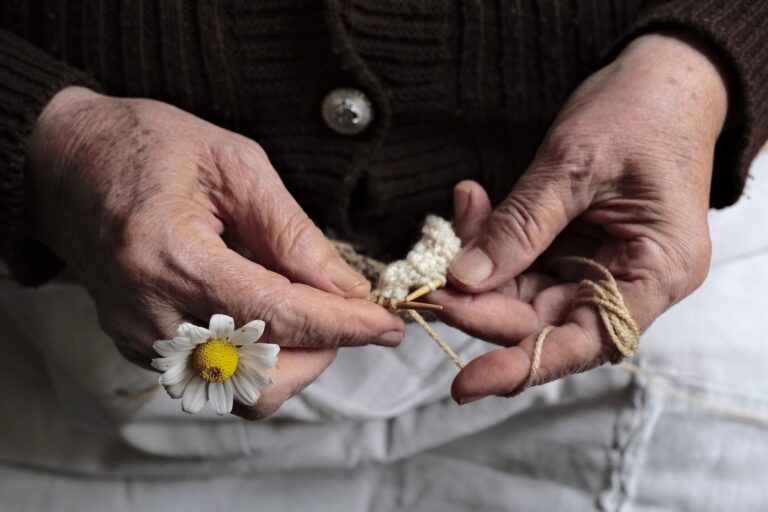
Adapt simple knitting for middle-stage dementia by stripping the craft down to plain, repetitive stitching while a helper handles the fiddly parts. Use bulky yarn, large needles, block colours, and one clear prompt at a time during a familiar part of the day.
Middle-stage dementia often leaves familiar hand skills workable even as recall fades. The dementia activities guidance from the National Council of Certified Dementia Practitioners notes that procedural memory for actions like knitting, folding laundry, or kneading dough often lasts longer than recall. That makes this a good time to protect calm participation rather than teach new skills.
Medical information disclaimer: This article is for general educational purposes only and does not provide medical advice, diagnosis, or treatment. Always consult a physician or other qualified health professional about symptoms, medications, tests, or treatment decisions.
Table of Contents
- What should you simplify first?
- Which yarn and needles work best?
- How do you share the work without taking over?
- How do you keep sessions calm and failure-free?
What should you simplify first?
Move away from patterns with counting, shaping, or colour changes. The wool crafts activity ideas from Alzheimer's Society UK advise simplifying wool crafts to simple patterns, block colours, or plain knit as dementia progresses. A small rectangle in one colour is enough.
Plain knit means the same stitch repeated across every row. It creates rhythm without decisions about increases, decreases, or pattern repeats. The finished size does not matter, so dropped stitches need not be fixed.
Which yarn and needles work best?
Choose materials that are easy to see, hold, and move. The knitting activities guide from Keeping Busy recommends larger needles and thicker or bulky yarn, with verbal prompts or step demonstrations as needed. Light-coloured yarn on dark needles, or the reverse, improves contrast.
Short, lightweight needles reduce wrist strain and are easier to control. Avoid thin yarn, small needles, fuzzy textures, dark colours in dim rooms, and long circular cables. Keep scissors, spare balls, and pattern sheets out of sight to reduce clutter.
How do you share the work without taking over?
Do the setup work yourself and leave the soothing repetition to the person. The wool crafts activity ideas from Alzheimer's Society UK suggest a helper can thread needles and do cast-on and cast-off, leaving only the repetitive stitching to the person.
This preserves independence where it matters most. Offer one step at a time and demonstrate rather than explain at length. Useful setup looks like this:.
- Cast on 10 to 15 stitches before the session starts.
- Place hands, then guide one stitch together if needed.
- Say "through, over, off" for each stitch, then pause.
- End before tiredness appears, with cast-off done later by you.
How do you keep sessions calm and failure-free?
Use the same time, chair, and light each day so knitting feels expected. Keep the visit short, quiet, and free from television, visitors, or competing tasks. Sit beside rather than opposite the person so your hands match theirs.
Watch for rubbing the yarn, pulling at stitches, sighing, or looking away. Those signs mean simplify further, switch to winding yarn or stroking fabric, or stop for today. End with the work left on the needles for next time, so starting again takes seconds.