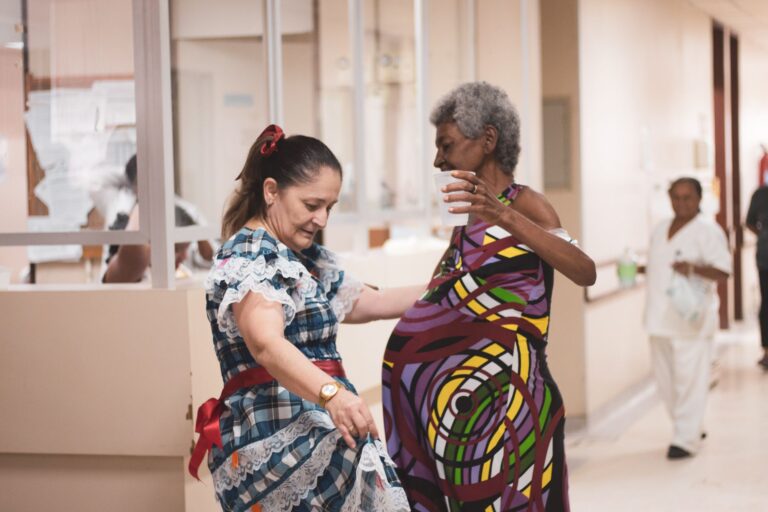
Adapt simple knitting for memory care groups by breaking each task into one easy step, using large easy-grip tools, and prizing enjoyment over a finished product. Memory care groups are small supervised activity groups for people living with memory loss, and each person can watch, touch yarn, or make a few stitches. Craft activity has drawn attention in brain-health research. The focus for middle- and late-stage dementia stays practical: match the task to current abilities and change course at the first sign of frustration.
Medical information disclaimer: This article is for general educational purposes only and does not provide medical advice, diagnosis, or treatment. Always consult a physician or other qualified health professional about symptoms, medications, tests, or treatment decisions.
Table of Contents
- What does the research show?
- How do you keep the activity failure-free?
- Which tools reduce hand strain?
- How can texture projects calm busy hands?
What does the research show?
The Mayo Clinic Study of Aging followed 1,321 adults ages 70-89. Those who did crafts such as knitting had 30-50% lower likelihood of mild cognitive impairment. Mild cognitive impairment means early memory loss before dementia, as reported by Y.
Geda and colleagues in the Journal of Neuropsychiatry and Clinical Neurosciences the PubMed study record. A later Mayo Clinic follow-up tracked 1,929 cognitively normal adults age 70 and older for about four years. Later-life craft activity was linked to 42% lower risk of new mild cognitive impairment. The finding is association only, not proof that knitting prevents decline, because early decline itself may reduce participation, according to researcher Janina Krell-Roesch the REHACARE research summary.
How do you keep the activity failure-free?
Build the plan around past interests and remaining skills. The Alzheimer's Association advises adapting familiar hobbies to current abilities, focusing on enjoyment rather than achievement, and stopping when attention fades the Alzheimer's Association activities guide. The U.S.
Department of Veterans Affairs dementia caregiver program gives the same direction: keep activities purposeful and failure-free, and let the person watch rather than participate when preferred. Pause quickly when hands clench, gaze drifts, or voices sharpen. A short drink, stretch, or change of texture often restores comfort better than urging one more row.
- Offer one simple step at a time, such as holding yarn or wrapping one stitch.
- Demonstrate first, then do the motion together.
- Praise effort and texture, not speed or accuracy.
- Switch to sorting colors or feeling samples if frustration appears.
Which tools reduce hand strain?
Stiff joints work better with chunky or bulky yarn and larger needles. Elder Care Alliance points to commonly used U.S. sizes 10-13 as easier to grip, see, and move with less strain. Lightweight bamboo or wooden ergonomic needles add helpful friction.
Hand surgeon Dr. J. Alan Lemley, cited by MostCraft, notes that this grip keeps stitches from slipping and lowers grip force on stiff hands. Choose short, smooth pairs without sharp points, and wind small balls that pull freely.
How can texture projects calm busy hands?
Twiddle muffs are hand-warmer tubes finished with securely attached ribbons, beads, buttons, or textured patches. Oxford University Hospitals NHS Foundation Trust describes them as visual and tactile stimulation that keeps hands warm, busy, and calmer for people with dementia.
Invite group members to choose a color, stroke a sample, or fasten one preselected trim. Finished muffs also serve members who prefer rubbing a texture over forming stitches. Fasten every decoration firmly and inspect seams before each session.