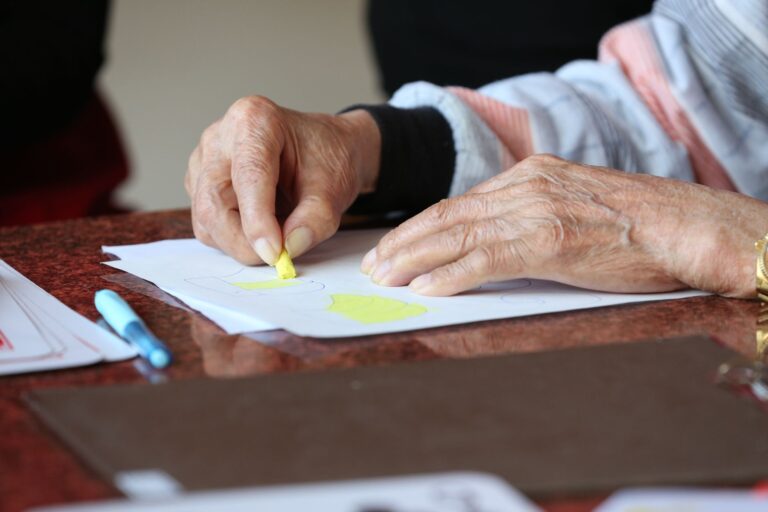
Holiday card activities for dementia care are hands-on card-making projects that build fine motor skills, the small hand and finger movements used to grip, place, peel, and draw. They give the person a clear, adult-level task with visible progress and a gift to share. Set out blank cards, colored paper, large stickers, and washable markers. Keep steps short, offer help to start, and let the person choose colors and placement.
Medical information disclaimer: This article is for general educational purposes only and does not provide medical advice, diagnosis, or treatment. Always consult a physician or other qualified health professional about symptoms, medications, tests, or treatment decisions.
Table of Contents
- What makes a card project work well?
- How do you set up for weak grip or one-handed work?
- Why combine hand movement with giving?
- How do you keep card-making safe?
What makes a card project work well?
Choose one simple design per session, such as a tree from torn paper strips or a wreath from thumbprint dots. The Alzheimer's Association advises caregivers planning art for middle- to late-stage Alzheimer's to keep the project adult-level, build conversation into the work, help the person begin, and encourage self-expression through guidance on art and music.
Licensed creative arts therapists recommend handmade holiday or birthday cards using blank cards, colored paper, large stickers and washable markers, with larger brushes and thicker markers when fine movements get harder, described in holiday art activities from creative arts therapists. Talk while you work about colors, memories, and who will receive the card. Praise effort and choices, not neatness.
How do you set up for weak grip or one-handed work?
For limited grip or one-handed work, taping paper down, using a non-slip mat or raised-edge tray, building up thin handles with foam tape, and choosing larger pieces lets older adults and people with dementia complete card crafts, according to Creative Activities in crafts for limited dexterity. Use this quick setup: Sit on the stronger side if only one hand is active. Hold the card steady while the person places, presses, or draws.
- Tape the blank card to the table or place it on a non-slip mat.
- Offer large stickers, pre-cut shapes, and thick washable markers.
- Wrap foam tape around short brushes or marker barrels for a wider grip.
- Keep water, glue, and scraps in a tray with a raised edge.
Why combine hand movement with giving?
Paper crafts such as homemade greeting cards exercise the hands and mind together, and Senior Helpers Concord notes they improve hand-eye coordination and dexterity while giving seniors a meaningful way to connect with loved ones. The National Institute on Aging lists an arts-and-crafts project such as painting or drawing as an around-the-house activity for a person with Alzheimer's, adjusted to preferences and abilities without requiring completion.
Research interest in hand practice is growing. In a University of Tsukuba trial, 57 adults averaging about 73.6 years did daily home manual-dexterity training for 12 weeks and improved both manual dexterity and cognitive functioning versus controls, reported in University of Tsukuba research news. A separate 12-week handicraft dexterity program reported intervention effects for hand dexterity and executive function, including Trail-Making and verbal-fluency measures.
How do you keep card-making safe?
Use safe non-toxic materials without sharp tools. Avoid small beads, craft knives, hot glue, and strong fumes.
Creative Activities notes that craft adaptations are not medical treatment. Stop if gripping causes pain, and consult a doctor or occupational therapist about hand problems.