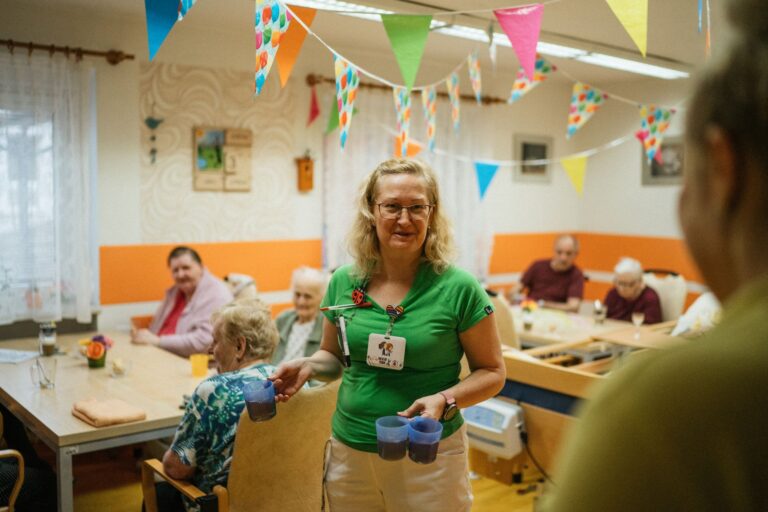
Dementia Care Mapping is an observational tool care-home staff use to watch daily life from the resident's perspective and improve person-centred care. Trained staff called mappers sit quietly in shared areas for several hours, recording what residents do and how they seem to feel. Dementia Care Mapping was developed at the University of Bradford to assess and improve person-centred dementia care. It focuses on ordinary moments — meals, conversation, rest, and staff contact — rather than medical tasks.
Medical information disclaimer: This article is for general educational purposes only and does not provide medical advice, diagnosis, or treatment. Always consult a physician or other qualified health professional about symptoms, medications, tests, or treatment decisions.
Table of Contents
- Who becomes a mapper?
- How does observation work?
- What do mappers record every five minutes?
- What happens after mapping?
Who becomes a mapper?
At least two staff per site train as mappers through a standardized 4-day course licensed by the University of Bradford, including a competence assessment, according to the systematic review by Surr and colleagues in the Dove Medical Press review. The course gives mappers a shared method for watching, coding, and feeding back observations.
Before mapping begins, the mappers brief the wider staff team about the purpose and schedule. Families and residents learn that observation will happen in public areas and is meant to improve daily care.
How does observation work?
Mappers sit unobtrusively in lounges or other public areas for several hours to watch daily life as experienced by residents with dementia. They do not join activities or direct care during the observation period. A typical mapping session follows the same steps: This quiet presence helps staff see routines, waiting times, and social contact through residents' eyes.
- watch a small group of residents continuously over several hours
- focus on the resident's experience, not staff performance
- record behaviour, mood, engagement, and staff interaction at set intervals
- prepare anonymized notes for team feedback
What do mappers record every five minutes?
Every five minutes the mapper records one Behaviour Category Code for the person's dominant activity, chosen from 23 lettered codes such as A for articulation, F for eating and drinking, and L for leisure, as described in the Bradford DCM manual hosted by NIHR. The code captures what the person is mainly doing in that interval. For the same interval, mappers score well-being or ill-being from -5 to +5, from very negative mood and disengagement to very positive mood and deep engagement.
They also note the level of engagement in the activity. Mappers add a separate record of staff-resident interactions as Personal Enhancers that support personhood or Personal Detractions that undermine it. An example of an enhancer is warmly including a resident in conversation; an example of a detraction is talking over a resident as if absent.
What happens after mapping?
After mapping, staff receive anonymized verbal and written feedback — explicitly not individual performance review — then jointly analyze patterns and agree action plans, according to the Alzheimer's Society toolkit page. The discussion looks for repeated low mood, long inactive periods, and helpful or unhelpful interaction styles. The team then agrees practical changes to routines, activities, and interaction styles.
Changes may include shorter waits before meals, more one-to-one contact, clearer invitations to join leisure, or calmer support during personal care. Benefits depend on follow-through. The NIHR-funded EPIC trial process evaluation found homes struggled with fidelity without ongoing expert support, so managers and staff need extra time, training, and facilitation, as reported in the EPIC process evaluation.