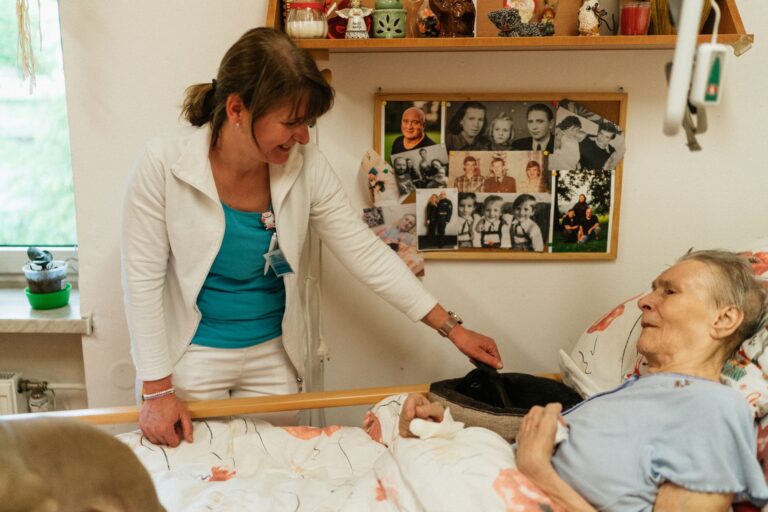
Yes—dementia can make someone lose the thread in a group conversation, meaning they cannot easily follow, remember, or rejoin the topic. This is not universal: communication changes vary by person and disease stage, and many people with early Alzheimer's disease still enjoy meaningful conversation and social contact. The difficulty often comes from trouble finding words, sustaining attention, holding a thought, or filtering background noise. Visits become easier when relatives slow the pace, reduce distractions, and create openings for the person to participate.
Medical information disclaimer: This article is for general educational purposes only and does not provide medical advice, diagnosis, or treatment. Always consult a physician or other qualified health professional about symptoms, medications, tests, or treatment decisions.
Table of Contents
- Why group conversations become difficult
- How to make the visit more accessible
- What to do when someone loses the thread
- When one-to-one contact may work better
- When communication changes need attention
- Frequently Asked Questions
Why group conversations become difficult
In Alzheimer's disease, a form of dementia, communication changes can affect word-finding, attention, and the ability to keep a train of thought. Background talk and noise can add another layer of difficulty, according to the National Institute on Aging. NIA's communication guidance A group conversation demands several skills at once.
The person must identify who is speaking, understand the topic, remember what was just said, and decide when to respond. Rapid topic changes or several people speaking together can overwhelm that process. The pattern differs widely. A person may follow a quiet conversation with one familiar visitor but struggle during a noisy meal with several relatives.
How to make the visit more accessible
Choose a quieter setting and limit competing sounds, such as television, music, or several side conversations. The Alzheimer's Association recommends quieter one-to-one conversation with few distractions for people in the middle stage of Alzheimer's disease.
The Alzheimer's Association's communication guidance Before the visit, agree that one person will guide the conversation while others listen. Keep the group small when possible, and allow pauses rather than filling every silence. Helpful steps include:.
- Say the person's name and make eye contact.
- Ask one simple yes-or-no or either-or question.
- Give extra time for an answer.
- Avoid interrupting or correcting every mistake.
- Speak directly to the person, even when others are present.
What to do when someone loses the thread
Reconnect without announcing that the person is confused. Briefly restate the topic, use names instead of pronouns, and offer one clear next question. For example, say, "We were talking about Maria's garden. Maria, did your roses bloom this year?" This gives the person the subject, the relevant name, and an easy way back into the conversation.
Pictures, writing, gestures, and familiar objects can support speech. Speech and language guidance from East Sussex Healthcare NHS Trust recommends these kinds of cues when dementia affects communication. East Sussex Healthcare NHS Trust's dementia communication guidance If the response seems unrelated, acknowledge it and look for its possible connection. Do not talk about the person as if they are absent; the NHS advises including them and responding to what they say. NHS guidance on communication and dementia.
When one-to-one contact may work better
A large gathering is not the only way to maintain social contact. A short, calm conversation with one visitor may allow more time to think and fewer distractions than a long family discussion. Try alternating formats: a brief group greeting, followed by a quieter conversation with one relative. A familiar activity, photograph, or object may provide a shared focus without requiring constant verbal exchange.
A small trial involving 55 nursing-home residents with Alzheimer's found that 16 weeks of structured one-to-one conversation improved the amount and conciseness of information compared with comparison conditions. The finding came from a specific, small population, so it does not establish that the same program will work for everyone. The goal is participation, not performance. Ending a visit while the person is still comfortable may be more helpful than extending it until conversation becomes tiring.
When communication changes need attention
Hearing or vision problems can make conversation harder and may be addressable. Check whether the person can hear the speaker, see faces clearly, and use needed glasses or hearing support.
A sudden new confusion problem differs from a gradual communication change. Delirium can begin abruptly and is often temporary and treatable, so sudden confusion warrants medical assessment, according to MedlinePlus. MedlinePlus information on delirium.
Frequently Asked Questions
Should I correct someone who gives an inaccurate answer?
Correct only when accuracy affects safety or an important decision. For ordinary conversation, acknowledge the response and gently return to the shared topic.
Is losing the thread proof that dementia is getting worse?
Not necessarily. Noise, fatigue, hearing or vision problems, the group's size, and the conversation's speed can all affect communication.
What is the best question to ask?
Ask one concrete question with a small choice, such as, "Would you like tea or water?" Then wait for the answer.