For middle-stage dementia, a life story book is best built in small, supported steps, but no separately validated "middle-stage" protocol exists. The strongest direct trial evidence involved people with mild to moderate dementia in care homes, so the title's exact premise remains unverified, as the Bangor University researchers reported in 2014 the controlled trial. "Middle stage" usually describes worsening memory, language and orientation, alongside greater support needs in daily life. A book can therefore serve as a familiar connection tool, not a test the person must pass, according to the Alzheimer's Association's guidance on reminiscence activities its activity guidance.
Medical information disclaimer: This article is for general educational purposes only and does not provide medical advice, diagnosis, or treatment. Always consult a physician or other qualified health professional about symptoms, medications, tests, or treatment decisions.
Table of Contents
- What should the book achieve?
- How do you build it step by step?
- Who should create the content?
- How should sessions be adapted for middle-stage dementia?
- What does the evidence show—and what are its limits?
What should the book achieve?
A life story book gathers meaningful photographs, objects, places, music and memories into an easy-to-use personal record. Its purpose may be conversation, reassurance, identity and connection with relatives or care staff. Set a modest goal for each session.
You might aim to choose one photograph, identify one familiar person, or decorate one page. Do not make accurate recall the measure of success. The person may remember older experiences more readily than recent events. Prompts from childhood, work, family occasions, homes or favorite activities may therefore be more useful than questions about yesterday.
How do you build it step by step?
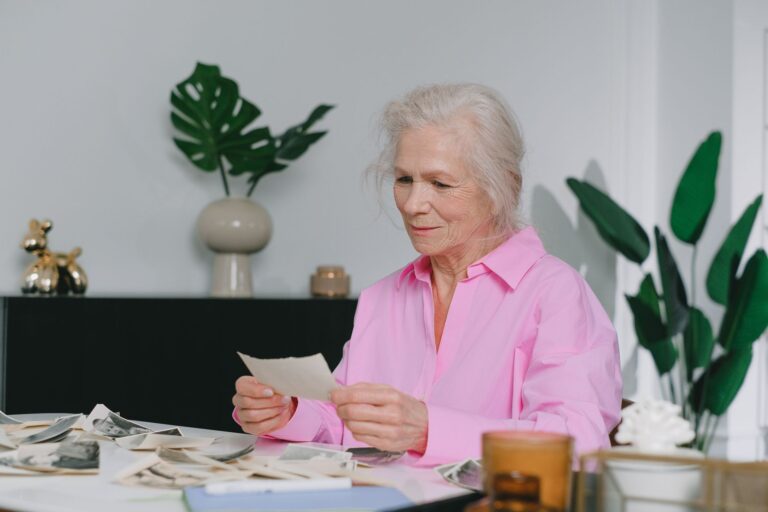
Work chronologically when that feels comfortable, moving from early life through family, education, work, relationships, interests and later experiences. The documented book-building sequence used clearly labelled pictures and occasions, added the person's quotations when possible, and shared copies with the person, relatives and staff the Bangor University study.
Use one simple task at a time. A practical sequence is: Keep pages uncluttered and labels easy to read. Add information that helps another person respond naturally, such as "Aunt May," "first home" or "Sunday dances," rather than filling pages with questions.
- Choose one life period or theme.
- Gather a few photographs or keepsakes.
- Ask a simple, open question.
- Write down the person's words or preferred name for the memory.
- Label each picture with names, places or occasions.
Who should create the content?
Family members often act as practical co-authors. They can supply photographs and memorabilia, explain relationships, and prepare a draft when the person cannot participate actively. The person with dementia should retain editorial control whenever possible. Ask whether a photograph belongs in the book, what name or description feels right, and whether a page should be changed or removed.
A relative's version may contain assumptions or details the person does not want shared. Check sensitive material carefully, especially photographs involving former partners, bereavement, conflict or private medical information. Keep copies available to the person, relatives and staff who support them. A shared book can help others recognize important people, places and interests, but it should remain the person's story rather than a general biography.
How should sessions be adapted for middle-stage dementia?
Break the work into short, manageable actions and adapt the activity to the person's remaining abilities. The Alzheimer's Association recommends assisting with difficult parts and avoiding forced participation when an activity causes distress or refusal its activity guidance. Offer choices instead of demanding answers. For example, ask whether a photograph shows a wedding or a holiday, or invite the person to point, smile, gesture or listen to familiar music.
Conversation can continue even when spoken answers become difficult. Treat uncertainty gently. Say, "This looks like your old house," rather than correcting every detail. If the person becomes upset, put the book away and return later with a different prompt or activity.
What does the evidence show—and what are its limits?
In the small controlled trial, 23 care-home residents with mild to moderate dementia either created a book through 12 individual life-review sessions or received a book created by a relative. Guided life review improved quality-of-life and autobiographical-memory scores, but after both groups had books for six weeks, quality of life did not differ between groups. Guided sessions also required training and supervision the trial report.
The evidence does not establish the best book format, number of sessions or target population. A systematic review found only 14 eligible empirical life-story-book studies from 55 records, with most using qualitative methods, case studies or small pilot trials the systematic review. Broader evidence on reminiscence therapy suggests small, context-dependent effects on quality of life, cognition, communication or mood. Results vary by delivery and setting, so use the book as a flexible support for connection rather than a guaranteed treatment.