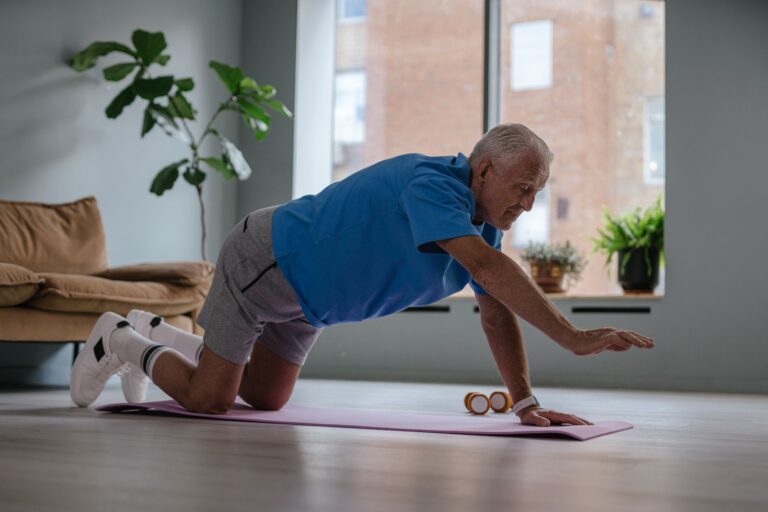
The seven exercises doctors most commonly recommend for spine strength are prone holds, bird dogs, bridges, dead bugs, superman holds, side planks, and cat-camel stretches. These movements strengthen the muscles that support and stabilize your vertebral column, reducing your risk of injury and age-related decline. For people in midlife and beyond, particularly those concerned with cognitive health and independence, a strong spine is foundational—it supports better posture, improved circulation to the brain, reduced fall risk, and the functional mobility needed to stay active as you age. This article breaks down each exercise, how to perform them correctly, what benefits they deliver, and how to build them into a sustainable routine.
A strong spine isn’t primarily about looking athletic. It’s about keeping your vertebrae properly aligned, reducing pressure on nerves, and maintaining the muscle support that lets you bend, twist, and recover from minor slips without injury. Studies on older adults show that people with stronger core and spinal muscles are significantly less likely to fall, experience chronic back pain, or develop the postural rounding that can compress the lungs and heart. For individuals focused on brain health, this matters because falls are a leading cause of hospitalization and cognitive decline in aging, and poor circulation from hunched posture limits oxygen flow to the brain.
Table of Contents
- What Makes These Seven Specific Exercises Effective for Spinal Stability?
- Why Core Strength and Spine Stability Matter Beyond Just “Back Pain”
- Breaking Down Each Exercise: How to Perform Them and What to Feel
- How to Progress These Exercises and Build a Sustainable Routine
- Common Mistakes and When These Exercises Might Not Be the Right Fit
- Combining Spinal Stability Work with Overall Movement and Activity
- The Long-Term Value of Spinal Strength in Aging and Independence
- Conclusion
What Makes These Seven Specific Exercises Effective for Spinal Stability?
These seven exercises are recommended by physicians and physical therapists because they target the three muscle groups most critical to spinal function: the deep stabilizers along the vertebral column, the abdominal muscles that support the front of your spine, and the muscles along your back body. Unlike traditional sit-ups or high-impact activities, these movements build strength through controlled tension and isometric holds, which are safer for your joints and more effective at engaging the stabilizer muscles that prevent injury. The spine has 33 vertebrae stacked with discs between them, and the muscles around these bones provide the actual structural support. When these muscles weaken—which happens naturally with age and sedentary behavior—your discs bear more load, your posture degrades, and your risk of herniation or nerve compression rises.
For example, a person who sits eight hours a day and doesn’t train their spinal stabilizers may develop anterior pelvic tilt, where the lower spine curves excessively forward. The seven exercises reverse this by rebalancing muscle engagement across all sides of the trunk. What distinguishes these exercises from general fitness work is their focus on controlled movement and time under tension rather than speed or repetitions. A 30-second plank hold that feels difficult is more valuable for spine strength than 20 rapid crunches, because the stabilizer muscles engage only when forced to maintain position against gravity for extended periods.
Why Core Strength and Spine Stability Matter Beyond Just “Back Pain”
The muscles supporting your spine aren’t isolated to your back. They form a cylinder around your trunk, including your deep abdominals, your pelvic floor, and the muscles along the sides of your body. This integrated system, sometimes called your “core,” does far more than prevent back pain—it stabilizes your entire torso during movement, supports good posture, and even improves breathing efficiency and digestion. For older adults and those in midlife, weak spinal stability contributes to falls in ways many people don’t anticipate.
If your core muscles are weak, your body can’t quickly adjust when you stumble or lose your footing. You collapse rather than catch yourself. Conversely, people with strong cores can correct their balance mid-step. A study published in a rehabilitation medicine journal found that older adults who trained their core muscles for just eight weeks reduced their fall risk by roughly 45 percent, independent of their age or existing fitness level. However, if you have existing spinal conditions like significant arthritis or a history of herniated discs, some of these exercises may need modification—this is where form and progression matter far more than doing all seven at once.
Breaking Down Each Exercise: How to Perform Them and What to Feel
The prone hold, or plank, is the foundational movement. You lie face-down, prop yourself on your forearms and toes, and hold your body in a straight line from head to heels. Your abdominals should feel engaged (as though bracing for impact), your glutes should be gently engaged (not clenched), and your neck should be neutral (looking at the floor, not ahead). Start with 15 to 20 seconds and build to 45 to 60 seconds. A common mistake is letting your hips sag, which removes the spinal benefit and puts stress on your lower back instead. The bird dog involves starting on your hands and knees, then extending one arm forward and the opposite leg backward simultaneously, holding for 2 to 3 seconds, then returning to center. Do eight to ten repetitions per side. This exercise is particularly valuable because it trains your core to stabilize while your limbs move—something your body needs to do constantly during daily life. Many people find bird dogs easier to tolerate than planks and can perform them daily without overuse concern. Bridges work the posterior chain, particularly your glutes and hamstrings, which are often weak in people who sit frequently. Lie on your back with knees bent and feet flat, then push through your heels to lift your hips toward the ceiling. Hold the top position for one or two seconds, then lower. Perform ten to fifteen repetitions. The glutes are among the largest muscles in your body, and when they’re weak, your lower back and knees compensate and become stressed.
This is why many people with back pain actually benefit most from stronger glutes, not additional back exercises. Dead bugs involve lying on your back, raising your arms straight up and bringing your knees to 90 degrees, then slowly lowering your right arm overhead while straightening your left leg, hovering just above the ground. Return to the start position and repeat on the other side. This teaches your spine to stay neutral while your limbs extend, and it’s one of the safest exercises for people concerned about back strain because your spine is supported throughout. Superman holds have you lie face-down and raise both your arms and legs a few inches off the ground, holding for 15 to 30 seconds. This directly engages the erector spinae muscles that run along your back. However, if you have lower back pain, superman holds can be uncomfortable—in that case, modified versions like raising just one arm and the opposite leg (the bird dog variation) are usually better options. Side planks target the lateral stabilizers, the muscles along the sides of your trunk that prevent unwanted spinal rotation. Lie on your side, prop yourself on one forearm, and lift your hips so your body forms a straight line. Hold for 20 to 45 seconds per side. This movement is often where people discover asymmetries in their strength—one side is typically noticeably easier than the other. Cat-camel stretches, the final of the seven, don’t build strength in the same way as the others but rather improve spinal mobility and teach you to control movement. On hands and knees, alternate between arching your back (camel) and rounding it (cat), moving slowly through your entire spine. These aren’t held positions but rather flowing movements done for eight to ten repetitions. They’re valuable because many people develop stiffness and fear movement in their spine as they age; cat-camel stretches help restore comfortable, controlled motion.
How to Progress These Exercises and Build a Sustainable Routine
Progression isn’t about doing more repetitions endlessly. It’s about increasing difficulty in ways that challenge your muscles without overwhelming them. For planks, you might start with a 20-second hold on your knees, move to a full plank for 20 seconds, then progress to 30 seconds, then one minute, then finally try variations like moving to one forearm (a side plank variation integrated into a front plank), or even a plank with one leg slightly elevated. For bird dogs and bridges, progression comes from increasing repetitions (start with eight per side, work up to fifteen), then increasing the hold time at the top of the movement, then adding resistance (bands around your legs for bird dogs, or holding a weight plate on your hips for bridges). A person starting a spinal stability routine might do two to three of these exercises, two or three days per week, for about five to ten minutes total.
After two to three weeks of consistent practice, you can add a second exercise or increase frequency to every other day. The tradeoff is between doing all seven exercises every session versus doing them on a rotating basis. Some physical therapists recommend doing all seven daily, while others prefer an every-other-day rotation where you perform a few exercises on alternating days. For most people, especially those new to spinal training or with existing back issues, the rotation approach is more sustainable. Doing three to four exercises on Monday and Wednesday, then the remaining ones on Tuesday and Thursday, allows better recovery and reduces the chance of overuse strain.
Common Mistakes and When These Exercises Might Not Be the Right Fit
The most frequent mistake is moving too fast or sacrificing form to increase repetitions. A 10-second perfect plank beats a 60-second sloppy one where your hips sag and your lower back hyperextends. Form should come first, always. A second error is doing these exercises while you’re fatigued or in pain—if you’re experiencing acute back pain, sharp nerve symptoms, or recent injury, consult a physical therapist or physician before starting any spinal training. Additionally, these exercises assume your spine itself is healthy.
If you have serious conditions like significant spinal arthritis, advanced stenosis (narrowing of the spinal canal), or recent fusion surgery, some of these movements may be inappropriate or need substantial modification. The cat-camel stretch, for instance, is often not recommended immediately after fusion surgery, whereas bridges might be modified to avoid full extension. Conversely, some people with disc issues find that a strong core actually reduces their symptoms dramatically, so the decision needs to be individualized. One more common concern: some people experience temporary soreness in their abdominals or back muscles after starting this type of training. This is normal and typically resolves within a few days as your muscles adapt. However, if you experience sharp pain, radiating symptoms down your leg, or pain that worsens over days rather than improving, you may be doing too much too soon or performing the exercises incorrectly.

Combining Spinal Stability Work with Overall Movement and Activity
These seven exercises are most effective when combined with general movement throughout your day. Someone who does a perfect five-minute spinal stability routine but then sits for eight hours with poor posture will see limited benefits. The exercises build capacity, but daily habits determine how much you use that capacity.
Walking, gardening, tai chi, swimming, or any activity that keeps you moving engages and reinforces spinal stability. For example, a person who starts doing bridges and dead bugs three times per week while also taking a 20-minute walk daily and being mindful of their posture while working will see improvements in back health within four to six weeks. Pain often improves sooner—sometimes within two weeks—while strength and endurance improvements take longer. The combination of targeted exercises plus consistent general movement is also protective against cognitive decline, since physical activity improves brain circulation and resilience.
The Long-Term Value of Spinal Strength in Aging and Independence
Maintaining spinal strength is one of the more underrated investments you can make in your long-term independence and health. People who maintain good core and spinal stability in their 50s and 60s are dramatically more likely to remain active, mobile, and injury-free in their 70s and 80s. Falls become less likely, independence is preserved longer, and the cascade of problems that often follows a serious fall—hospitalization, immobility, cognitive decline, loss of autonomy—is prevented.
Research on aging consistently shows that people who maintain muscular strength, particularly in the core and legs, age differently than sedentary populations. They experience less joint pain, fewer falls, better sleep, improved balance, and notably, better cognitive function (likely due to increased physical activity, better circulation, and maintained physical autonomy). Starting these exercises now, even if you’re already in your 50s, 60s, or beyond, produces measurable benefits within weeks.
Conclusion
The seven exercises doctors recommend for spine strength—prone holds, bird dogs, bridges, dead bugs, superman holds, side planks, and cat-camel stretches—form a practical, time-efficient routine that builds the muscular support your spine needs to remain healthy and pain-free. These aren’t complicated or exotic movements; they’re well-established physical therapy exercises that address the three main muscle groups that stabilize your vertebral column. The key is consistent practice, good form, and patience with progression.
If you’ve been experiencing back discomfort, notice yourself moving more cautiously, or simply recognize that your mobility and independence matter to your long-term health, starting a spinal stability routine is a reasonable next step. Begin with two to three exercises, two to three times per week, and build from there. Most people see noticeable improvements in how their back feels within two to three weeks, with meaningful strength gains visible within two months. Combine your exercise routine with daily movement, good posture awareness, and addressing any existing pain with your doctor or physical therapist, and you’ll be investing in the spine health that supports an active, independent, and cognitively engaged life as you age.