Six evidence-based exercises consistently recommended by doctors to strengthen the back are: dead bugs, bridges, bird dogs, cat-cow stretches, planks, and rows. These movements target the muscles that support your spine and improve stability without requiring gym equipment or high impact. For people concerned with cognitive health and balance—particularly important in older age—back strength is essential because a strong posterior chain reduces fall risk, improves posture, and maintains the upright alignment necessary for healthy circulation to the brain.
Back strength becomes increasingly important with age because vertebral compression and muscle deterioration accelerate once we stop using our stabilizer muscles regularly. When these muscles weaken, the spine loses structural support, leading to poor posture, decreased mobility, and a cascade of functional problems that affect daily life. This article covers the six core exercises doctors recommend most frequently, how to perform each one safely, when to modify them, and how they work together to build lasting spinal stability.
Table of Contents
- Why Do Doctors Recommend These Specific Six Exercises for Back Strength?
- The Foundation Movements—Dead Bugs and Bridges
- Intermediate Control Movements—Bird Dogs and Planks
- Active Movement Patterns—Cat-Cow Stretches and Rows
- Avoiding Common Mistakes and Understanding Progression
- Back Strength and Cognitive Function in Aging
- Building a Sustainable Back Strengthening Routine
- Conclusion
Why Do Doctors Recommend These Specific Six Exercises for Back Strength?
Doctors recommend these particular exercises because they address both the deep stabilizing muscles and the larger muscles that support spinal movement. Unlike random stretching or high-impact exercise, each of these six targets either the erector spinae, multifidus, transverse abdominis, or the posterior chain muscles that work in concert to prevent injury and maintain posture. The dead bug and bird dog, for example, teach your nervous system how to engage deep core stabilizers while your limbs move—a skill that transfers directly to everyday activities like reaching, bending, and standing up from a chair.
The research supporting these exercises comes from physical therapy outcomes and spine health studies showing that progressive strengthening of stabilizer muscles reduces back pain more effectively than rest or passive treatments. A specific example: someone with chronic lower back pain who performs bridges daily typically sees improvement within two weeks because the glute and erector spinae activation directly offloads stress from the lumbar discs. However, these exercises work best when performed with attention to form rather than speed or high repetitions—a common mistake is rushing through them, which actually bypasses the deep stabilizers and engages only the superficial muscles.

The Foundation Movements—Dead Bugs and Bridges
Dead bugs teach you how to move your limbs independently while keeping your lower back locked and stable. The movement itself is simple: lie on your back, raise your arms toward the ceiling and your knees to 90 degrees, then extend one arm overhead while straightening the opposite leg, returning to center, and repeating on the other side. The challenge is keeping your lower back pressed firmly against the floor throughout—many people arch their back as their leg extends, which means they’re using hip flexors instead of engaging the core stabilizers that should prevent that spinal movement. Bridges are equally foundational but work the posterior side of the chain.
Lying on your back with knees bent and feet flat, you press through your heels to lift your hips until your body forms a straight line from knees to shoulders. The glutes and lower back extensors activate powerfully in this position, and holding the top for even 2 seconds per repetition generates significant strength gains. One limitation to be aware of: if you have tight hip flexors or spend most of your day sitting, your glutes may struggle to fully activate even when you try to squeeze them deliberately. In this case, starting with glute activation exercises—like lying on your side and lifting your top leg—can prepare the muscles to engage more effectively when you progress to full bridges.
Intermediate Control Movements—Bird Dogs and Planks
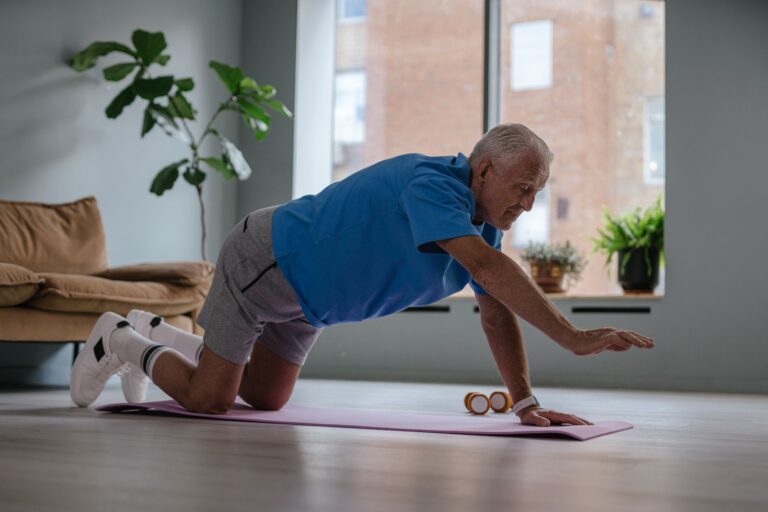
The bird dog combines the stability principle of dead bugs with a more functional position. From hands and knees, you extend one arm and the opposite leg simultaneously, creating a straight line from fingertips to heel. This movement integrates the deep stabilizers (transverse abdominis, multifidus) with the larger back extensors because you must prevent your trunk from rotating or sagging as your limbs extend. Unlike dead bugs, bird dogs also challenge rotational stability, which matters significantly for real-world activities like reaching across your body or turning to look over your shoulder.
Planks are the progression that turns static stability into full-body endurance. A standard plank—holding your body in a straight line from head to heels while supported by forearms and toes—recruits the entire anterior and posterior chain simultaneously. The value of planks goes beyond back strength; they build the capacity to maintain good posture under fatigue, which is why doctors particularly recommend them for people who spend long hours sitting or who have noticed their spinal alignment deteriorating. A specific example of their utility: someone who starts a plank routine often finds that their standing posture improves within a week because the back extensors and core develop enough endurance to hold proper alignment without conscious effort throughout the day.

Active Movement Patterns—Cat-Cow Stretches and Rows
Cat-cow stretches are the most dynamic movement in this set, involving spinal flexion and extension in a controlled rhythm. Starting on hands and knees, you alternate between dropping your belly and lifting your gaze (cow) and rounding your spine while tucking your chin (cat). This gentle oscillation between flexion and extension mobilizes the entire spine, warms up the muscles, and teaches your nervous system the available range of motion. Many doctors recommend cat-cow as a warm-up before the strength exercises rather than as a standalone strengthener, though the movement does engage stabilizers through the full range.
Rows—whether performed with resistance bands, dumbbells, or a cable machine—add a pulling component that engages the back muscles differently than the previous exercises. A dumbbell row involves bending slightly at the hip while standing, then pulling a weight toward your ribs while squeezing your shoulder blade back, which activates the latissimus dorsi and mid-back muscles. The tradeoff with rows is that they require some form of resistance to be effective, unlike dead bugs or bridges which use only bodyweight. For someone without access to equipment, resistance band rows (anchoring a band at chest height and pulling toward you) provide nearly identical stimulus and cost less than five dollars. However, if you have rotator cuff concerns or shoulder impingement, rows must be performed with lighter weight and stricter form than someone without shoulder history can use.
Avoiding Common Mistakes and Understanding Progression
The most frequent mistake people make with these exercises is performing them inconsistently or with poor form. Dead bugs with an arched back, bridges without glute activation, and planks that sag in the middle all fail to deliver the intended stimulus to deep stabilizers. A warning: if an exercise causes acute sharp pain—as opposed to muscle fatigue or a gentle stretch—stop immediately and consult a physical therapist, because pain often signals that your body is compensating in an unhealthy way rather than using the target muscles.
Progression typically means adding repetitions or duration before adding weight or complexity. Most doctors recommend starting with 2-3 sets of 8-12 repetitions for each exercise, performed 3-4 times per week, and progressing by adding 2-3 more repetitions every week or two. Once you can perform 2-3 sets of 20 repetitions with perfect form, adding external resistance (like a dumbbell on a bridge, or a heavier resistance band for rows) increases the demand. Rushing progression or skipping the form-focused phase is a common source of plateaus and injury because the nervous system hasn’t learned to recruit the deep stabilizers before you’re asking it to handle heavier loads.

Back Strength and Cognitive Function in Aging
The connection between back strength and brain health may seem indirect, but posture significantly affects blood flow to the brain and the overall neurological health of older adults. When the spine weakens and posture deteriorates, the forward head position that develops—sometimes called “tech neck” or age-related forward slouch—can compress blood vessels and reduce oxygen delivery to the brain.
Additionally, strong back muscles contribute to balance and proprioception (body awareness), which reduces fall risk; falls are a leading cause of head injury and cognitive decline in aging populations. For people concerned about dementia prevention or managing early cognitive decline, back strengthening exercises offer a dual benefit: they maintain postural alignment that supports cerebral circulation, and they engage the proprioceptive system through their focus on movement control and spatial awareness. Research in physical therapy shows that resistance training—including back strengthening—correlates with better cognitive outcomes in older adults, though the mechanism is still being studied.
Building a Sustainable Back Strengthening Routine
The ideal back strengthening routine is one you’ll actually maintain long-term, which usually means starting conservatively and building gradually rather than committing to an intense program that feels unsustainable. Most doctors recommend beginning with dead bugs and bridges 3 times per week, adding bird dogs and cat-cow stretches once those feel solid, and then incorporating planks and rows. This staggered approach prevents the overwhelm and soreness that can occur when someone jumps into all six exercises simultaneously.
Long-term back health depends more on consistency than intensity. Someone performing these six exercises for 15-20 minutes, three times weekly, will develop significantly more back strength than someone doing a one-time intense session monthly. As you age, maintaining back strength becomes increasingly important because muscle naturally atrophies without stimulus, and the structural support of your spine determines much of your quality of life—how you move, sit, stand, and avoid injury.
Conclusion
The six exercises doctors most frequently recommend for back strength—dead bugs, bridges, bird dogs, cat-cow stretches, planks, and rows—work together to build stability, endurance, and resilience in the muscles supporting your spine. Each exercise targets different aspects of spinal support, from deep stabilizers to large posterior chain muscles, and all can be performed with minimal equipment and low injury risk when done with proper form. Consistency matters far more than intensity or complexity; performing these exercises 3-4 times weekly with attention to movement quality will produce noticeable results within 2-3 weeks.
If you’re beginning a back strengthening routine, start with dead bugs and bridges, pay attention to form over speed, and progress gradually. If you have a history of back pain, spinal surgery, or neurological concerns, consult with a physical therapist or doctor before starting, as some modifications may improve safety and effectiveness for your specific situation. The payoff—improved posture, reduced back pain, better balance, and the spinal stability that supports overall health and independence—makes these exercises a practical investment in your long-term wellbeing.