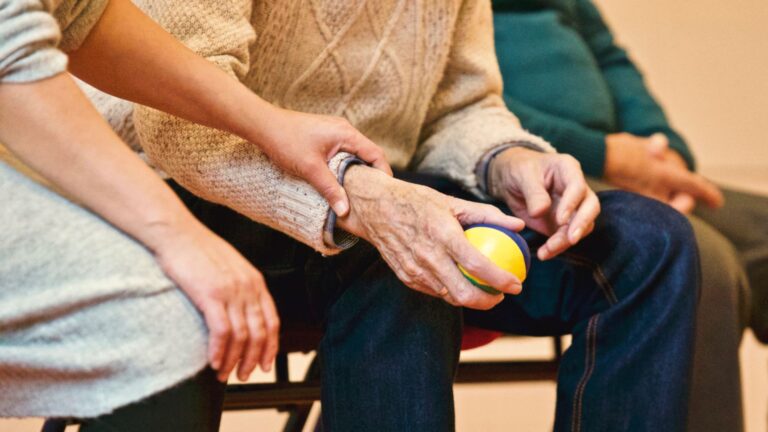
The vibrating items that reach the hands in advanced dementia are general-purpose vibrating cushions and pillows — small battery or mains-powered pads sold through sensory suppliers such as specialneedstoys.com — held or rested under the palms. The dementia-specific hand products on the market are the non-vibrating kind: Relish's Tactile Turn is a weighted fidget pillow with two contrasting textures, built for restless hands rather than for buzzing.
That split matters for anyone choosing one. The strongest evidence for calming hands in late-stage dementia is not about devices at all — it is about hand massage, delivered by a person. Vibration research exists, but it has been done almost entirely in chairs and platforms, so a hand-held vibrating toy is an extension of that work rather than a tested product.
Medical information disclaimer: This article is for general educational purposes only and does not provide medical advice, diagnosis, or treatment. Always consult a physician or other qualified health professional about symptoms, medications, tests, or treatment decisions.
Table of Contents
- What the hand-massage evidence actually shows
- Where vibration has and has not been tested
- What guidelines and care organisations recommend instead
- The battery risk that rules out many cheap options
- Trying it without guessing
- Frequently Asked Questions
What the hand-massage evidence actually shows
Hand massage is the best-supported way to settle agitated hands. A 2017 meta-analysis in the Journal of Advanced Nursing by Wu and colleagues concluded that massage and touch improve agitation in dementia in the short term, and singled out hand, head and foot massage as the sites that reduce it — the hand being the one still reachable when someone is bed-bound or non-verbal. A larger 2025 meta-analysis in the Journal of Clinical Nursing pooled 17 randomised trials covering 980 patients and found massage and touch eased agitation and behaviour problems.
That is a substantial step up from where the field sat in 2006, when a Cochrane review found only two small studies with 110 participants between them and judged the evidence insufficient to draw conclusions, while noting no severe side effects. "Short term" is the honest limit. These trials measure calm during and shortly after a session, not weeks later. Treat a hand massage as something that works now, repeated as often as it helps.
Where vibration has and has not been tested
The vibration literature in dementia covers two different things. A 2022 Frontiers in Psychology scoping review by Campbell and colleagues examined both low-frequency sound vibration, known as vibroacoustic therapy, and mechanical vibration such as whole-body platforms, and concluded that higher-quality research is needed. Its September 2022 corrigendum revised the section on how participants responded and notes an included study where 40-Hz sound vibration improved cognition across mild, moderate and severe Alzheimer's.
The same document records that few studies asked the person what the vibration felt like — a real gap when the whole point of a hand-held toy is the sensation. Delivery is the second gap. A 2022 study of deep micro-vibrotactile stimulation in 35 residents across three nursing homes reported better cognitive scores after a month, but it was single-arm with no control group and used fixed equipment. Nothing in that body of work tests a toy in a palm.
What guidelines and care organisations recommend instead
NICE guideline NG97 does not back multisensory stimulation as a stand-alone treatment for agitation. Recommendation 1.7.9 of the 2018 guideline offers personalised activities to promote engagement, pleasure and interest; multisensory stimulation appears separately, as something to consider training staff to provide for people with moderate to severe dementia and communication difficulties.
The Alzheimer's Association takes the same practical line for late-stage care. Its late-stage care tip sheet names touch as a powerful connector and lists holding the person's hand and giving a gentle hand, leg or foot massage among the ways to communicate through sights, sounds, smells and touch. Read together, the guidance points at the person doing the touching, with the device as optional support — not the reverse.
The battery risk that rules out many cheap options
Most small vibrating novelties run on button or coin cells, and that is a serious hazard where a resident mouths objects. The US Consumer Product Safety Commission explains that Reese's Law and its implementing standards set performance and warning-label requirements for such products because a swallowed cell can cause internal chemical burns, serious injury or death. Enforcement is live.
The CPSC recalled Anzmtosn Luminous Fidget Spinner Balls, sold on Amazon, because the button cells in the included mini flashlight were too easily accessible. A fidget marketed to children can fail the same standard that protects an adult who puts things in their mouth. Before handing over any vibrating item:.
- Check the battery type. Prefer AA/AAA or a sealed mains-powered unit over coin cells.
- Open the compartment yourself. If it opens without a tool or a screw, do not use it.
- Pull on seams, buttons and the motor housing to see what detaches.
- Choose a washable cover, since hand-held items pick up food and saliva.
- Stay in the room while it is in use rather than leaving it in a chair.
Trying it without guessing
Start with the hands themselves. A few minutes of slow, gentle hand massage costs nothing, matches what the trials measured, and tells you quickly whether touch to the hands is welcome or resisted on a given day. If you add vibration, treat it as one trial at a time.
Hold a vibrating cushion against the palms on its lowest setting for a short spell and watch the face, breathing and whether the hands stay open or pull away. Because the published work rarely captured subjective experience, the person's own reaction is the only reading you have. Stop if the response is withdrawal, a flinch, or rising distress rather than settling, and go back to plain hand-holding. Keep in mind that the dementia-specific hand products — the textured, weighted fidgets — carry no published trial either, so neither path is evidence-led in the way hand massage is.
Frequently Asked Questions
Is a vibrating pillow safer than a vibrating fidget toy?
Usually, because sensory-supplier cushions tend to use larger cells or mains power rather than the coin cells behind CPSC's button-battery warnings. Still open the compartment and check.
Does the 40-Hz finding mean a hand toy will help cognition?
No. That result came from sound vibration stimulation in a study setting, not from a hand-held device, and the review containing it called for higher-quality research.
How often can hand massage be repeated?
The trials measured short-term calming, so there is no fixed schedule. Caregivers commonly use it at known flashpoints, such as before personal care or in the late afternoon.