Jigsaw puzzles almost certainly exercise the aging brain, but the only randomized trial built to test whether they slow cognitive decline found no measurable transfer. People who puzzle more do score better on visuospatial tests, yet 30 days of assigned puzzling made participants better at puzzles without making them better at anything else. That gap — strong association, weak proof of cause — is the whole story here, and it matters for families deciding how to spend limited time and attention. The evidence does support puzzle-type activity as part of an engaged life, and it points to other measures with far stronger effects on dementia risk.
Medical information disclaimer: This article is for general educational purposes only and does not provide medical advice, diagnosis, or treatment. Always consult a physician or other qualified health professional about symptoms, medications, tests, or treatment decisions.
Table of Contents
- What the only randomized trial actually found
- Why lifelong puzzlers still score better
- The mechanism argument, and its ceiling
- Crosswords beat brain games — what that changes
- Where puzzles sit next to interventions that are proven
- Choosing puzzles sensibly anyway
- Frequently Asked Questions
What the only randomized trial actually found
The PACE trial, led by Patrick Fissler and colleagues, assigned 100 cognitively healthy adults aged 50 and older to either 30 days of home jigsaw puzzling plus health counseling, or counseling alone. The puzzling group got better at puzzles. On global visuospatial cognition — the ability to perceive, rotate and assemble objects in space — they did not improve relative to the control group, according to the trial report in Frontiers in Aging Neuroscience. The outcomes were decided in advance, not chosen afterward.
The study was registered as NCT02667314, "The Effect of Solving Jigsaw Puzzles on Visuospatial Cognition in Older Adults," on ClinicalTrials.gov, with a separately published protocol. That makes the null result harder to dismiss as a reporting artifact. One month is a short dose, and the participants started out cognitively healthy, which leaves less room to show gains. Those are real limits on what the trial can rule out. But it is the direct test of the question, and it came back negative.
Why lifelong puzzlers still score better
The same paper also looked at participants at a single point in time, and there the picture flips. Puzzle skill tracked global visuospatial cognition at a correlation of 0.80 — close to the ceiling for this kind of measure. More lifetime jigsaw experience was also linked to better visuospatial cognition after statistical adjustment.
The authors described jigsaw experience as "a – not necessarily causal – protective factor for visuospatial cognitive aging." That hedge is doing real work. People with sharper spatial reasoning find puzzles rewarding and do more of them, so decades of accumulated puzzling may be a marker of preserved ability rather than its cause. The two findings are not in conflict. A cross-sectional link describes who puzzles; a trial tests what puzzling does.
The mechanism argument, and its ceiling
Jigsaw puzzling is not a narrow task. Fissler's team broke it down and found it draws on visual perception, constructional praxis (assembling parts into a whole), mental rotation, cognitive speed and visual scanning, cognitive flexibility, perceptual reasoning, and working memory — all at once. That breadth is the best reason to expect a benefit. It is not evidence of one.
Many activities recruit multiple abilities without producing gains that show up outside the activity itself. Cognitive training generally runs into this wall. In the ACTIVE trial, the largest randomized training study in healthy older adults, only the speed-of-processing arm was associated with lower dementia odds a decade later; NIA's Jonathan King has noted that training gains are typically "incredibly specific" to the trained skill, as summarized in reporting on brain games and dementia. Fissler measured exactly that specificity for puzzling: skill improved, transfer did not.
Crosswords beat brain games — what that changes
The strongest trial result for any puzzle-type activity involves crosswords, not jigsaws. Devanand and colleagues randomized 107 adults with mild cognitive impairment, mean age about 71, to 12 weeks of computerized crossword training or computerized cognitive games, with booster sessions out to 78 weeks. Crosswords won on the primary cognitive outcome (ADAS-Cog) at both 12 and 78 weeks, won on daily function at 78 weeks, and showed less brain volume loss on MRI, per Columbia's report on the trial. Read the design before reading the result as proof.
There was no inactive control group, so the trial shows one activity outperforming another, not either one slowing decline compared with doing nothing. The investigators called for replication in a larger controlled trial, as Duke's School of Medicine noted. A broader Texas A&M analysis of older adults, including people with mild cognitive impairment, found higher engagement in word games, puzzles and reading was associated with better memory and processing speed. It did not isolate jigsaw puzzles, and the researchers were explicit that whether such activities prevent decline remains largely unknown.
Where puzzles sit next to interventions that are proven
The 2024 Lancet Commission on dementia concluded that addressing 14 modifiable risk factors could prevent or delay roughly 45% of dementia cases, and it recommends staying cognitively active in midlife. Notably, cognitive inactivity is not one of the 14 factors.
Hearing loss, untreated vision impairment, high blood pressure, high LDL cholesterol and physical inactivity are. That ordering is the practical takeaway. A reader choosing where to put effort should treat puzzles as a good use of leisure time and the Lancet list as the intervention plan.
- Get hearing checked and use hearing aids if prescribed — hearing loss is on the Commission's list; puzzles are not.
- Have vision corrected, including cataract treatment.
- Treat blood pressure and LDL cholesterol to target.
- Keep moving; physical activity has far better trial support than puzzling.
- Then puzzle, because it is engaging and social — not as a substitute for the above.
Choosing puzzles sensibly anyway
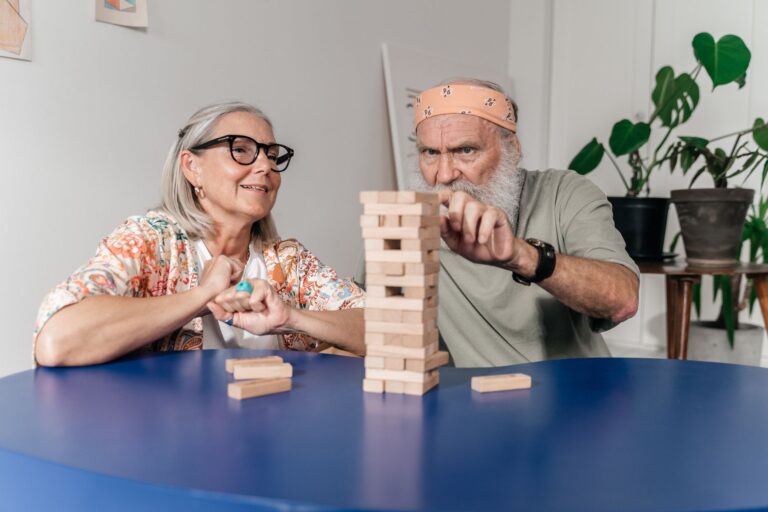
Nothing in the evidence argues against jigsaw puzzles. They are low-cost, low-risk, and the kind of absorbing activity people stick with, which is what the crossword trial's engaging-and-familiar design seemed to reward. If a person with mild cognitive impairment enjoys them, that enjoyment is a reason to continue.
Set expectations honestly with family members. Expect better puzzling and a pleasant shared hour; do not promise preserved memory, and do not drop a hearing-aid appointment or a blood pressure medication because the puzzling is going well. Match difficulty to ability so the activity stays rewarding rather than demoralizing — large-piece puzzles, familiar images, a partner who can help without taking over. If someone has stopped being able to do a puzzle they previously managed easily, that change is worth mentioning to their clinician as an observation, not self-diagnosed from a puzzle box.
Frequently Asked Questions
Are crossword puzzles better than jigsaw puzzles for the brain?
Crosswords have the stronger trial evidence in people with mild cognitive impairment, beating computerized brain games on cognition, daily function and brain volume loss at 78 weeks. But that trial had no do-nothing comparison group, so it ranks two activities against each other rather than proving either slows decline.
Do commercial brain-training apps work better?
In the crossword trial, computerized cognitive games lost to crosswords. In ACTIVE, only speed-of-processing training was linked to lower dementia odds 10 years on, and training benefits tend to stay confined to the trained skill.
My mother has puzzled for 40 years and is sharp at 80. Isn't that proof?
It is consistent with the association researchers measured, but it cannot separate cause from selection. People with strong spatial reasoning tend to enjoy and keep doing puzzles, so lifelong puzzling may reflect preserved ability as much as it builds it.