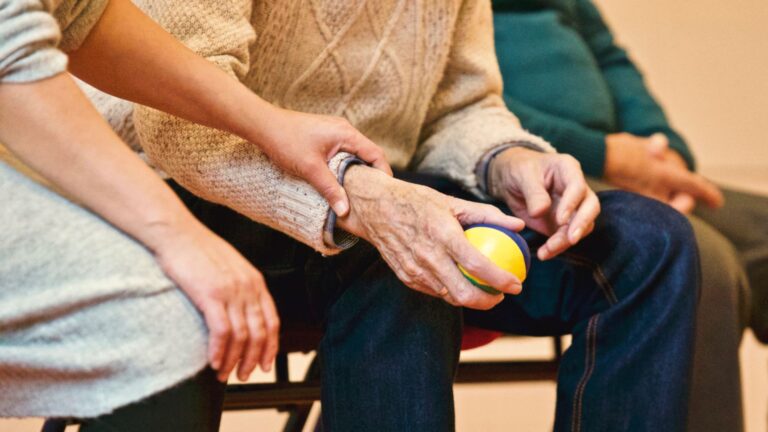
Caregivers in memory care introduce a new toy by offering it rather than giving it, leaving it within reach and waiting for the resident to pick it up on their own. The item stays only if the resident shows interest; if they ignore it or push it away, staff remove it quietly and try something different later. That sequence — screen first, offer without pressure, then let the resident keep the item — is what the research on doll therapy and rummage objects actually tests. "Doll therapy" is the practice of giving a person with dementia a lifelike baby doll or soft toy animal to hold and care for, and it is the best-studied version of this question.
Medical information disclaimer: This article is for general educational purposes only and does not provide medical advice, diagnosis, or treatment. Always consult a physician or other qualified health professional about symptoms, medications, tests, or treatment decisions.
Table of Contents
- The resident decides, not the care plan
- How the offer is made
- Once it is theirs, it is theirs
- What the evidence does not promise
- Training and family conversations come first
- Objects other than dolls
- Frequently Asked Questions
The resident decides, not the care plan
The strongest trial on this screened residents before anything else happened. In a randomized study of 52 Italian nursing-home residents published in BMC Geriatrics by Santagata, Massaia and D'Amelio, only residents who first responded positively to a doll were randomized at all. Among those residents, doll therapy beat standard treatment on agitation and aggressiveness at 45 and 90 days, and also reduced dysphoria, wandering and apathy.
That design detail is the practical lesson. The measured benefit belongs to residents who already showed interest, so a unit that hands dolls to everyone is not reproducing the study — it is doing something the study deliberately excluded. Screening is also quick. Staff place the item nearby during an ordinary quiet moment and watch for whether the resident looks at it, reaches for it, speaks to it, or turns away.
How the offer is made
The technique taught to staff is specific: do not force the person to hold the item, and wait for them to acknowledge it themselves. Guidance adapted from Alzheimer's Australia and published by DementiaHub.SG, run by Singapore's Agency for Integrated Care, states that rule plainly. Choice and pacing matter alongside it.
A Dementia UK leaflet advises offering a choice of different dolls or soft toy animals, introducing them gradually, and avoiding noisy toys — and notes that some people simply do not find dolls or soft toys engaging. It also places the clearest benefit in middle-to-later-stage dementia. A workable introduction looks like this:.
- Pick a calm time of day, not during a transition or personal care.
- Set two or three options within easy reach and say nothing about what they are.
- Let the resident look, touch, or ignore them without prompting.
- Follow their language for the item rather than correcting it.
- Note what happened in the record so the next shift does not restart from zero.
Once it is theirs, it is theirs
After a resident accepts an item, removing it becomes the main risk. Doll therapy guidance from the Southern Health and Social Care Trust in Northern Ireland states that the doll should never be taken away without the permission of the person with dementia, because doing so can cause distress.
This is also why memory care units assign items individually instead of keeping a shared basket. A researcher at NeuRA and UNSW, quoted by UNSW Sydney in November 2024, notes that some residents become upset when other people handle their doll — while also acknowledging the practice is contested as infantilising. Practically, that means laundering, repairs and relocations need planning around the resident rather than around the housekeeping schedule.
What the evidence does not promise
The results are not uniform. A randomized trial of 35 residents across five long-term care facilities in Queensland, Australia, reported in Aging & Mental Health in 2018, found a lifelike baby doll did not significantly reduce anxiety, agitation or aggression compared with usual care at week 3, its primary outcome, or at week 1. Only "pleasure" showed a significant group-by-time effect.
Other work suggests the object itself carries weight. A single-blind randomized trial of 134 women with moderate-to-severe dementia, published in the Journal of Clinical Medicine in October 2022, compared a doll against a sham cube over 30 sessions. Residents showed significantly more interest and caregiving behaviour toward the doll and a significant drop in total Neuropsychiatric Inventory-NH scores, though stress biomarkers did not differ between groups. Read together: expect improved engagement and mood for residents who take to the item, and treat agitation reduction as likely but not guaranteed.
Training and family conversations come first
Education precedes the first introduction. The doll therapy guidelines from DementiAbility Enterprises, written by Gail Elliot and Anne Kelly in 2015, call staff and family education "critically important" and require it before a program starts.
A 2026 mixed-methods cluster-randomized pilot of staff-mediated doll therapy in Chinese residential dementia care, published in Frontiers in Public Health, named the conditions for ethical delivery: training, non-deceptive introduction, active monitoring of dissent, family communication, and clear operational responsibility. Acceptability turned on two things — whether participation is genuinely optional, and whether staff can adapt or stop promptly. Families often object before residents do, which is why the conversation happens in advance rather than after a relative finds a doll in their mother's room.
Objects other than dolls
The same offer-and-wait rule applies to memory or rummage boxes — collections of familiar objects a resident can sort through. The Alzheimer Society of Canada suggests building one, noting that physically handling objects may trigger memories more effectively than looking at pictures.
The same source carries the warning that belongs with it: handling objects can uncover painful memories as well as happy ones. Staff introducing a box should stay in the room for the first few sessions and be ready to close it and move on.
Frequently Asked Questions
What if a resident ignores the item completely?
Remove it without comment and try a different object another day. The Dementia UK leaflet notes some people never find dolls or soft toys engaging, and that is a normal outcome rather than a failed attempt.
Should staff correct a resident who treats a doll as a real baby?
The Frontiers in Public Health pilot frames the requirement as non-deceptive introduction — staff do not claim the doll is real, but they also do not argue. Following the resident's own language keeps the interaction calm.
At what stage of dementia does this usually fit?
Dementia UK places the greatest benefit in middle-to-later-stage dementia.