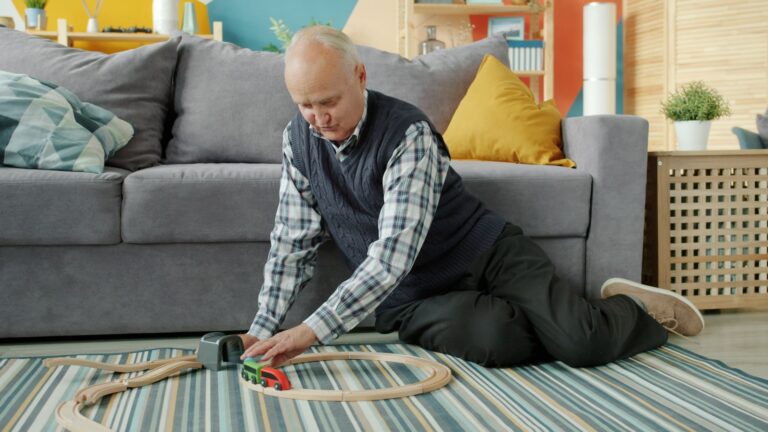
Check age guidance, choking-hazard warnings, ASTM F963 compliance, and permanent tracking marks. These child-toy labels help caregivers screen out choking, chemical, and recalled products before choosing play items for cognitive decline. Cognitive decline means steady loss of memory, thinking, and daily function from conditions such as dementia. Labels rate child safety only, so use them for hazard screening and then match size, simplicity, and supervision to the adult.
Medical information disclaimer: This article is for general educational purposes only and does not provide medical advice, diagnosis, or treatment. Always consult a physician or other qualified health professional about symptoms, medications, tests, or treatment decisions.
Table of Contents
- What does the age label tell you?
- Where do you find choking and swallowing warnings?
- What do safety seals and tracking marks mean?
- How do you match play to the person's stage?
- What quick check works in the aisle?
What does the age label tell you?
The American Academy of Pediatrics advises caregivers to read the label for safe age and use (how to buy safe toys). It also advises choosing toys and parts larger than the mouth. For an adult with memory loss, treat age guidance as a size and complexity clue.
Do not pick a toy rated under 3 if the person mouths objects. Pick large-piece puzzles, chunky dominoes, or soft sorting shapes instead. Larger parts lower choking risk and are easier to grip.
Where do you find choking and swallowing warnings?
Federal rule 16 CFR Part 1501 bans toys for children under 3 that pose small-parts hazards, according to the U.S. eCFR. It uses a test cylinder to flag parts that fit entirely inside.
HelpDementia.com, citing CPSC toy safety tips, notes toys for ages 3 to under 6 with risky small parts must carry a choking-hazard warning. It warns pieces that fit entirely in the test cylinder pose fatal choking risk. TDmonthly's checklist citing the CPSC Toy Report 2024 estimated 267,100 toy-related emergency-department injuries in 2024 (holiday toy safety checklist). Head and face were most injured, with small parts, magnets, button batteries, and water beads as priority label hazards.
- Choose toys and parts larger than the mouth.
- Avoid small detachable parts, magnets, button batteries, and water beads.
- Pick rounded edges and sturdy, non-toxic materials.
What do safety seals and tracking marks mean?
Spilma's guide following CPSIA texts notes every toy sold in the U.S. must meet ASTM F963-23 (CPSIA toy safety guide). The rule became mandatory under 16 CFR 1250.2(a) on April 20, 2024, with third-party testing and a Children's Product Certificate. Spilma's summary of 15 U.S.C.
2063(a)(5) notes children's toys must bear permanent tracking marks. The marks name the maker, production place and date, plus batch or run information to enable recalls. Look for the ASTM mark, age grade, warnings, and tracking code on the package before purchase. Keep the package or a photo of the codes for recall checks.
How do you match play to the person's stage?
HelpDementia.com, citing a dementia-games guide, recommends simple familiar activities with large, high-contrast, easy-to-handle pieces. It favors rounded edges and sturdy non-toxic materials and avoiding small detachable parts. Alzheimer's Los Angeles notes people in late-stage dementia connect mainly through the senses.
They may enjoy touch such as stroking pets or fabrics with different textures. Choose adult-respectful themes, not childish characters. Offer close supervision when mouthing, poor grip, or swallowing problems appear.
What quick check works in the aisle?
Use this 30-second screen before you buy. It applies child-label facts to adult needs.
HelpDementia.com adds a key limit: child labels certify child safety, not dementia suitability. Match simplicity, supervision, mouthing risk, and dignity to current abilities.
- Read age grade and use, and pick parts larger than the mouth.
- Reject choking warnings and small detachable parts.
- Pick large, high-contrast, easy-grip pieces with rounded edges.
- Keep tracking marks for recall checks.