Kitchen safety becomes one of the most pressing concerns after a dementia diagnosis because the kitchen contains some of the most dangerous equipment and substances a person encounters daily. A person with dementia may forget that the stove is on, leave a pan unattended, or mishandle sharp objects—each scenario capable of causing serious burns, fires, or cuts.
One woman left her gas stove on for an entire afternoon while her caregiver was out of the room; the thermostat never triggered an alarm, and the caregiver returned to find the kitchen dangerously hot and the woman confused about why things felt warm. As dementia progresses, even someone who has cooked safely for decades may lose the ability to sequence tasks, remember safety rules, or respond appropriately to emergencies. The kitchen is not just a place where meals happen—it’s where many injuries actually occur, and unlike some other home hazards, kitchen dangers escalate quickly.
Table of Contents
- How Does Dementia Change Kitchen Safety and Cooking Ability?
- What Are the Most Serious Kitchen Hazards for People with Dementia?
- Why Does Medication Safety in the Kitchen Matter?
- What Physical Changes in the Kitchen Actually Prevent Injuries?
- When Should a Caregiver Stop Allowing Kitchen Access?
- What Should You Do with Food in the Kitchen?
- How Do You Balance Independence with Safety Requirements?
How Does Dementia Change Kitchen Safety and Cooking Ability?
dementia disrupts the specific skills required for safe kitchen work. Memory loss affects the ability to recall whether you’ve already turned off the burner. Judgment changes mean a person might not recognize that a temperature is dangerously hot or that something is burning. Executive function decline—the ability to plan, sequence steps, and problem-solve—means even simple tasks like making toast can become hazardous when each step must be consciously thought through and the overall plan is forgotten. In the early stages, a person might make a cup of tea without incident but then forget why the electric kettle is still plugged in.
In middle stages, they may not recognize the smell of smoke as a warning sign. By later stages, cooking becomes actively dangerous because the person cannot safely handle heat, sharp objects, or appliance controls at all. The progression is not uniform—someone might retain the ability to open a refrigerator far into their illness but lose the ability to use a microwave safely much earlier. A comparison: a person without dementia can cook while distracted by a phone call because they have automatic recall of stove safety. Someone with dementia may lack that automatic recall entirely and require supervision because the knowledge has degraded, not just their attention.
What Are the Most Serious Kitchen Hazards for People with Dementia?
Stoves and cooktops represent the single largest fire risk. A person may turn on the burner and forget, place an inappropriate item on the stove, or leave a flammable object too close to heat. Microwave injuries also occur—someone might microwave a can, metal-trimmed plate, or a sealed container, all of which can spark or explode. Knives, graters, and food processors pose cutting hazards because grip and coordination decline, and the person may not stop using these tools when they become unsafe. Refrigerator hazards are often overlooked.
Someone with dementia might not recognize spoiled food and eat it, leading to foodborne illness. They may also hoard food or leave the refrigerator door open, creating both food waste and temperature-unsafe conditions. Gas appliances carry an additional risk: a person may smell gas but not understand the danger or know how to respond. Chemical hazards are a serious limitation of typical kitchens. Cleaning products, medications, and pesticides stored under the sink or in low cabinets can be confused with food, particularly if packaging is removed or labels are not read carefully. There is also the risk of ingesting dish soap, dishwasher tablets, or other toxic substances.
Why Does Medication Safety in the Kitchen Matter?
Many people keep medication in or near the kitchen—in a drawer, on the counter, or above the sink. With dementia, the risk of taking the wrong medication, taking a dose twice, or taking multiple medications at once increases significantly. Someone might forget that they already took their morning pills and take them again at lunch. Or they might see a medication and believe they need it immediately, without checking when they last took it.
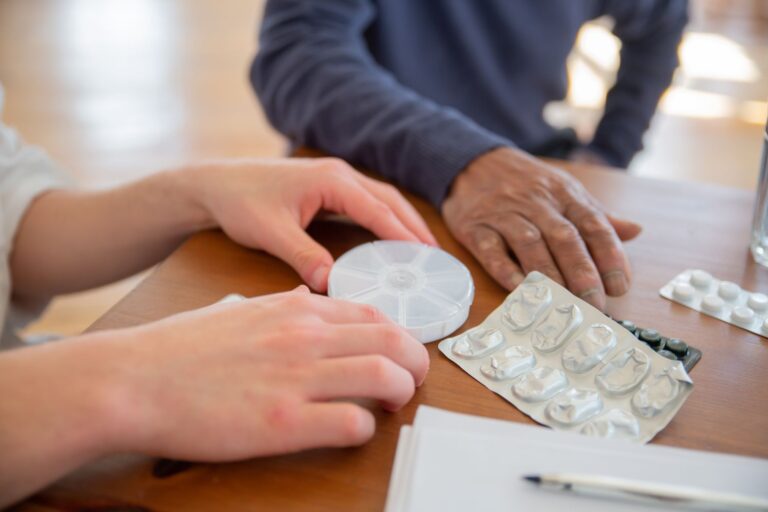
Prescription bottles often look similar, and without consistent cognitive function, the person cannot reliably distinguish between heart medication and blood pressure medication. Some people put all their pills in a single container to simplify storage, which removes the identifying label—a particularly high-risk practice once dementia is present. One daughter discovered her mother had been taking her arthritis medication instead of her blood pressure medication for a week because the pills were mixed in a bowl on the counter. The limitation here is that relying on the person with dementia to self-manage medications in the kitchen is not safe once cognitive decline reaches a certain point. Pill organizers, reminder alarms, and caregiver oversight become essential rather than optional.
What Physical Changes in the Kitchen Actually Prevent Injuries?
Removing stovetop controls entirely is more effective than installing burner covers. Covers can be removed or manipulated by someone with dementia, whereas removing access to the controls themselves eliminates the risk entirely. Similarly, locking the oven door or disconnecting the oven electrically prevents its use more reliably than warning labels do. Installing automatic shut-off features on kettles and coffee makers eliminates the risk that a person will forget the appliance is on.
A comparison: a warning sign on a microwave might be read by someone without dementia but will likely be ignored or forgotten by someone with dementia. An automatic shut-off removes the decision entirely. Removing or securing knives, graters, and sharp tools prevents their use entirely. While this reduces the person’s independence slightly, it prevents injuries far more effectively than reminders or supervision (which cannot be constant). Keeping the kitchen uncluttered also matters—fewer objects mean fewer hazards and less confusion about what is food and what is not.
When Should a Caregiver Stop Allowing Kitchen Access?
There is no universal timeline. Some people with early dementia can safely prepare simple meals with supervision. Others cannot. The decision depends on the severity of memory loss, judgment changes, and the specific person’s history with kitchen safety. A person who has never been a careful cook is higher-risk than someone with decades of safety-conscious kitchen experience—though even skilled cooks become unsafe eventually.
Warning signs include: forgetting the stove is on; attempting to use appliances in dangerous ways (microwave with metal, for example); eating spoiled food; leaving the stove on multiple times in one week; or confusion about which appliances are which. If supervision is required more than once a month, or if supervision itself is becoming unreliable because you cannot watch every moment, it is time to restrict kitchen access more severely. A limitation of supervision-based approaches is that no caregiver can watch constantly. Leaving someone alone in the kitchen for even five minutes to answer the phone or use the bathroom creates a window for injury. For many families, this means transitioning to no unsupervised kitchen access earlier than the person’s actual cognitive decline might suggest is necessary—it is a tradeoff between independence and safety that favors safety.
What Should You Do with Food in the Kitchen?
Food storage requires attention. Remove clearly labeled medications from where food is stored. Use clear containers for leftovers with dates written on tape, so the person can see at a glance how old food is.
Do not rely on the person with dementia to read dates or assess freshness. Simplified meal options—pre-made foods, labeled portions, easy-to-eat items—reduce the need for complex food preparation. Some families prepare frozen meals in individual portions so the person can retrieve a single item rather than assembling ingredients. One family set up a dedicated drawer with only safe, ready-to-eat snacks, allowing the person to open the refrigerator without accessing raw ingredients or hazardous items.
How Do You Balance Independence with Safety Requirements?
Dementia care involves unavoidable tradeoffs. Removing the stove’s ability to function removes some independence but prevents fires. Locking medication storage removes the option to access medication independently but prevents overdose.
The goal is to preserve dignity and choice in areas where it is safe to do so while restricting access in areas where dementia creates significant risk. Some people will resist these restrictions, which adds emotional and practical complexity to caregiving. Framing safety modifications as “the appliance is broken” rather than “you can’t use this” sometimes reduces conflict, though this approach works differently for different people. The concrete reality is that kitchen safety modifications often cannot be fully preserved without restricting access—and that restriction, though difficult, prevents injury far more reliably than any other approach.
- —