Families may save birthday cards from before dementia progressed because the cards preserve a loved one's words, handwriting, humor, and way of relating before communication became harder. Each card can become a tangible connection to the person and a shared moment that illness cannot recreate.
The National Institute on Aging defines dementia as cognitive loss severe enough to disrupt daily life; symptoms can affect memory, speech, understanding, reading, and writing in its overview of dementia. Still, no study shows that families generally save early cards for this specific reason. The meaning is plausible and deeply personal, not universal.
Medical information disclaimer: This article is for general educational purposes only and does not provide medical advice, diagnosis, or treatment. Always consult a physician or other qualified health professional about symptoms, medications, tests, or treatment decisions.
Table of Contents
- What an earlier card can preserve
- Why the card may matter to relatives
- What handwriting can—and cannot—show
- How to share a card without turning it into a test
- How to preserve the card and its context
What an earlier card can preserve
A card captures exact details that memory may blur: a nickname, familiar joke, affectionate phrase, or distinctive sign-off. Its date also places those words within a specific relationship and moment. Autobiographical memory means memory of one's own past.
It supports identity, intimacy, and empathy, but is commonly affected in Alzheimer's and frontotemporal dementias, according to a peer-reviewed study of autobiographical memory. A dated message can therefore serve as an external record of family history when personal recollection becomes less reliable. That does not mean the card restores a lost memory. Its value may instead come from preserving what the person chose to communicate at that time.
Why the card may matter to relatives
For the recipient, the card may represent more than the words on the page. It can bring back the birthday, the relationship, or an ordinary family ritual that continued for years. For a caregiver or relative, the message may also protect a fuller image of the person.
Dementia-related changes can dominate daily life, while an earlier card reflects a relationship that extends beyond illness and care tasks. The emotional response may change over time. One person may find comfort in the handwriting, while another feels grief or unease. Relatives do not have to display, circulate, or read the card before they are ready.
What handwriting can—and cannot—show
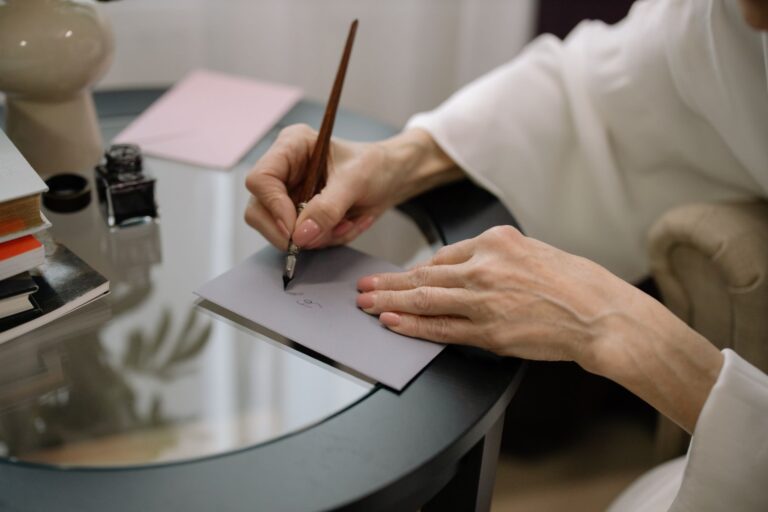
handwriting may change with Alzheimer's disease, but a single card cannot establish when dementia began or how far it had progressed. A 2023 review of 91 articles found changes across movement, spatial organization, and language, especially in written text. Results were mixed, and signatures tended to remain more preserved in the handwriting research review.
Avoid treating spelling, spacing, word choice, or signature changes as a diagnosis. Comparing cards may reveal a difference, but it cannot explain that difference or prove a disease stage. Cards are keepsakes and relationship records, not cognitive tests or treatments. Concerns about cognitive decline require clinical evaluation rather than conclusions drawn from handwriting samples.
How to share a card without turning it into a test
A card can support connection if the person enjoys seeing it. It should not become a quiz about who sent it, what year it was, or whether the person remembers the birthday. Communication abilities vary by person and stage.
Some people in the early stage can still have meaningful conversations, while others may struggle to find words or organize thoughts. The National Institute on Aging offers additional guidance for communicating with someone who has Alzheimer's. Helpful approaches include:.
- Introduce the card simply: "I found this birthday card you wrote."
- Ask whether the person wants to hold it, hear it read, or put it away.
- Respond to the emotion the card brings up instead of correcting uncertain details.
- Stop if the person asks to stop or appears distressed.
- Use a copy when the original is fragile or especially important.
How to preserve the card and its context
First decide whether the original should remain private, stay with its recipient, or be shared among relatives. Respect the wishes of the writer and recipient whenever those wishes are known. Then create a simple record: Keep later explanations separate from the card itself so future readers can distinguish the writer's original words from the family's memories and interpretations.
- Photograph or scan the front, inside, back, and envelope.
- Include the date, sender, recipient, and occasion in the filename.
- Store the original flat in a clean, dry place.
- Record relevant family context in a separate note.
- Mark uncertain details as uncertain instead of guessing.