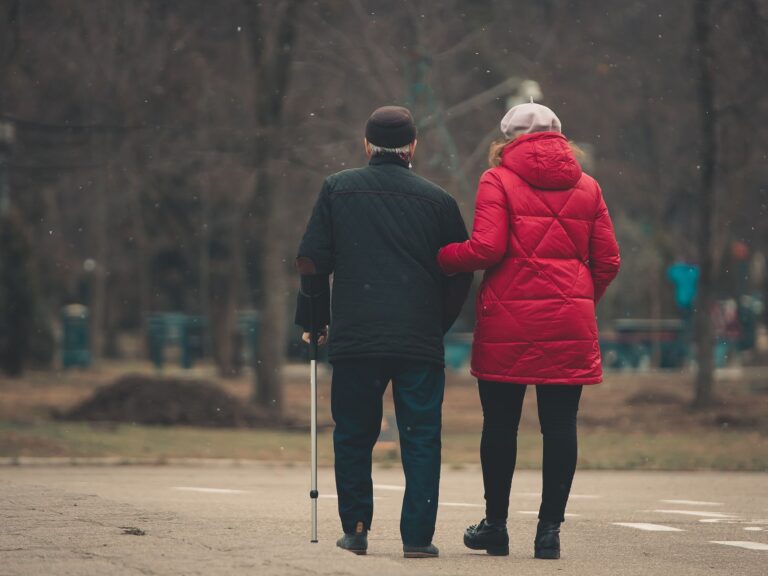
People with dementia forget how to walk because the disease eventually damages the parts of the brain that plan, sequence, and coordinate movement, not just the areas that store memories. Walking feels automatic, but it is actually a complex motor task that depends on the brain sending clear, timed signals to the legs, trunk, and feet while simultaneously judging balance, distance, and the position of the body in space. As dementia progresses, the connections that carry these signals break down, and the smooth, unconscious act of putting one foot in front of the other becomes hesitant, effortful, and finally impossible. The person has not forgotten walking the way they forget a name; their brain has lost the physical machinery that produces the movement. This decline usually appears late in the disease, though subtle changes often start much earlier.
A daughter caring for her father with Alzheimer’s might notice that he stands in a doorway and shuffles his feet without moving forward, as if his legs and his intention have come unhooked from each other. He is not being stubborn or lazy. The signal to step is getting lost somewhere between the decision and the muscle. In later stages, some people lose the ability to stand or bear weight at all, which is why walking difficulty is considered a marker of advancing disease rather than a temporary problem. Understanding why this happens helps families respond with patience instead of frustration, and it helps them plan for safety before a serious fall occurs. The loss of mobility is one of the most emotionally difficult stages of dementia, but knowing its biological roots can make the changes feel less like a personal failing and more like what they truly are: a symptom of brain disease.
Medical information disclaimer: This article is for general educational purposes only and does not provide medical advice, diagnosis, or treatment. Always consult a physician or other qualified health professional about symptoms, medications, tests, or treatment decisions.
Table of Contents
- What Happens in the Brain That Makes Someone With Dementia Forget How to Walk?
- How Motor Planning and Apraxia Cause the Loss of Walking Ability
- How Balance, Perception, and Fear Contribute to Walking Difficulty
- What Caregivers Can Do to Support Safe Movement
- What Warning Signs Signal a Serious Decline in Mobility
- How the Loss of Walking Connects to the Stages of Dementia
- How Physical Therapy and Assistive Devices Fit Into Care
- Frequently Asked Questions
What Happens in the Brain That Makes Someone With Dementia Forget How to Walk?
walking is controlled by several brain regions working in concert. The frontal lobes plan and initiate movement, the cerebellum fine-tunes balance and coordination, and the basal ganglia help make movement smooth and automatic. Deep white-matter pathways carry the electrical signals between these regions and down to the spinal cord. Dementia damages this network in different ways depending on the type of disease, but the result is similar: the choreography of walking falls apart. When the frontal lobes are affected, a person may struggle to start moving, a problem clinicians call gait initiation failure or “freezing.” Different dementias attack different parts of this system, which is why walking problems look different from one person to the next.
Vascular dementia, caused by strokes or damaged small blood vessels, often produces walking problems early because it frequently injures the white-matter tracts that carry movement signals. By contrast, Alzheimer’s disease typically affects memory first and gait later, once the damage spreads to motor-planning areas. Lewy body dementia and Parkinson’s disease dementia often cause stiffness, shuffling, and a stooped posture from the start because they directly damage the basal ganglia and its dopamine system. Consider two people in a memory care unit. One has Alzheimer’s and walks fluidly at first but gets lost and confused; the other has vascular dementia and can still recall recent events fairly well but walks with a wide, unsteady, magnetic gait as though his feet are stuck to the floor. Same broad diagnosis of dementia, very different bodies, because the underlying brain damage sits in different neighborhoods.
How Motor Planning and Apraxia Cause the Loss of Walking Ability
A large part of walking difficulty in dementia comes from apraxia, the loss of the ability to carry out learned, purposeful movements even when the muscles themselves are strong. A person with gait apraxia may have perfectly healthy legs and no paralysis, yet still cannot organize the sequence of movements that walking requires. Asked to step forward, they may lift a foot only slightly, rock in place, or move their feet in the wrong order. The intention is present and the strength is present, but the brain’s program for translating intention into coordinated motion has been erased or scrambled. This is why physical strength alone does not preserve the ability to walk. Families sometimes assume that if they can just keep their loved one’s legs strong through exercise, walking will continue.
Strength training genuinely helps and should not be abandoned, but it has a real limitation: it cannot rebuild the neural program that sequences the movement. A person can have strong leg muscles and still be unable to walk because the wiring that tells those muscles when and how to fire is failing. This is one of the hardest truths for caregivers to accept. A warning worth heeding: because the person still wants to walk and often does not understand that they cannot, the gap between intention and ability is a major fall risk. Someone may try to stand and step exactly as they always have, not realizing their brain can no longer guarantee the movement. Falls in this stage frequently happen not from weakness but from this mismatch between confidence and capability.
How Balance, Perception, and Fear Contribute to Walking Difficulty
Walking safely requires more than moving the legs; it requires the brain to constantly sense where the body is in space and adjust for balance. Dementia often damages the systems that process this information, so a person may misjudge the height of a step, the edge of a rug, or the distance to a chair. Visual-perceptual problems are especially common in Lewy body dementia and posterior forms of Alzheimer’s, where the brain misreads what the eyes see. A dark mat on the floor may look like a hole to step around, and a shiny floor may look wet and dangerous. These perceptual errors interact with balance in a dangerous way.
When the brain cannot reliably tell whether the body is upright or tilting, walking becomes a slow, tentative negotiation. Many people respond by taking tiny steps, widening their stance, or reaching for furniture, all signs that the automatic balance system is no longer trusted. Over time this cautious, unstable pattern itself becomes exhausting and discouraging. For example, a woman with dementia might refuse to cross from her carpeted living room onto her tile kitchen floor, stopping abruptly at the threshold. To caregivers this can look like confusion or defiance, but she may genuinely perceive the change in flooring as a step down or an obstacle. Her hesitation is a rational response to a brain that is feeding her wrong information about the ground beneath her feet.
What Caregivers Can Do to Support Safe Movement
Practical support starts with the environment. Removing loose rugs, improving lighting, adding grab bars, and clearing clutter reduces the number of hazards a failing balance system has to manage. Contrasting colors help too: a toilet seat or chair in a color that stands out from the floor is easier for a struggling brain to locate. Many families find that reducing visual clutter and busy floor patterns lowers the number of freezing episodes, because the person has fewer confusing signals to interpret. When it comes to helping someone move, caregivers face a genuine tradeoff between independence and safety. Doing everything for the person, or moving them straight to a wheelchair, may prevent falls in the short term but accelerates the loss of muscle and mobility through disuse.
On the other hand, pushing someone to keep walking without adequate support invites dangerous falls. The middle path, guided by a physical therapist, usually means keeping the person walking as long as it is reasonably safe, using assistive devices and hands-on support rather than removing walking entirely. Verbal and visual cues can also help bridge the gap left by failing motor programs. Counting out loud, saying “step, step, step,” or placing a foot or a line of tape on the floor to step over can sometimes unlock a person who is frozen in place. These cues work by routing the movement through a different, more conscious part of the brain. The limitation is that they demand attention and energy, so they tend to work best for short distances rather than sustained walking.
What Warning Signs Signal a Serious Decline in Mobility
Certain changes deserve prompt attention because they can signal either disease progression or a treatable problem layered on top of the dementia. A sudden worsening of walking, over days rather than months, is not typical of ordinary dementia progression and may point to an infection, a medication side effect, a small stroke, or dehydration. Urinary tract infections in particular are notorious for causing abrupt declines in mobility and alertness in older adults, and they are often reversible once treated. Assuming a sudden change is “just the dementia” is a mistake that can delay important care. Other warning signs include new stiffness, frequent freezing, leaning consistently to one side, or an increase in falls.
It is worth remembering that some medications, especially sedatives and certain antipsychotics, can worsen stiffness and unsteadiness. Any drug that affects the brain has the potential to make walking worse, and the balance of benefit and risk should be reviewed regularly with a physician rather than left unquestioned. The hard limitation here is that in advanced dementia, much of the decline is genuinely irreversible. Even with excellent care, the eventual loss of walking is part of the disease’s natural course for many people. The goal shifts from restoring walking to preserving comfort, dignity, and safety, and to catching the reversible problems that sometimes hide underneath the permanent ones.
How the Loss of Walking Connects to the Stages of Dementia
The loss of mobility tends to track with the overall stage of dementia. In early and middle stages, walking is often preserved even when memory and judgment are severely impaired, which can create a false sense that the body is fine. In the later stages, the ability to walk, then to stand, then to sit up unsupported, is gradually lost as the brain damage becomes more widespread.
Clinicians sometimes use walking ability as one signpost among several when discussing how far a disease has advanced. For example, a family may be surprised that their mother, who could still walk briskly through the garden a year ago, now needs two people to help her move from bed to chair. This is not neglect or a failure of care; it reflects the expected trajectory of a brain disease that eventually reaches the regions controlling basic movement. Recognizing this pattern helps families anticipate needs like hospital beds, lifts, and additional help before a crisis forces a rushed decision.
How Physical Therapy and Assistive Devices Fit Into Care
Physical therapy does not cure the underlying brain disease, but it plays a concrete role in keeping people moving safely for as long as possible. A therapist can assess gait, recommend the right assistive device, and teach caregivers safe techniques for guiding and transferring someone without injuring themselves or the person. Choosing a device matters: a standard walker may be too complex for someone with advanced dementia to operate, because it requires remembering a sequence of steps, while a simpler wheeled walker or a gait belt with hands-on help may suit them better.
Assistive devices carry their own real considerations. A wheelchair can restore access to meals, gardens, and family gatherings for someone who can no longer walk far, but relying on it too soon can hasten physical decline. Gait belts give caregivers a secure hold during transfers and reduce injury risk, yet they require proper training to use safely. Matching the device to the person’s current stage, and reassessing as that stage changes, is an ongoing process rather than a one-time decision.
Frequently Asked Questions
Is forgetting how to walk a normal part of aging or a sign of dementia?
Ordinary aging may slow walking, but losing the ability to sequence and coordinate steps despite strong legs points to brain disease such as dementia rather than normal aging.
Can a person with dementia suddenly stop walking overnight?
A sudden change over hours or days is not typical of dementia itself and often signals a treatable problem like a urinary tract infection, dehydration, medication effect, or a small stroke, and should be checked promptly.
Does keeping the legs strong prevent loss of walking?
Strength training helps and is worthwhile, but it cannot rebuild the brain’s movement programs, so a person can have strong legs and still be unable to organize the act of walking.
Why does my loved one stop at doorways or changes in flooring?
Damaged visual-perceptual processing can make a change in floor color or texture look like a step or a hole, so the hesitation is a response to faulty information rather than stubbornness.
Should we move to a wheelchair to prevent falls?
A wheelchair can improve access and reduce falls, but using it too early accelerates muscle loss, so the timing is best guided by a physical therapist who can balance safety against mobility.