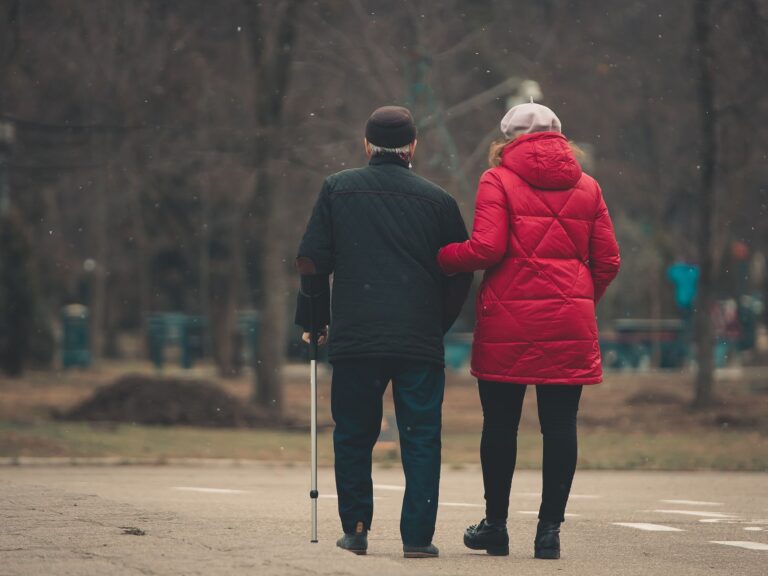
Walking aids can help a person with dementia stay mobile and independent, but only when the device is matched to their thinking ability, not just their legs. The short answer is that canes work for people with mild balance problems and intact judgment, standard walkers suit those who need more support but can still remember a sequence of steps, and wheeled or four-wheeled walkers reduce the mental load because the user does not have to lift and place the device with each stride. As dementia advances, the safest aid is often the simplest one, paired with a caregiver who provides calm, consistent cueing rather than relying on the person to use the device correctly on their own. Consider a woman in the early stages of Alzheimer’s who used a cane confidently for a year. As her disease progressed, her family noticed she would carry the cane like an umbrella instead of leaning on it, or set it down and walk off without it.
The cane had not stopped working; her ability to remember what it was for had changed. Switching her to a wheeled walker that stayed in front of her body, combined with a caregiver saying “hands on the grips, walk with me,” restored a measure of safety that the cane alone no longer provided. This is the central tension in dementia and mobility. Fall risk rises as the disease affects gait, depth perception, and attention, yet the very tools designed to prevent falls demand memory and coordination that the disease erodes. Getting the pairing right requires looking at cognition and physical need together.
Medical information disclaimer: This article is for general educational purposes only and does not provide medical advice, diagnosis, or treatment. Always consult a physician or other qualified health professional about symptoms, medications, tests, or treatment decisions.
Table of Contents
- How Do Canes, Walkers, and Dementia Interact When Choosing a Walking Aid?
- Matching the Walking Aid to the Stage of Cognitive Decline
- What Is Safe Cueing and Why Does It Matter for Mobility?
- Practical Steps for Introducing and Managing a Walking Aid at Home
- Common Mistakes and Limitations of Walking Aids in Dementia Care
- Adapting Cueing as Communication Changes
- The Role of Footwear and the Walking Surface
- Frequently Asked Questions
How Do Canes, Walkers, and Dementia Interact When Choosing a Walking Aid?
A walking aid is not a neutral object for someone with dementia; it is one more thing to remember, sequence, and interpret. A cane requires the user to hold it in the correct hand, advance it with the opposite leg, and trust it to bear weight. Those steps are automatic for most adults, but dementia can strip away the procedural memory that makes them automatic. A person may grip the cane on the wrong side, plant it too far forward, or forget it entirely on the way from the bedroom to the bathroom. Compared with a cane, a rollator, or four-wheeled walker, keeps the support directly in front of the body and moves with the person, which removes the “lift and place” sequence that trips up many people with moderate dementia.
The comparison matters because the physically strongest choice is not always the cognitively safest one. A standard walker with no wheels offers the most stability when standing still, but it forces the user to lift the frame, move it forward, and step to it in a repeating cycle. For someone who can no longer hold that sequence in mind, the no-wheel walker can actually increase falls, because they may try to walk into it or pull it backward. A four-wheeled rollator glides continuously, which feels more natural, but it can roll away on a slope or when the person leans on it to stand. The practical lesson is to assess the person’s cognition alongside their balance. A physical therapist evaluating an older man with vascular dementia found he had strong legs but poor sequencing; the team chose a rollator with locking brakes over a cane, precisely because the rollator asked less of his memory.
Matching the Walking Aid to the Stage of Cognitive Decline
Dementia is progressive, and a device that fits well in the early stage can become a hazard later. In mild dementia, when judgment and routine memory are largely intact, a single-point cane or a rollator may be entirely appropriate, and the person can often use it with only occasional reminders. As the disease moves into the moderate stage, working memory shrinks, and the person may no longer connect the device with the act of walking. This is when many families see the aid abandoned, misused, or turned into an obstacle. The important warning is that a walking aid is never a substitute for supervision in the later stages. Brakes go unlocked, wheels get pushed instead of leaned on, and a person may attempt to climb over or around the frame.
A rollator with a seat, useful for resting, can become dangerous if the person tries to sit without first backing up and locking the wheels. Families sometimes assume that giving a parent a “good walker” solves the fall problem, then feel blindsided when falls continue or worsen. The device reduces risk only for the tasks the person can still perform correctly. There is also a real downside to introducing a new device too late. Learning to use any walking aid depends on repetition and motor learning, both of which decline with the disease. A rollator introduced in mild dementia may be used semi-automatically for years, while the same rollator handed to someone in advanced dementia is often rejected because they cannot form the new habit. Timing the introduction early, before the learning window narrows, tends to produce better long-term use.
What Is Safe Cueing and Why Does It Matter for Mobility?
Cueing is the practice of giving a person with dementia short, clear prompts that guide their movement without startling or overwhelming them. Because the person may no longer remember how or why to use their walker, the caregiver supplies the missing memory in the moment. Effective cues are brief, concrete, and delivered one at a time: “hold the grips,” then “look ahead,” then “step with me.” Piling instructions together, or asking “why aren’t you using your walker?” tends to produce confusion or resistance rather than movement. Cueing works best when it combines words with gesture and position. A daughter caring for her father learned that saying “walk to me” while standing a few feet ahead and patting her own chest got him moving, whereas verbal instruction alone left him frozen.
Placing a hand lightly on the walker’s grip, or tapping the seat of a chair, gives a physical anchor that a sentence cannot. The goal is to reduce the cognitive load of the task so the person can act on what their body still knows. Timing and tone are part of safety. Rushing a person, cueing from behind where they cannot see you, or raising your voice can trigger a startle response and an actual fall. Approaching from the front, matching the person’s pace, and pausing between prompts gives the nervous system time to respond. For someone with dementia, the caregiver’s calm is itself a form of stability.
Practical Steps for Introducing and Managing a Walking Aid at Home
Start by involving a physical or occupational therapist rather than buying a device off a shelf. A professional fitting sets the handle height so the person’s elbow bends slightly, checks that the wheels and brakes suit the home’s flooring, and evaluates whether the person can learn the device at all. The tradeoff between a cane and a rollator is worth weighing openly: a cane is lighter, cheaper, and easier to carry through tight spaces, but it demands more balance and judgment, while a rollator is more stable and offers a seat but is bulky, harder to maneuver in narrow hallways, and can roll away. Once a device is chosen, shape the environment around it. Clear throw rugs, cords, and clutter that a walker can catch on, improve lighting so shadows are not mistaken for steps, and create clear paths between the rooms the person uses most.
Many falls happen not because the walker failed but because the person tried to cross a cluttered room without it. Keeping the aid in a consistent, visible spot, next to the bed or beside a favorite chair, uses the environment itself as a cue. Build a routine so the device becomes part of the person’s automatic movements. Prompt them to reach for the walker at the same transitions each day, such as rising from bed or leaving the table, and pair the prompt with the same words each time. Consistency matters more than complexity; a family that used identical phrasing across all caregivers found their relative responded far better than when each person improvised their own instructions.
Common Mistakes and Limitations of Walking Aids in Dementia Care
One frequent mistake is treating the walking aid as a fix that removes the need for watching. In moderate to advanced dementia, a person may walk away from the device, use it incorrectly, or forget how to operate the brakes, so the aid supplements supervision rather than replacing it. Another common error is choosing a device based only on physical strength; a person with strong legs but poor sequencing may do worse with a complex four-wheeled rollator than with a simpler option or a caregiver’s arm. Wheeled walkers carry specific hazards worth naming plainly. Unlocked brakes on a rollator with a seat are a leading cause of falls, because the person sits and the walker rolls out from under them.
Slopes, thresholds, and thick carpet can cause a rollator to stop suddenly or roll away, and a person who leans their full weight on the handles while standing may pitch forward. These are not reasons to avoid rollators, but they are reasons to lock brakes habitually and to supervise transfers. There is also a limit to what any device or cueing can accomplish. As dementia reaches its late stages, walking itself often declines regardless of the aid, and the focus shifts from independent mobility to safe assisted transfers and comfort. Insisting that a person keep using a walker they can no longer understand can cause distress and increase falls. Recognizing when to move from a walking aid to hands-on assistance, a transport wheelchair, or a different plan of care is part of using these tools wisely.
Adapting Cueing as Communication Changes
As dementia advances, spoken language often becomes harder to process, and cueing has to shift from words toward demonstration and touch. A caregiver might model the movement themselves, walking a few steps so the person can imitate, or gently guide the person’s hands onto the walker grips. Visual cues, such as a strip of colored tape marking where to place the walker or a contrasting mat showing where to turn, can guide movement when verbal instructions no longer register.
For example, a care home found that residents who no longer followed the instruction “use your walker” would still respond to a staff member holding out a hand and stepping backward slowly, inviting the person to follow. The invitation to move, communicated through body language, reached them when the sentence did not. Matching the cue to the person’s remaining abilities, rather than repeating instructions that no longer land, keeps movement possible for longer.
The Role of Footwear and the Walking Surface
Walking aids do their job only when the person’s feet and the floor cooperate. Well-fitted, low-heeled shoes with non-slip soles and secure fastenings give a stable base, while loose slippers, socks on smooth floors, or shoes with slick leather soles undermine even the best walker. Some people with dementia develop a shuffling gait that catches on thick carpet or raised thresholds, and a shoe that grips too aggressively can cause a trip when the foot sticks and the body keeps moving.
The walking surface deserves the same attention as the device. Transitions between flooring types, a glossy kitchen tile meeting a dark rug, can read as a step or a hole to someone with impaired depth perception, causing them to stop, reach down, or lose balance. One family removed a black bathmat after realizing their mother saw it as a void and refused to step over it with her walker. Consistent, matte, evenly lit flooring lets both the walking aid and the person’s remaining balance work as intended.
Frequently Asked Questions
Is a cane or a walker better for a person with dementia?
It depends on both balance and cognition. A cane suits mild cases with good judgment, but as memory declines, a wheeled rollator is often safer because it stays in front of the body and requires no lift-and-place sequence.
Why does my relative keep forgetting to use their walker?
Dementia erodes the procedural memory that links the device to the act of walking. This is normal in the moderate stage and is why consistent caregiver cueing, such as “hands on the grips, walk with me,” becomes essential.
Can a walking aid prevent falls on its own?
No. In moderate and advanced dementia the aid supplements supervision rather than replacing it, because brakes go unlocked, devices get misused, and the person may walk off without it.
What is safe cueing?
It is giving short, clear, one-at-a-time prompts from the front, at the person’s pace, often paired with gesture or light touch, so the caregiver supplies the memory the person can no longer access.
When should we stop using a walker?
When the person can no longer understand the device and using it causes distress or more falls. At that point the focus shifts to assisted transfers, a transport wheelchair, or hands-on help.