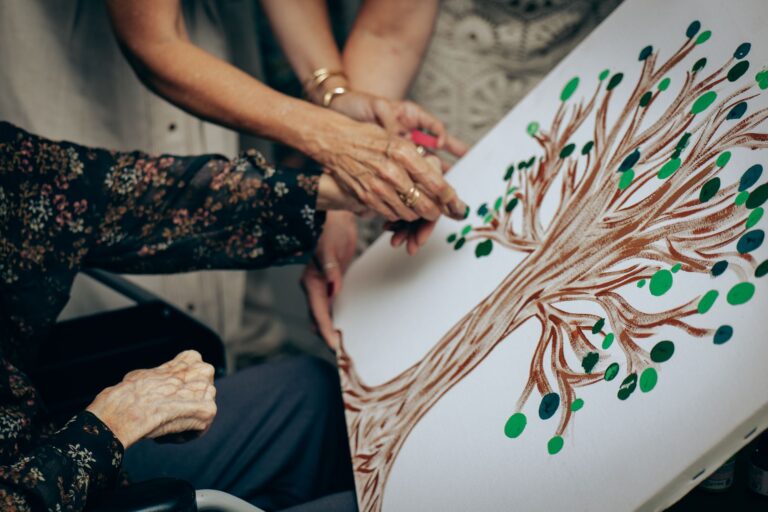
Memory care programs can learn several critical lessons from community events: prioritizing genuine social engagement over isolated activities, creating multi-sensory experiences that trigger memory and emotion, and building meaningful participation rather than passive observation. Community events naturally combine music, conversation, food, and familiar routines in ways that resonate with people living with dementia—not because events are designed for memory loss, but because they engage fundamental human needs for connection and sensory experience. When a local festival brings together music, familiar foods, and neighbors in a familiar setting, residents experience something memory care facilities often struggle to replicate indoors: the sense of belonging to a broader community rather than being managed within institutional walls.
Memory care facilities typically operate as closed systems focused on activities designed specifically for cognitive decline. They miss what makes community events powerful: the natural flow of social interaction, the authentic participation of volunteers and family members, the environmental richness, and the sense that something real and valued is happening. A memory care program in Portland, Oregon discovered this by bringing residents to a monthly farmers’ market rather than serving pre-arranged “market-themed” activities indoors. Staff reported increased alertness, more natural conversations, and fewer behavioral disruptions on those days compared to structured indoor programming—not because the activity was more complex, but because it was genuinely embedded in the community.
Table of Contents
- How Do Community Events Create Authentic Engagement That Memory Care Programs Miss?
- Sensory Richness and Environmental Design: What Memory Care Programs Often Overlook
- Social Cohesion and the Protective Effect of Genuine Community Integration
- Staffing Models: Volunteers, Community Participation, and Shifting Away from Paid Staff Dependency
- Time, Flexibility, and the Risk of Programming-Driven Exhaustion
- Sensory Reminiscence and Cultural Anchoring in Memory Care Programming
- Physical Participation and the Problem of Passive Programming
- Frequently Asked Questions
How Do Community Events Create Authentic Engagement That Memory Care Programs Miss?
Community events succeed because they are fundamentally unstructured compared to memory care programming. A concert in a park has no preset schedule for when people must pay attention, no activity director redirecting conversation, and no predetermined endpoint. Participants drift in and out, sit for as long as they wish, talk to neighbors, and respond to what’s actually happening rather than what staff planned. Memory care activities, by contrast, are often scheduled in blocks (10:00 AM trivia, 2:00 PM craft hour), require sustained attention, and assume a level of participation that may not match the resident’s present capacity.
This difference matters because people with dementia respond better to environments where failure is not possible. At a community concert, someone can sit silently and listen—that counts as full participation. In a memory care trivia game, sitting silently means “not participating.” A Philadelphia memory care facility began hosting informal music sessions where volunteers came to play rather than staff running an activity. Musicians came for themselves; residents could engage as much or as little as they wanted. Staff noted that residents who rarely spoke during organized activities initiated conversations during these sessions, asked musicians about their instruments, and stayed engaged much longer than typical one-hour programs.
Sensory Richness and Environmental Design: What Memory Care Programs Often Overlook
community events are sensory-rich by accident. A street fair offers the smell of food vendors, the sound of live music, the visual variety of crowds and decorations, and the tactile experience of moving through space and touching goods at booths. This sensory layering is not therapeutic—it is simply what happens when people gather. Memory care facilities often deliberately strip sensory input, creating quiet, controlled, consistent environments based on the assumption that stimulation may overstimulate or agitate residents. While excessive or jarring sensory input can indeed be problematic, under-stimulation is more common in memory care and contributes to apathy, withdrawal, and cognitive decline. However, a critical limitation of importing community event sensory richness into memory care is that residents have varying sensory tolerances.
A loud street fair works for a community event because people self-select, can leave, and can choose their position and duration. A 75-year-old with dementia who becomes distressed by crowds cannot easily leave an indoor recreation room. Memory care programs attempting to recreate event atmospheres must build in flexibility: dimmed versions of decorations, lower volume levels, smaller group sizes, and clear exit options. One care facility in Chicago held weekly “community market” programs that scaled sensory input based on resident response. Staff learned that what one resident found engaging (loud music, many visitors), another resident found overwhelming. The successful model was small, modular—like a market with different zones—rather than one-size-fits-all.
Social Cohesion and the Protective Effect of Genuine Community Integration
Community events create social bonds between people who might not interact otherwise. A block party brings together neighbors of different ages, backgrounds, and abilities in neutral space. This incidental social contact is protective—it reduces isolation and builds the sense that diverse people belong in the same place. Memory care residents are often highly isolated, spending most time with staff and other residents in the same facility. While peer interaction matters, relying entirely on other residents creates an insular environment. Genuine community integration—volunteers of different ages, family members visiting with their own friends, community members invited to participate—replicates what community events naturally provide.
A Denver memory care program formalized community integration by hosting monthly “intergenerational events” where local high school students volunteered alongside residents. Initially, staff worried the students would not know how to interact with residents with dementia. Instead, the students’ lack of training was an advantage: they did not use the clinical communication style common in memory care. They treated residents like neighbors, told jokes, shared stories about their lives, and responded naturally to whatever residents said. Over six months, residents showed increased smiling and spontaneous conversation on event days, and several residents named student volunteers as their friends. The program cost nearly nothing compared to typical activity programming—it was structured community participation, not staff-facilitated activity.
Staffing Models: Volunteers, Community Participation, and Shifting Away from Paid Staff Dependency
Community events run on volunteers. A local festival might have a planning committee of 5-8 people but mobilize 50-100 volunteers on the day. Memory care activities run entirely on paid staff and are therefore limited by budget: facilities can afford 3-5 activity staff, which means programming is scarce or repetitive. The community event model shows that when participation is framed as community contribution rather than employment, many more people engage. Retired teachers volunteer to lead discussion groups. Musicians volunteer to play. Neighbors volunteer to share their skills.
The tradeoff is significant: community volunteer models require more training oversight and create liability concerns that paid staff do not. A volunteer who misunderstands dementia communication and becomes frustrated, or who shares inappropriate stories, can damage a resident’s day and trust. Memory care facilities have learned this through incident reports. Yet facilities that invest in volunteer training and create clear roles (volunteer as peer participant, not as activity leader) report strong results. An Indianapolis facility trained community volunteers for four two-hour sessions on dementia communication before participation. These trained volunteers then came regularly. The facility’s activity hours expanded from 5 per week (paid staff-led) to 12-15 per week (volunteer-led and staff-supervised), without increasing budget. Residents experienced more social contact and more variety in their interactions.
Time, Flexibility, and the Risk of Programming-Driven Exhaustion
Community events have natural rhythms and endpoints. A farmers’ market runs Saturday morning; people come when they wish and leave when they wish. A concert has a start and end. Memory care programming often runs in fixed blocks, with the implicit expectation that residents will be engaged and participate. This creates a kind of programming-driven exhaustion: residents are expected to participate in activity time, meals are served on schedule, medication is distributed on schedule, bedtime is enforced, and recreation is scheduled even when residents are clearly tired or uninterested. The limitation is that importing community event flexibility into memory care requires abandoning some of the structure that makes institutional care operational. Staff cannot run a memory care facility if each resident’s meals and medications follow a different schedule.
Yet successful facilities find middle ground: core routines (meals, medications, sleep) remain predictable, but recreation and social time become flexible. Residents can choose to participate in the weekly community volunteer music session or rest in their room. They can attend the intergenerational program or skip it. One facility in Austin eliminated the requirement that all residents attend daily activities. Instead, activities were offered continuously, and residents participated as they wished. Staff worried that participation would drop, but instead, residents who voluntarily attended showed higher engagement during activities and fewer behavioral disruptions during their rest time. The program worked because it stopped treating activities as mandatory therapy and started treating them as opportunities, like community events.
Sensory Reminiscence and Cultural Anchoring in Memory Care Programming
Community events often have strong cultural or historical anchors. A local parade celebrates the neighborhood’s ethnic heritage. A farmers’ market reflects the season and the region’s agriculture. These anchors create continuity with how the community has always gathered. Memory care residents benefit from similar anchoring: programming that reflects their personal and cultural history, not generic “senior activities.” A San Francisco memory care facility created programming around residents’ actual community histories.
They learned that many residents had attended a famous local street fair for decades. The facility invited the fair’s organizers to send volunteers who had also attended for decades. The volunteers and residents were peers who had shared the same community experience, even if dementia had changed the residents’ memories of specific visits. They shared stories about how the fair had changed, favorite foods that used to be there, musicians they remembered. Staff reported this was the closest they came to seeing residents truly present and engaged. The programming cost nothing extra but required staff to know residents’ histories and connect those histories to actual community resources and people.
Physical Participation and the Problem of Passive Programming
Community events assume physical participation. At a street fair, you walk between booths, pick up items, talk to vendors, taste samples. At a community concert, you navigate finding a good seat, stand or sit, move to where you can see. This physical agency and minor problem-solving activate different parts of cognition than sitting and watching staff-led activities. Memory care programming often defaults to passive observation: residents sit and watch performers, residents sit and listen to a speaker, residents sit and view a slideshow. A Boston facility reorganized its activity space to require more physical movement and choice. Instead of gathering everyone in a common room for the morning activity, staff set up stations: a “music corner” with instruments and a volunteer, a “garden area” with plants and gardening tools, a “café” with coffee and simple snacks where visitors sat and talked.
Residents could walk the circuit, spend time at stations they chose, and move as their energy allowed. Staff did not call it “programming”—it was more like a community gathering space. Participation increased and behavior problems decreased. A 78-year-old man with severe dementia who had not spoken in months was observed at the garden station, pointing at plants and asking a volunteer (who worked as a gardener in the neighborhood) what they were. He was asking questions—something caregivers said he had not done in years. He was not receiving therapy in that moment. He was participating in something that resembled a community gathering rather than an institution’s activity schedule.
- —
Frequently Asked Questions
Can memory care facilities realistically recreate community event atmospheres indoors?
Partially. Indoor recreation rooms can incorporate sensory elements, social participation, and volunteer involvement. However, true community event feeling requires actual community participation (not simulated markets), real volunteers, and flexible attendance. Facilities achieve the best results by taking residents to actual community events rather than recreating them indoors.
What’s the biggest barrier to adopting community event principles in memory care?
Liability and safety concerns. Community events are open environments where people self-manage risk. Memory care facilities are legally required to monitor and control risk, which inherently reduces the spontaneity and openness of community events. Facilities must create volunteer training and clear protocols to bridge this gap.
How much does volunteer-based programming cost compared to staff-led programming?
Volunteer programming has lower direct labor costs but higher coordination and training costs. A facility running one staff-led activity hour weekly might spend $500-800 in wages. A volunteer program delivering the same hours requires 20-30 hours of volunteer coordination and training per month. For facilities with capacity to manage this coordination, the net cost is similar or lower. For small facilities, volunteer programs are more expensive.
Do residents with advanced dementia benefit from community event-style programming?
Yes, but differently. Residents with severe dementia may not remember or understand the event, but they benefit from the sensory input, social presence of others, and emotional tone. Research shows that even residents who cannot form new memories respond positively to music, familiar food, and warm social interaction. The benefit is present-moment engagement rather than memory-making.
Is it safe to bring memory care residents to actual community events?
Generally yes, with planning. Residents need supervision, clear exit strategies, and awareness of crowds and noise levels. Some residents with dementia navigate community events successfully with one staff member. Others become anxious or disoriented. The key is matching individual residents to events that fit their temperament and sensory tolerance, which is why one-size-fits-all off-site programming fails—personalization is essential. —