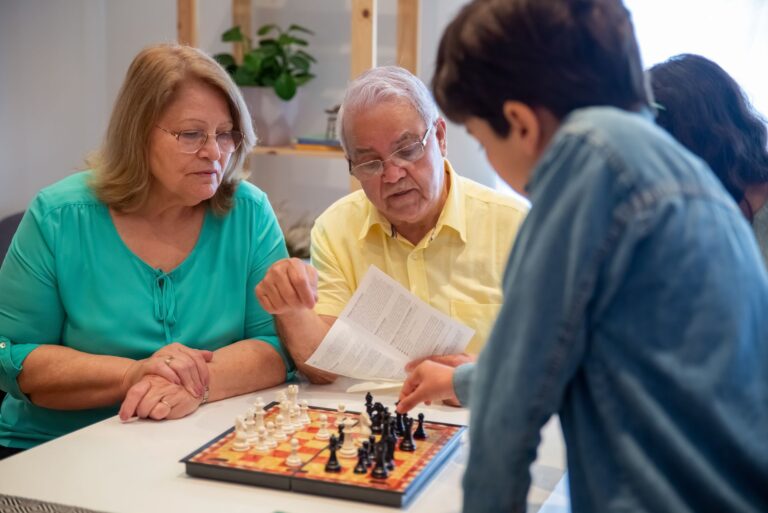
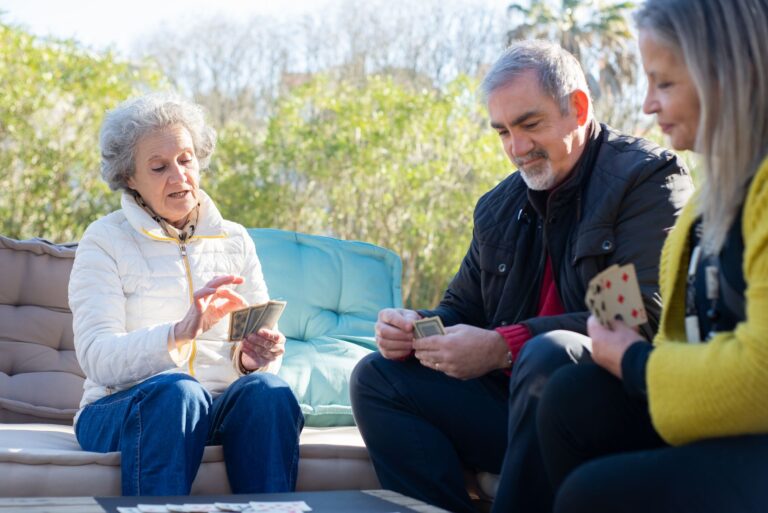
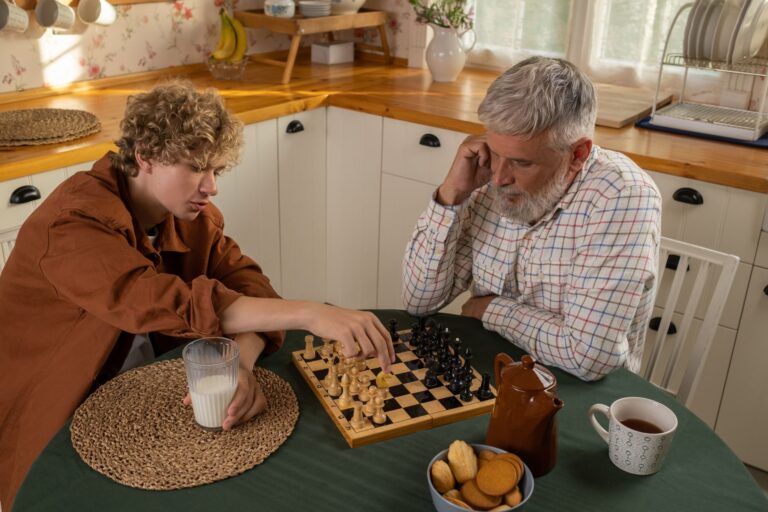
The games that hold up best in December are the ones the person already knows: a simple board game, a familiar card game, a singalong of carols, or a photo-sorting session. The National Institute on Aging's guidance on adapting activities for people with Alzheimer's disease names exactly these — a simple board game, playing music and talking about the artist, singing or dancing to well-known songs — rather than new or rule-heavy activities. That distinction matters more in December than any other month, because holiday gatherings add noise, visitors, and late-day timing to activities that already take effort. The practical question is not which game is cleverest but which one a person with memory loss can join without being tested, and which one a tired caregiver can set up in five minutes.
Medical information disclaimer: This article is for general educational purposes only and does not provide medical advice, diagnosis, or treatment. Always consult a physician or other qualified health professional about symptoms, medications, tests, or treatment decisions.
Table of Contents
- Why familiar games beat new ones
- What music actually does, and what it does not
- Running an activity on a video call
- Protecting the day around the game
- Interactive light tables and other devices
- Who is doing this planning
- Frequently Asked Questions
Why familiar games beat new ones
A new game asks the person to learn rules, hold them in working memory, and perform under the eyes of relatives they may see once a year. A familiar one asks only for recognition. That is why the NIA's list is short and conservative: known songs, known music, a simple board game.
The Alzheimer's Association recommends card and board games for a second reason — they let other family members and friends join in, which turns the activity into shared time rather than supervised time. It also notes that some games come in multiple skill levels, so the person living with dementia can keep taking part as abilities change. That last point is worth acting on before the holiday, not during it. If a game has a simplified or junior edition, buying that version now avoids the mid-game moment where someone has to quietly stop playing.
What music actually does, and what it does not
Singing carols is the most reliably recommended holiday activity, and there is now pooled evidence behind it. Cochrane's March 2025 updated review, pooling 30 studies with 1,720 people — mostly care-home residents — concluded that music-based therapeutic interventions probably reduce depressive symptoms and may improve overall behavioral problems by the end of treatment. The same review is clear about the ceiling.
Music-based therapy is unlikely to meaningfully change agitation, aggression, emotional well-being, or cognition, and effects beyond four weeks after treatment stops are uncertain. So frame a December singalong as mood support for the afternoon, not as symptom control. If a family is hoping carols will reduce sundown agitation or slow memory loss, the evidence does not promise that, and a disappointed caregiver may abandon something that was genuinely helping with low mood.
Running an activity on a video call
Relatives who cannot travel often default to an open-ended video call, which is the hardest format for someone with dementia — all conversation, no structure, and a screen that gives few social cues. The Alzheimer's Association suggests building the call around a trivia game, seasonal songs, or photographs of past gatherings instead. The practical version of this: decide the activity before dialing, and have the materials on the dementia-care side of the call, not only on the distant relative's screen.
A photo album in the room beats a screen-shared slideshow, because the person can hold it and the remote relative can simply ask about each page. Trivia works best when the answers live in long-term memory — old songs, old film stars, hometown landmarks — rather than recent news. The goal is a call where the person succeeds repeatedly.
Protecting the day around the game
No activity survives a room with fourteen people in it. The Alzheimer's Association's holiday guidance tells caregivers to set aside a quiet room stocked with the person's favorite activities or calming music, to limit how many visitors arrive at once, and to move a holiday dinner to a holiday lunch when late-day confusion is a problem.
That quiet room is where the games belong. A deck of cards, one simple board game, the photo album, and a speaker in a side room gives the person a place to go that is not a bedroom and not a retreat from the party — it is a second, smaller party. A short checklist for the week before:.
- Pick two activities the person already knows, and skip anything requiring new rules.
- Check whether a favorite game has a simplified edition and buy that version.
- Stage the quiet room: cards, photos, music, comfortable seating.
- Stagger arrivals so visitors come in small groups.
- If late-day confusion is common, schedule the main meal at lunch.
Interactive light tables and other devices
Care homes increasingly use projected light games — the Tovertafel is the best-known — which cast interactive games onto a dining table that residents touch and swipe. A German within-subject study of 25 long-term-care residents reported significant short-term effects on apathy and social activity, published in 2024. That study also found the gains were not durable within the trial: apathy rose again by its end, and negative social behaviors such as pushing away were slightly more pronounced during use.
A separate US study of 12 residents with moderate to severe dementia found significantly fewer memory-related behaviors (p=.047) and fewer instances of apathy (p=.027) during sessions than in the control period — promising, but a sample of twelve. For a family deciding what to do this month, the useful read is that these devices belong to the care-home budget, not the household one, and the evidence behind them is early. If a relative lives in a facility that has one, ask whether it is running during the holiday period; it is a reasonable thing to join a visit around.
Who is doing this planning
The Alzheimer's Association's 2026 Facts and Figures reports 12.7 million unpaid US dementia caregivers providing 19.6 billion hours of care in 2025 — roughly 30 hours each per week. December activity planning lands on people who are already at capacity. That is the argument for keeping the list short.
Two known games, one quiet room, and a lunch instead of a dinner is a complete plan, and it is one a caregiver can execute while also cooking, hosting, and managing visitors who have not seen the changes since last year. Hand the games off where possible. A niece who knows the rules of the card game and is willing to sit with it for an hour is doing more for the day than any purchase.
Frequently Asked Questions
Should we teach a new game so everyone can play something together?
No. Both the NIA and the Alzheimer's Association point toward familiar games, and the Association specifically favors card and board games because others can join a game the person already knows. If you want a new purchase, buy a simplified edition of a game they recognize.
Will a carol singalong help with agitation in the late afternoon?
The Cochrane review found music-based therapy unlikely to meaningfully change agitation or aggression, though it probably reduces depressive symptoms. For late-day confusion, the Association's structural advice applies instead: fewer visitors at once, and the main meal at lunch.
How many visitors is too many?
The guidance is to limit how many arrive at once rather than to set a number, and to keep a quiet room available throughout. Staggered small groups give the person repeated manageable greetings instead of one overwhelming entrance.