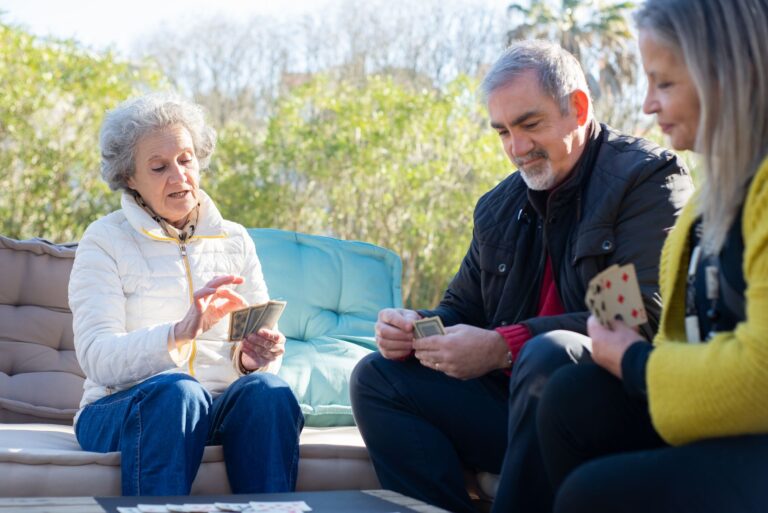
Card games can modestly reduce agitation in people with Lewy body dementia, but only as part of a personally meaningful activity routine — not as a treatment in their own right. The strongest evidence behind them is indirect: Cochrane's 2023 review of personally tailored activities in long-term care found a small reduction in agitation, and no trial has tested card games in Lewy body dementia specifically. That is still a reason to try one. Cards are cheap, familiar to most older adults, and carry none of the risk that antipsychotic drugs carry in this particular form of dementia — which is the real comparison a family is making at four in the afternoon when a parent starts pacing.
Medical information disclaimer: This article is for general educational purposes only and does not provide medical advice, diagnosis, or treatment. Always consult a physician or other qualified health professional about symptoms, medications, tests, or treatment decisions.
Table of Contents
- What the evidence actually shows
- Why the game matters less than the person
- What has not been tested
- The risk calculation that makes cards worth trying anyway
- Setting up a card game that has a chance of working
- When to escalate instead
- Frequently Asked Questions
What the evidence actually shows
Lewy body dementia is a progressive brain disease caused by abnormal deposits of the protein alpha-synuclein, and it combines memory and thinking changes with movement problems, visual hallucinations and fluctuating alertness. Agitation here means restlessness, pacing, repetitive demands, or verbal and physical outbursts. The closest thing to direct evidence comes from Cochrane's 2023 review of personally tailored activities for people with dementia in long-term care.
Across 7 studies and 485 participants, tailored activities may slightly reduce agitation — a standardised mean difference of −0.26, with a confidence interval of −0.53 to 0.01 that just crosses zero. Cochrane rated this low-certainty evidence. Read plainly: the average effect is small and favourable, and the data cannot rule out no effect at all. A comparative review summarised by NIH reached the same conclusion from a different angle, finding only small decreases in agitation from personally tailored interventions while massage showed moderate decreases and seven other non-drug approaches showed none.
Why the game matters less than the person
Cochrane's definition of "personally tailored" is the useful part. Activities were selected from each resident's present or past interests and preferences, as the plain-language summary of that review describes, with agitation and quality of life as the primary outcomes. So the mechanism is familiarity and personal meaning, not the deck of cards. Gin rummy helps the man who played it every Thursday for forty years.
It does nothing for someone who never played, and a card game introduced cold can itself become the trigger — a new rule set, a demand to remember, a sense of failing in front of family. This also tells you what to substitute when cards do not land. The same logic supports sorting photographs, folding laundry, winding a watch, or shuffling a deck with no game attached. The activity needs a history, not a scoreboard.
What has not been tested
No trial has tested card games for agitation in Lewy body dementia specifically. Connors, Quinto and McKeith's systematic review of non-pharmacological interventions for Lewy body dementia, published in Psychological Medicine in 2018, found that most of the studies it included reported benefit, but concluded that small samples and weak study quality prevented firm recommendations. The one large, rigorous trial of tailored activity in a mixed dementia population came out flat on this outcome. Gitlin and colleagues' single-blind randomized trial of the Tailored Activity Program enrolled 250 caregiver–patient dyads with clinically significant agitation or aggression across the Baltimore–Washington DC area, and the 2021 BMC Geriatrics report found no benefit for agitation or aggression at three months against an attention control.
It found other things. The activity program reduced the assistance people needed with daily activities and improved caregiver wellbeing. By six months, 15 people with dementia in the activity group had experienced at least one health-related event, against 28 in the control group (p=0.03). Agitation scores held still while the household around them measurably improved.
The risk calculation that makes cards worth trying anyway
Lewy body dementia is the form of dementia where the drug alternative is most dangerous. The DLB Consortium's fourth consensus report, published in Neurology in 2017, documents that patients given typical antipsychotics — haloperidol especially — can suffer sedation, worsened cognition and acute parkinsonism that is sometimes irreversible. Against that, a card game has effectively no downside.
This is why the Alzheimer's Association advises that non-drug approaches be tried before medication for dementia-related behaviours, and directs caregivers first to identify what is causing the behaviour and to remove environmental triggers it names: noise, glare, and space that does not feel secure. Those three triggers describe how to set the table. A card game under a bright overhead light, with the television on and people moving behind the chair, is a poor test of whether cards help.
Setting up a card game that has a chance of working
Expect a small, inconsistent effect rather than a solution, and judge it on more than the outbursts. Gitlin's trial is the honest template here: the behaviour score may not move while the person needs less help getting through the day and the caregiver sleeps better.
- Pick a game with a documented history for that person, and ask a sibling or old friend if you are not sure which one.
- Cut the rules down rather than the deck — one suit, matching pairs, or simply sorting by colour still counts as the activity.
- Kill the competing noise and the glare, and seat the person with their back to a wall rather than to an open room.
- Run it during their better hours. Alertness in Lewy body dementia fluctuates sharply, so the same game can succeed at 10am and fail at 5pm.
- Stop the moment it stops being pleasant. A session abandoned early is a session that can be offered again tomorrow.
When to escalate instead
Agitation that arrives suddenly, or that is much worse than the person's usual pattern, is a medical question before it is an activity question. Pain, constipation, a urinary tract infection and medication changes all present as agitation in dementia, and no card game addresses any of them.
Bring the specific numbers to that appointment if antipsychotics are raised. Around 1 million people in the US have Lewy body dementia by the NINDS estimate, with the Lewy Body Dementia Association putting the figure nearer 1.4 million — a population large enough that clinicians unfamiliar with the antipsychotic sensitivity described in the 2017 consensus report still encounter it regularly.
Frequently Asked Questions
How long before I know whether cards are helping?
Judge it over weeks of repeated sessions, not one attempt, and track daily function and your own strain alongside agitation — Gitlin's trial found gains in those areas while agitation scores stayed flat.
Does it matter whether the person wins?
No. Cochrane's tailored-activity model selects activities from past interests and preferences, so engagement is the outcome. Correcting mistakes or enforcing rules turns a familiar pastime into a test.
Can a care home do this, or is it a family activity?
Both. The Cochrane evidence comes specifically from long-term care settings, so it is reasonable to ask a facility's activity staff to record which games a resident has a history with.