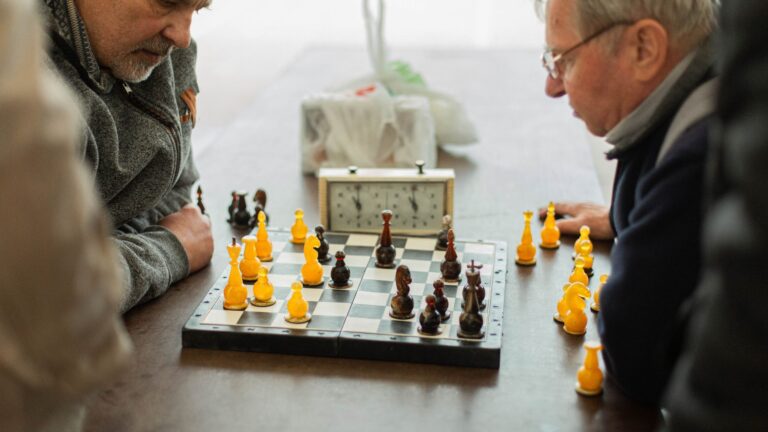
In early Alzheimer's, the games with the strongest research behind them are tile and board games played with other people — mahjong above all, plus traditional board games like Go, checkers, backgammon, or dominoes played in a regular group. The honest headline is that these games reliably help attention, mood, and engagement, and they do not reverse memory loss.
Early Alzheimer's means the stage when a person still handles most daily life but shows clear memory and thinking changes. At that stage the practical question is not which game is "best for the brain" in the abstract, but which one the person can still win, enjoy, and come back to next week. That is the criterion the evidence actually supports.
Medical information disclaimer: This article is for general educational purposes only and does not provide medical advice, diagnosis, or treatment. Always consult a physician or other qualified health professional about symptoms, medications, tests, or treatment decisions.
Table of Contents
- Why mahjong has the best evidence of any single game
- What counts as a board game in the research
- Choosing a game for a specific person
- What the wider evidence does and does not promise
- Board games versus brain-training apps
- Frequently Asked Questions
Why mahjong has the best evidence of any single game
Mahjong is the tile-matching game played by four people with suits, winds, and dragons — closer to rummy than to chess, and fast, social, and noisy. It is the only game with a randomized trial in dementia showing measurable cognitive gain. A 2014 Hong Kong randomized trial in the American Journal of Geriatric Psychiatry assigned about 110 nursing-home residents with very mild to moderate dementia to mahjong, tai chi, or a handicraft control group; the mahjong players beat controls on forward digit span by 1.11 points at six months and 1.78 points at nine. Forward digit span is repeating back a list of numbers in order — a measure of attention and working memory.
That is exactly where the gain appeared, and nowhere else. In the same trial, mahjong produced no benefit on verbal memory, immediate or delayed recall, or backward digit span. A companion cluster-randomized trial in Hong Kong care homes, summarized in a 2024 scoping review in Healthcare via PMC, found slower progression on the Clinical Dementia Rating sum-of-boxes score among mahjong players than controls. That remains the single dementia-progression signal in this literature — one result, in care homes, not a general finding about games.
What counts as a board game in the research
The broader evidence base pools games rather than ranking them. A 2023 systematic review and meta-analysis in the Journal of Alzheimer's Disease by Pozzi and colleagues looked only at traditional board games — studies that mixed board games with card games were excluded — and concluded they may slow global cognitive decline and improve quality of life in older adults at risk of or living with cognitive impairment. The catch sits in which games were studied.
Most of the trial base uses Go and mahjong, games common in Asia, as a 2025 analysis in Frontiers in Psychology notes. Evidence for Western staples — Scrabble, dominoes, Rummikub, checkers, backgammon — in early Alzheimer's is extrapolated from the shared ingredients rather than directly tested. Those shared ingredients are what to look for: turn-taking with other people, visible game state, a rule set already in long-term memory, and short rounds. A game that demands storing new information between turns works against the person; a game that lets them read the board does not.
Choosing a game for a specific person
The decision is about fit at the current stage, not difficulty. Use these filters: Reading aids matter more than people expect. Large-print tiles, high-contrast pieces, a card listing the rules, and good overhead light remove obstacles that look like cognitive decline and are not.
- **Already known, not newly learned.** A game played for decades sits in procedural memory, which early Alzheimer's spares longest. Teaching a new rule set invites the failure the game is meant to avoid.
- **The board shows the state.** Checkers, dominoes, Chinese checkers, and mahjong keep everything visible. Trivia games and anything scored from memory expose the deficit directly.
- **Rounds under about 20 minutes.** Short rounds let the person stop at a win rather than at exhaustion.
- **Chance in the mix.** Backgammon, dominoes, and mahjong let dice or draws carry some of the outcome, so a loss is not a verdict on the person's thinking.
- **Three or four players.** The social contact is doing real work here, not just filling the table.
What the wider evidence does and does not promise
Games sit inside a broader approach called cognitive stimulation — group activities including games, puzzles, and discussion. The 2023 Cochrane review by Woods and colleagues found it probably produces small cognitive benefits in mild-to-moderate dementia, with slighter possible gains in quality of life, mood, and daily living, and judged group programs cost-effective. Heterogeneity was high — I² of 62% for cognition, meaning the trials disagreed substantially with each other. Some of the most-quoted numbers are observational.
A 20-year French PAQUID cohort analysis of about 3,670 older adults, published in BMJ Open in 2013, found regular board-game players had roughly 15% lower dementia incidence along with less cognitive decline and less depression. That may reflect who chooses to play — people with intact thinking, social networks, and no early apathy — rather than any effect of playing. The small trials are blunt about their own limits. A 2022 pilot randomized trial reported via PMC split 30 people with mild-to-moderate dementia across control, olfactory stimulation, and board-game arms, leaving 10 players per arm; board-game MMSE and TIBSIT scores did not improve more than controls'. Studies that size cannot settle how often to play or which game to pick.
Board games versus brain-training apps
Families often weigh a game night against a subscription app, and the two have different evidence. The National Institute on Aging tells consumers that evidence for a lasting cognitive benefit from brain-training games is not definitive, and that commercial brain-training apps have not been shown to match the structured training used in the ACTIVE trial. An app's marketing copy is not a finding. The structured training is a separate story.
A 20-year ACTIVE follow-up reported in February 2026 by University of Florida Health found participants given speed-of-processing training with booster sessions at one and three years were 25% less likely to be later diagnosed with dementia, while the memory and reasoning training arms showed no such reduction. Those diagnoses came from health records rather than specialist testing, and that training was delivered to healthy older adults, not as a treatment after diagnosis. So the two serve different purposes. A standing mahjong or dominoes game is an activity with documented gains in attention, engagement, and quality of life for someone living with early Alzheimer's; neither it nor an app is a treatment for the disease.
Frequently Asked Questions
How often should we play?
No trial has established a dose. The mahjong trial ran sessions over months with benefits measured at six and nine months, and the pilot work is too small to settle frequency, so set a schedule the person will keep rather than a target number.
Should we switch games as Alzheimer's progresses?
Simplify the version before changing the game. Playing open-handed, dropping scoring, or pairing up keeps a familiar game available longer than moving to something unfamiliar.
Is playing alone on a tablet worth anything?
It loses the social contact that the cognitive stimulation evidence treats as part of the activity, and the National Institute on Aging says app benefits are not definitive. Solo play is fine as entertainment; the group table is what the research tested.