Dementia care is isolating not because caregivers are unloving, but because the disease itself builds walls. A daughter spending twelve hours a day with her mother with Alzheimer’s disease—bathing her, managing medications, listening to repeated questions—can feel profoundly alone even surrounded by family. She may lose friendships because she cannot leave. She may withdraw from hobbies because they feel frivolous. She may stop talking to friends about her day because they have stopped asking, unsure what to say.
The loneliness is not failure; it is a common side effect of intensive caregiving that most people do not anticipate until they are living it. Breaking this isolation requires recognizing it first. Loneliness in dementia care stems from several sources: the unpredictability of the disease, the physical demands that make leaving home difficult, the social stigma many people feel around memory loss, and the simple fact that friends and family often do not know how to help. Each of these barriers has practical solutions, but they require deliberate action. Waiting for loneliness to resolve on its own will not work. Most caregivers who report feeling less isolated have taken specific steps—sometimes small, sometimes large—to rebuild connection in their lives.
Table of Contents
- Why Dementia Caregivers Become Isolated
- The Cumulative Cost of Caregiving Alone
- The Person with Dementia Often Feels Alone Too
- Creating Small Moments of Connection
- Navigating Difficult Conversations with Family and Friends
- When Technology Helps and When It Falls Short
- Rebuilding a Life Beyond Caregiving
Why Dementia Caregivers Become Isolated
The isolation begins with the schedule. dementia care is a 24/7 commitment disguised as a daytime job. A caregiver who manages medications, prepares meals, handles incontinence, and monitors safety cannot simply leave for an evening with friends. Even hiring respite care—a care aide who comes for a few hours—requires money many families do not have. Medicaid covers some in-home care, but the waiting lists are long and the hours often do not align with when a caregiver might want to take a break. This is different from caring for a child, where school provides built-in relief. There is no “dementia kindergarten” that ends at three o’clock.
The second layer is social. Dementia changes a person’s behavior in ways that public outings become exhausting or risky. A person with advanced dementia may become agitated in crowded places, wander away, or say things that embarrass their caregiver. Some caregivers report that their loved one’s behavior has become so unpredictable that they no longer feel safe taking them out. The caregiver is then left with a choice: stay home or go out alone, leaving the person with dementia unsupervised. Many choose to stay home, telling themselves it is temporary. After months or years, it stops feeling temporary.
The Cumulative Cost of Caregiving Alone
caregivers who remain isolated report higher rates of depression, anxiety, and burnout than those with social support. A 2023 survey found that isolated caregivers were twice as likely to report depressive symptoms compared to those with regular social engagement. But the warning is often missed: isolation does not feel like a problem until it is severe. In the early stages, the caregiver may not notice they have stopped calling friends or that nobody has visited in weeks. They may attribute their mood to the stress of caregiving itself, not realizing that the isolation is compounding the stress.
The risk also extends to the quality of care. A burned-out, isolated caregiver is more prone to impatience, mistakes, and resentment—not because they are unkind, but because humans require connection to sustain compassion. Some research suggests that caregiver isolation is linked to higher rates of emotional abuse in care settings, though most isolated caregivers never reach that point. The limitation of this research is that it is hard to prove causation; it is possible that harder-to-manage patients cause both isolation and caregiver stress. Regardless, the pattern is clear: isolation is a risk factor, not a safe state to remain in indefinitely.
The Person with Dementia Often Feels Alone Too
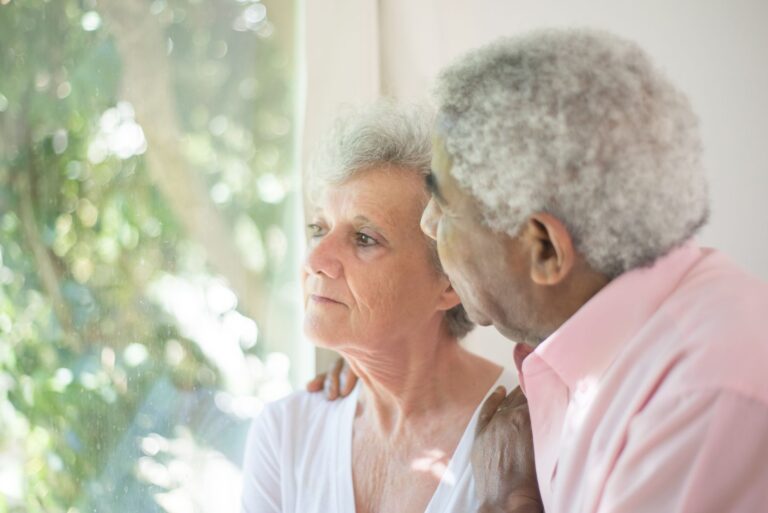
The isolation is not one-sided. A person with dementia often experiences loneliness alongside their caregiver, even though they are in the same house together. As the disease progresses, the person with dementia may lose the ability to recognize family members, may not understand why a familiar friend has stopped visiting, or may have difficulty initiating conversation due to language problems.
A son caring for his father with vascular dementia described his experience: his father would sit in the living room during the day, physically present but unable to engage in the activities they used to do together—watching TV together became watching TV in silence because his father no longer followed the plot. Some people with dementia experience what researchers call “social withdrawal”—they become less interested in interaction, which can be a symptom of the disease itself, not a choice. This can paradoxically make the caregiver feel more isolated, because the person they are caring for does not seem to want connection. The caregiver may respond by pulling back, interpreting the lack of interest as reciprocated loneliness, when the person with dementia might have wanted connection but lacked the ability to ask for it.
Creating Small Moments of Connection
Breaking the cycle does not require dramatic intervention. Effective strategies often start small. Some caregivers find that a weekly phone call with one friend—someone who agrees to listen without advice—becomes a lifeline. Others join a dementia caregiver support group, either in person or online, where they can speak honestly without explanation. A woman caring for her mother with progressive supranuclear palsy described joining a PSP support group and experiencing profound relief: for the first time, she could say “My mother had a fall today and I felt angry instead of sad” without someone saying “But you’re doing a great job” or “At least she’s still alive.” The tradeoff is that these small moments require time and energy the caregiver does not feel they have.
A support group means another commitment. A weekly call with a friend means scheduling respite care or asking a family member to watch the house. Some caregivers resist this because they believe their only responsibility is to the person with dementia. But this is a false choice. A caregiver who has one hour of social connection per week is more present and patient during the remaining 167 hours than a caregiver who has none. The investment returns immediately.
Navigating Difficult Conversations with Family and Friends
One barrier to connection is that well-meaning people do not know what to say. A friend might disappear not out of judgment but out of fear—they do not want to say something wrong or intrude on grief. A family member might offer unsolicited advice (“You should put her in a home”) instead of listening, which sends the caregiver further into silence. Many caregivers report that they have stopped initiating contact because they are tired of explaining the situation or defending their choices.
A specific warning: if a caregiver’s only family member is the person with dementia, the isolation can become severe. Some adult children are the sole caregiver for a parent with no siblings to share the load, no spouse at home, and limited extended family. In these situations, the risk of burnout is higher, and the barrier to seeking help is often shame—the caregiver may feel they should be able to handle this alone, or may fear judgment if they admit they cannot. This is where professional support, such as a therapist or a counselor trained in caregiver issues, becomes essential, even if it means using care funds for mental health services instead of additional in-home care hours.
When Technology Helps and When It Falls Short
Video calls have made it possible for some caregivers to maintain connection when in-person visits are not feasible. A grandchild can read a book to a grandparent with dementia via video, or a caregiver can check in with a friend while sitting in the car during a lunch break. Some people with dementia can engage with video calls better than phone calls because they can see faces, which helps with recognition.
The limitation is that technology does not replace presence. A video call with a grandchild is not the same as a grandchild visiting and helping with a task—say, sorting through old photos together while sitting on the couch. Technology is useful as a supplement to connection, not as a replacement for it.
Rebuilding a Life Beyond Caregiving
Some of the most resilient caregivers are those who maintain at least one activity or relationship separate from dementia care. A woman who continues to meet her book club once a month, even if she has to hire someone to sit with her mother for those two hours, reports that the break sustains her. A man who keeps his woodworking hobby, working in the garage for an hour while his sister watches his father, describes it as essential—not selfish. These activities are not escapes from responsibility; they are the reason the caregiver does not burn out.
This requires permission from the caregiver themselves. Many believe that taking an hour for themselves is abandonment, that they should be grateful for their role and find fulfillment in it alone. But caregivers who have tried this approach often find that the opposite is true: maintaining a small piece of their own life makes them better caregivers, more present, and more able to find meaning in the relationship rather than resentment. A caregiver who stopped exercising during her father’s illness found that when she rejoined a gym, even for 30 minutes twice a week, her patience improved noticeably, and she was able to have more genuine interactions with her father during the time they spent together.
- —