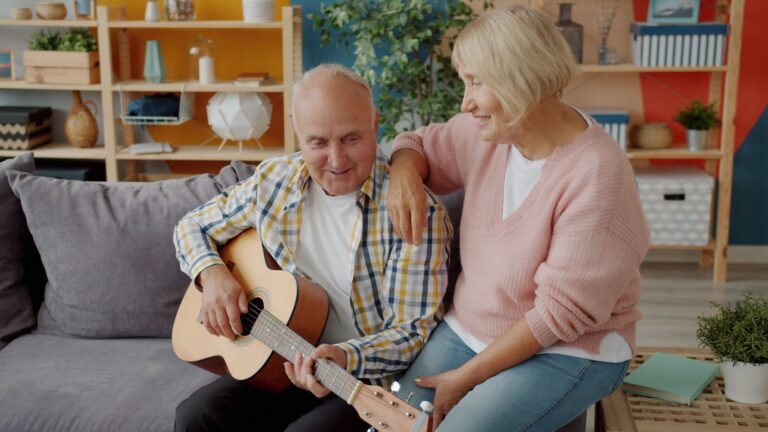
Regular listening to or playing music is linked to lower dementia risk in older adults, with a small added cognitive benefit once mild cognitive impairment — noticeable memory or thinking changes that do not block daily life — has developed. Music does not provenly prevent Alzheimer's disease. This gap between popular claims and study results matters for families planning care. The research points to association, mood support, and daily enrichment rather than guaranteed protection.
Medical information disclaimer: This article is for general educational purposes only and does not provide medical advice, diagnosis, or treatment. Always consult a physician or other qualified health professional about symptoms, medications, tests, or treatment decisions.
Table of Contents
- What did the large Australian study find?
- Does music prevent Alzheimer's?
- What helps after MCI or early dementia?
- How can families use music day to day?
What did the large Australian study find?
Among 10,893 initially dementia-free Australians age 70 and older, those who always listened to music had lower risk than never, rarely, or sometimes listeners. The Monash University 2025 study in the International Journal of Geriatric Psychiatry linked always listening to 39% lower dementia risk and 17% lower risk of cognitive impairment no dementia, as described in the Monash study record. Playing an instrument showed a similar pattern in the same group.
Often or always playing was linked to 35% lower dementia risk, while doing both listening and playing was linked to 33% lower dementia and 22% lower cognitive impairment risk, according to the same Monash study record. These numbers describe groups followed over time, not personal odds. They suggest frequent musical activity travels with healthier brain aging for many older adults.
Does music prevent Alzheimer's?
These studies show association, not proof of prevention. The links were adjusted for age, sex, and education, yet healthier people may stay more musical and reverse causation remains possible, a point made in the NEA summary of NIH-supported cohorts. Broader prevention guidance stays cautious.
The National Institute on Aging states there is currently no definitive evidence about what can prevent Alzheimer's disease or age-related cognitive decline, while healthy diet, activity, weight control, and blood-pressure control support overall health, as noted in the NIA Alzheimer's FAQ. For readers, the practical meaning is modest. Treat music as one healthy habit among several, not a shield against Alzheimer's.
What helps after MCI or early dementia?
For people who already have mild cognitive impairment or mild-moderate dementia, active music-making showed a small positive effect on cognition. A 2021 meta-analysis of nine trials with 495 participants found a standardized mean difference of 0.30. That effect favors doing music, such as singing, rhythm tasks, or simple instrument play, over passive background listening.
Gains tend to be small and vary across people and programs. Music-based therapy also supports mood and behavior in dementia. A 2025 Cochrane review of 30 studies with 1,720 people found probable improvement in depressive symptoms and possible improvement in overall behavioral problems, but likely no improvement in cognition, agitation, or aggression.
How can families use music day to day?
Clinicians frame regular listening or playing as a low-cost, accessible complement to exercise, vascular-risk control, and social engagement for at-risk older adults. For mid-to-late dementia, they use familiar songs to soothe distress and cue memories. A simple routine works best when it fits the person's taste and energy.
Keep sessions short, regular, and social when possible. Long-term benefit after therapy ends is less certain because few trials tracked outcomes beyond four weeks. Keep music as an ongoing pleasure and care tool, not a short course with lasting immunity.
- Pick familiar songs the person enjoys and can follow
- Sing, clap, or play a simple instrument together
- Schedule music at calm times, such as after meals or before rest
- Watch response and lower volume or stop if distress rises