The simplest honest answer: keep dolls available rather than handed out, run short repeated sessions on a fixed schedule, and let each person choose whether to pick one up. There is no official simplified group protocol for doll therapy — the published evidence comes from individual-level trials in nursing homes, not from a standardized group curriculum, so anything labelled a "group protocol" is an adaptation staff build themselves.
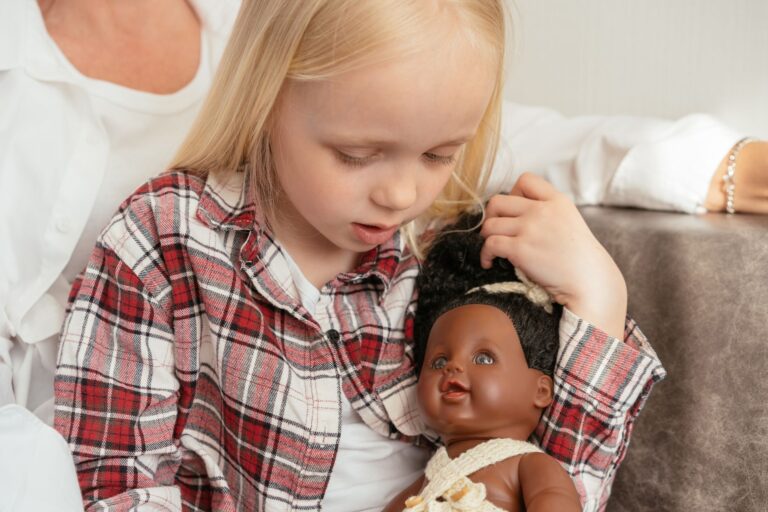
Doll therapy means offering a person with dementia a realistic baby doll and allowing, not directing, an attachment to form. It is a non-pharmacological approach studied mainly for behavioural and psychological symptoms of dementia (BPSD) — agitation, aggression, anxiety, low mood. The research below is strong enough to justify trying it and thin enough that a group programme needs written limits from day one.
Medical information disclaimer: This article is for general educational purposes only and does not provide medical advice, diagnosis, or treatment. Always consult a physician or other qualified health professional about symptoms, medications, tests, or treatment decisions.
Table of Contents
- What the evidence actually supports
- The one rule that simplifies a group session
- A workable session shape
- The failures to plan for before the first session
- Ethics, families, and where the evidence runs out
- Frequently Asked Questions
What the evidence actually supports
The strongest signal is on agitation. A 2023 systematic review and meta-analysis in *Geriatric Nursing* found doll therapy improved overall behaviours among older nursing-home residents with dementia (SMD = −0.42, P = 0.01), with the largest effect on agitation (SMD = −0.94, P < 0.001), plus gains in pleasure, anxiety and depression. The dose matters. A single-blind randomized controlled trial of 134 women with moderate-to-severe dementia, reported by Pezzati, Vaccaro and colleagues in 2022, compared a doll against a sham object — a cube — and found lower Neuropsychiatric Inventory–Nursing Home scores with the doll, sustained from the first session through the thirtieth.
That is the argument for a standing weekly or twice-weekly slot rather than an occasional novelty activity. Benefits extend past the resident. In a 2021 *BMC Geriatrics* trial, Santagata and colleagues randomized 52 nursing-home residents with BPSD to doll therapy or standard treatment and measured them at baseline, 45 days and 90 days using the NPI and A.Di.CO scales, a caregiver-burden scale, and the Confusion Assessment Method. Doll therapy reduced agitation and aggressiveness more than standard treatment and also cut caregiver burden and delirium incidence — meaning staff workload is a measurable outcome, not a side note.
The one rule that simplifies a group session
Do not distribute dolls. Dementia UK's guidance is that a doll must never be forced: present it non-intrusively, wait for the person to acknowledge it, and let them decide whether to touch or hold it. In a group, the practical translation is that dolls sit in the room — in a bassinet, on a chair, on a side table — and people come to them. This removes the hardest judgement call from the session.
Staff no longer have to decide who "should" get a doll, and no one is put in the position of refusing an object pressed into their hands. Non-response becomes ordinary rather than a failure, which also stops the activity from looking like infantilization to a visiting family member. It also means the group does not need equal numbers. Six dolls for twelve people is fine if six people never approach one.
A workable session shape
Keep the structure minimal and identical each time. The activities documented in practice are already simple and scale without extra staff: a narrative review by Cai and colleagues in *Annals of Palliative Medicine* lists singing lullabies, settling a doll to sleep, bathing, dressing and walking it in a stroller, and reports secondary benefits including increased dietary intake, better sleep and greater cooperation with care.
That last line is what tells you whether the group is working. Without it you have an activity, not a programme.
- Set the room first: dolls placed and visible before residents arrive, so nothing is handed over.
- Run 20–30 minutes on a fixed day and time, repeating for weeks — the RCT effect held across 30 sessions.
- Offer one shared activity (a lullaby, folding blankets) that people can join or watch.
- Keep a second staff member free to follow anyone who leaves with a doll.
- Record one line per person afterwards: approached, held, calmed, distressed.
The failures to plan for before the first session
Over-attachment is the documented adverse effect. Alzheimers.net reports that some residents become distressed when a doll is misplaced, and others treat doll care as a stressful obligation rather than a comfort. A group makes both more likely, because dolls move between rooms and because residents see each other's attachments. Decide two things in writing now.
First, what happens when a doll leaves the room — the usual answer is that it stays with the person and becomes theirs, which means you need spare dolls and a rule that no one takes a doll that another resident has claimed. Second, what a staff member does when a resident cannot put one down at the end: nothing, in most cases, is the correct response. Watch for the obligation pattern specifically. A person who looks anxious, checks the doll repeatedly, or resists meals and care to attend to it is not benefiting, and the doll should quietly stop being available to them.
Ethics, families, and where the evidence runs out
The ethical objection is real and predates the recent trials. Mitchell and Templeton's analysis in *Nursing Ethics* concluded that doll therapy is challenged on dignity and non-maleficence grounds, distresses some family members, and lacks both rigorous empirical evidence and legislative guidelines — so it should be approached cautiously. Brief families before the first session, not after they walk in on it. The evidence base is also narrower than the effect sizes suggest.
The closest thing to a synthesis of practice is a scoping review in *Nursing Reports* covering just 12 primary studies published between 2013 and 2023, grouped around reduced BPSD, better communication and less caregiver distress. Twelve studies is a starting point, not a standard. Generalizability has hard edges too. The largest RCT enrolled women only, and doll therapy outside Western residential care remains largely untested — a pilot feasibility cluster-RCT of a staff-mediated doll-therapy care package in Chinese residential care is still at protocol stage. If your residents are men, or your setting is not a Western nursing home, you are extending the findings rather than applying them.
Frequently Asked Questions
Is it dishonest to let someone believe the doll is a real baby?
This is the dignity objection raised in the *Nursing Ethics* analysis, and it has no settled answer. Most guidance avoids it by never asserting the doll is real and never correcting the person either — you respond to the feeling, not the factual claim.
How many dolls does a group of twelve need?
Fewer than twelve, since non-response is expected and dolls are not distributed. You do need spares, because a doll that leaves the room with a resident usually does not come back.
Should men be offered dolls?
There is no evidence against it, but note the limit: the 134-person RCT enrolled women only. Offer on the same availability basis and record what happens.
How soon should we see a change?
The RCT found lower neuropsychiatric scores from the first session, sustained through the thirtieth — so an immediate settling effect is plausible, but judge the programme on weeks of records, not one good afternoon.