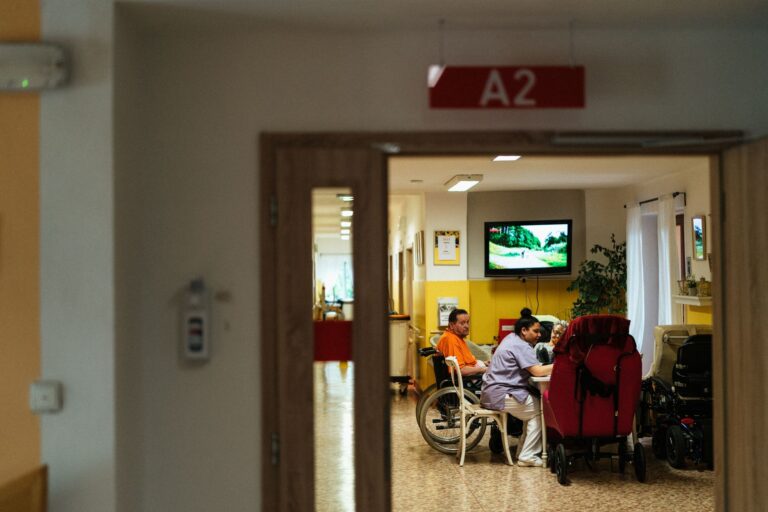
Poetry therapy supports people living with dementia by giving them a way to speak, be heard, and be recognized as themselves when ordinary conversation has become hard. Facilitators recite familiar poems aloud, invite responses, and write down what participants say — and the measurable result is more engagement, more self-expression, and stronger connection with care staff and family. What it does not do is slow the disease.
A 2025 scoping review in the journal *Dementia* screened 1,106 articles and included six studies spanning 1993 to 2023, concluding that poetry functions as a person-centred activity that supports personhood and social connection. The same review reported no significant change in dementia severity over time. That split — real gains in quality of life, none in cognition — is the honest frame for any family deciding whether to try it.
Medical information disclaimer: This article is for general educational purposes only and does not provide medical advice, diagnosis, or treatment. Always consult a physician or other qualified health professional about symptoms, medications, tests, or treatment decisions.
Table of Contents
- What a poetry session actually looks like
- What the evidence shows it changes
- The limits families should know going in
- Who delivers it, and what the credentials mean
- Poetry for the caregiver, not only the person with dementia
- Trying it at home this week
- Frequently Asked Questions
What a poetry session actually looks like
The best-known model is the Alzheimer's Poetry Project, founded by Gary Glazner in 2003. Its signature format is the "Poetry Party": a trained facilitator leads a group in reciting classic, often memorized poems aloud, then adds songs and movement. According to the Alzheimer's Poetry Project, its programming has reached 36 states plus Australia, Canada, England and Germany. Recitation comes first because it asks the least.
A poem learned in childhood — Blake, Longfellow, a nursery rhyme — often returns in full when the first line is offered, even to someone who cannot recall breakfast. The facilitator reads a line, the group echoes it, and the rhythm carries people who could not have produced the words unprompted. Composition comes second. Participants answer open questions, and the facilitator writes their exact words into a poem that is then read back to them. Aagje Swinnen's qualitative study of eight memory-impaired participants, published in *Dementia* in 2016, documented memories surfacing through recitation and co-written compositions exchanged between performers and residents — evidence of retained expressive capacity, not of cognitive improvement.
What the evidence shows it changes
The strongest observational work comes from long-term care. In its Wisconsin implementation study, the Alzheimer's Poetry Project trained activities and care staff in 15 nursing homes over three-month periods, then compared poetry sessions against non-arts programming in the same facilities. The findings reported to the Gerontological Society of America used observational mapping of social engagement, alertness, vocalization and affect.
That method was extended between 2017 and 2023 into Dementia Arts Mapping, developed and tested across staff training at 23 Wisconsin nursing homes. The project reported that engagement increased in every domain of activation observed, and that poetry workshops surpassed other activities in eliciting self-expression. The 2025 scoping review found the same pattern in the published literature: spoken-word poetry programs had positive impacts on self-expression, personhood and agency. Its thematic analysis produced six themes, including exploring and preserving memories, communicating with service users, co-authorship of poems, and continuity of care — three of which are about the relationship between the person and their carers, not about the person alone.
The limits families should know going in
Researchers and the Alzheimer's Poetry Project's own materials state it directly: reciting poetry is unlikely to change the progression of dementia. What it can change, as Kaplan and Glazner argue in *Medical Research Archives*, is how unaffected individuals and society perceive dementia.
Treat it as a quality-of-life and communication intervention and it delivers. Treat it as a treatment and it will disappoint. Two further gaps matter when weighing the research:.
- The evidence base is small. Six included studies across thirty years is a thin foundation, and much of the strongest data is observational rather than randomized.
- The 2025 review identified a lack of literature on programs serving under-represented and minority populations. If a program's poem canon does not match a participant's own language, era or culture, the recitation effect — which depends entirely on familiarity — has nothing to work with.
Who delivers it, and what the credentials mean
"Poetry therapy" covers two different things, and the distinction decides who you are hiring. As a clinical discipline it is credentialed by the International Federation for Biblio/Poetry Therapy. Per the IFBPT's credentialing requirements, the Certified Applied Poetry Facilitator track requires a bachelor's degree, while the Certified Poetry Therapist requires a licensed graduate degree in a clinical mental health field — both involving roughly 200 didactic hours and 60 hours of supervised facilitation.
Community poetry programming is the other thing, and it is not lesser — the Wisconsin work trained existing activities and care staff rather than importing clinicians. But it is not therapy in the clinical sense, and a facility should not describe it as such. Questions worth asking a provider:.
- Are you credentialed through IFBPT, or trained in a specific program model such as the Alzheimer's Poetry Project?
- Do you include composition, or only recitation?
- How do you choose poems for someone whose first language or cultural background differs from the standard canon?
- Is anything written down and given back to the family?
Poetry for the caregiver, not only the person with dementia
Family caregivers are a target group in their own right. A randomized feasibility study of a poetry-writing intervention for caregivers of elders with dementia found positive participant experiences but concluded that a larger sample is needed to test effectiveness.
Keep expectations proportionate to that evidence. A related review rated the included writing studies at only 40 to 60 percent of MMAT quality criteria — meaning the work is promising and preliminary, not established. Caregiver poetry writing is reasonable to try as an outlet; it is not a substitute for respite, counseling or a support group.
Trying it at home this week
Nothing in the format requires a facilitator to begin. Pick poems or song lyrics the person would have learned before roughly age 25, since those are the ones most likely to return intact. Read the first line and pause rather than reading the whole poem through — the pause is where the person gets to participate.
Say the line again if nothing comes, and move on without correcting a wrong word. A substituted or invented line is a contribution, not an error, and treating it as one ends the session. Then write down what they say, verbatim, and read it back to them aloud. That read-back is the part the research keeps pointing at: co-authorship was one of the six themes the 2025 review identified, and it is the step that turns an activity into recognition.
Frequently Asked Questions
Does poetry therapy work in later-stage dementia?
Recitation is the component that holds up longest, because echoing a familiar line asks less than producing original speech. Swinnen's 2016 study documented memory-impaired participants expressing themselves through both recitation and co-written work, which indicates expressive capacity persists further than conversation suggests.
Is it covered by insurance?
Treat coverage as unlikely for community poetry programming, which is usually funded as activities programming inside a facility. Clinical poetry therapy delivered by a licensed mental health professional is a different billing question and depends on that clinician's license and your plan.
How often should sessions happen?
The Wisconsin implementation work ran over three-month periods with trained in-house staff, which points toward regular, embedded sessions rather than one-off visits. Continuity of care was itself one of the six themes the 2025 review drew out of the literature.