Building block toys exercise real cognitive skills, but no evidence shows they maintain brain health or lower dementia risk on their own. The strongest finding is narrower than the question: block construction reliably trains spatial reasoning, and hands-on hobbies of that general type sit alongside lower rates of cognitive decline in large observational studies. That distinction matters if you are buying blocks for an aging parent or for yourself. The habit is cheap, enjoyable and plausibly useful — but it does not substitute for the health measures that actually have evidence behind them.
Medical information disclaimer: This article is for general educational purposes only and does not provide medical advice, diagnosis, or treatment. Always consult a physician or other qualified health professional about symptoms, medications, tests, or treatment decisions.
Table of Contents
- What building blocks demonstrably do to thinking
- The observational case for hands-on hobbies
- Why the statistics may be reading the decline backwards
- When the habit counts
- Where blocks belong in a real prevention plan
- Blocks in dementia care, as distinct from prevention
- Frequently Asked Questions
What building blocks demonstrably do to thinking
The clearest trial evidence comes from children. A six-week teacher-led LEGO construction programme delivered to 409 English primary pupils improved both mental rotation and mathematics scores compared with ordinary lessons, while spatial language showed no change, according to the University of Surrey and Loughborough study published in *Mind, Brain, and Education*. Mental rotation is the ability to picture an object turning in your head — judging whether a piece will fit before you place it.
That is exactly what block building demands, so the result is a direct hit on the trained skill. What the trial does not show is any effect in older adults, or any effect beyond spatial and mathematical tasks. It is evidence that blocks train a specific ability, not that they protect a brain over decades.
The observational case for hands-on hobbies
Among 1,929 cognitively normal older adults followed for about four years in the Mayo Clinic Study of Aging, those who played games had 22% lower risk of developing mild cognitive impairment and those who did craft activities had 28% lower risk, while reading books showed no protective effect — findings reported in *JAMA Neurology*. Mild cognitive impairment, or MCI, is measurable memory or thinking loss that has not yet reached dementia. Block construction is not named in these studies, but it belongs to the same family: a hands-on, goal-directed project with a visible result.
Related work points the same way. A randomized trial of 100 cognitively healthy adults aged 50 and over found jigsaw-puzzle skill correlated with global visuospatial cognition at r = 0.80 and with every ability tested at r ≥ 0.45, though the authors concluded that only long-term puzzling — not their 30-day, one-hour-a-day program — could meaningfully benefit cognition, as published in *Frontiers in Aging Neuroscience*. English adults aged 50 and over who engaged in cognitive leisure activities at medium or higher levels had lower dementia risk in an ELSA data analysis in the *Journals of Gerontology*, which framed such activities as markers of cognitive reserve rather than proven protectors.
Why the statistics may be reading the decline backwards
The Mayo researchers raised the main alternative explanation themselves: people in the earliest stages of cognitive decline may simply stop doing crafts, games and construction projects. If that is what happens, the numbers above appear without any protective effect existing at all. The Alzheimer's Society reaches the same cautious conclusion, stating that this body of evidence is observational, cannot show that puzzle-type activities are themselves responsible for the lower dementia rates, and that there is very little evidence brain training prevents dementia.
The transfer problem is the other gap. The ACTIVE trial, the largest cognitive-training study with over 2,800 adults aged 65 and older, produced lasting gains on the trained tasks a decade later but found no evidence those gains carried over into everyday functioning. Getting better at building blocks is the likeliest outcome of building blocks.
When the habit counts
Timing shows up repeatedly. A Mayo follow-up of roughly 2,000 people averaging age 78 linked mid-life computer use to 48% lower MCI risk, while craft activities were tied to 42% lower risk only when done in later life, as summarized by Harvard Health.
A Chicago cohort reported in *Neurology* in 2021 found cognitive activity in both midlife and late life independently associated with lower Alzheimer's risk, while early-life cognitive activity was not. Read together, those results point at current habit rather than past exposure. The blocks a person played with at seven are not the relevant variable; the ones in use this month may be.
Where blocks belong in a real prevention plan
The 2024 Lancet Commission identified 14 modifiable dementia risk factors, and estimated that addressing them could prevent or delay 45% of cases. Puzzles and construction play are not among them.
That is the practical hierarchy. Block building is a reasonable addition once the evidence-backed items are handled — not a replacement for any of them: If you do buy blocks, choose sets that stay difficult: larger builds, open-ended designs, or models rebuilt from instructions rather than repeated from memory. Difficulty is the ingredient the studies describe, and a build that has become automatic has stopped supplying it.
- Treat hearing loss; get hearing aids fitted if needed
- Control blood pressure, cholesterol and blood sugar
- Stay physically active and avoid smoking and excess alcohol
- Keep social contact and address depression and isolation
- Protect vision, and treat it when it declines
Blocks in dementia care, as distinct from prevention
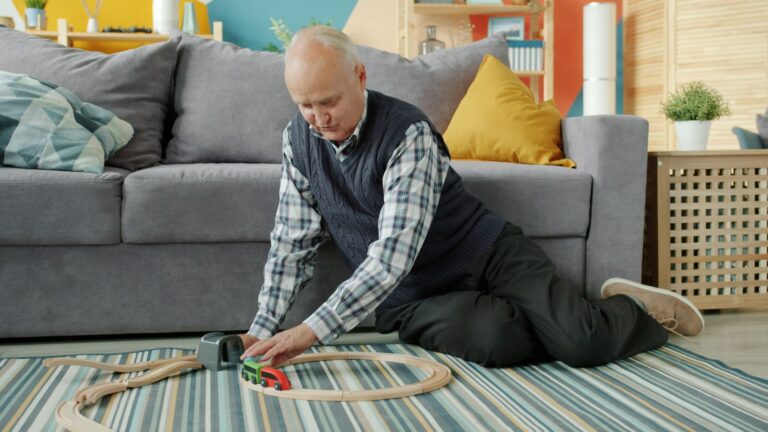
For someone already living with dementia, the question changes. Nothing here suggests blocks slow progression, and a set pitched above a person's current ability creates failure rather than engagement. What they can offer is a tactile activity with no wrong answer, no time pressure and a visible result — useful on its own terms.
Chunky, easy-to-grip pieces and free building rather than instruction-following suit mid-stage ability better than a detailed model kit. A sudden loss of interest in a long-standing building or craft hobby is worth mentioning to a clinician. That withdrawal is the pattern the Mayo authors flagged as a possible early sign of decline, which makes it information rather than just a change of taste.
Frequently Asked Questions
Are adult LEGO sets better than children's for brain health?
No study compares them. The relevant feature in the research is sustained difficulty, so any set that stays challenging over months fits the pattern better than one mastered in an afternoon.
Do blocks beat jigsaw puzzles or crossword-style games?
The evidence cannot rank them. Mayo found games and crafts both associated with lower MCI risk while reading books showed none, and no trial has compared construction play against puzzles in older adults.
How much building would I need to do?
Unknown for blocks. The nearest figure is the *Frontiers in Aging Neuroscience* puzzle trial, where one hour a day for 30 days was judged too short, and the authors pointed to long-term practice instead.