For most people living with dementia, an ordinary telephone call is one of the hardest ways to communicate, and video calls or written cues usually work better once the condition moves past its early stages. A voice-only call strips away every visual signal — faces, lip movement, gestures, surroundings — at exactly the moment the brain most needs them to make sense of speech. A usability study in BMC Geriatrics found that people with dementia struggle with ordinary phones on three fronts at once: visualising an absent speaker, interpreting speech without visual context, and physically handling the device. Understanding why the phone fails points directly to what to use instead — video when someone can support the call, and written or pictorial cues when conversation itself needs scaffolding.
Medical information disclaimer: This article is for general educational purposes only and does not provide medical advice, diagnosis, or treatment. Always consult a physician or other qualified health professional about symptoms, medications, tests, or treatment decisions.
Table of Contents
- Why a voice-only call is uniquely hard in dementia
- When video calls work better — and when they still don't
- What written and pictorial cues add
- Matching the method to the stage
- Making an audio-only call work when it's the only option
- Frequently Asked Questions
Why a voice-only call is uniquely hard in dementia
A phone call is an abstract interaction. The person must hold in mind who is speaking, why, and what was just said — all working-memory tasks that dementia erodes early. There is no face to anchor recognition, no lips to help decode words, and no shared room to supply context. Hearing loss makes this worse, and it commonly travels with dementia.
The Alzheimer's Society notes that hearing loss is often worst for soft or high-pitched sounds — which is what phone audio is. A call therefore compounds two impairments at once: it degrades the only remaining channel while removing every visual backup. The handset itself is a third barrier. Answering, holding, and ending a call are learned procedures, and procedural confusion means a ringing phone can go unanswered or a call can end mid-sentence by accident.
When video calls work better — and when they still don't
Video restores most of what the phone removes. Dementia UK explains that seeing facial expressions, lip movement and familiar surroundings can trigger recognition and memories that a voice alone does not, making conversation clearer and less confusing. Its guidance is that ordinary phone calls tend to suit only the early stages, with video becoming the better remote option as dementia progresses. The evidence backs this up in real settings. During the spring 2020 COVID confinement, the French TOVID survey of 132 frail older adults found care-home residents were satisfied with video calls 93% of the time, versus 50% for phone calls.
A Swedish study of families using video phones with nursing-home residents with dementia found some video conversations were actually more focused and of better quality than face-to-face visits. The catch is support. In the TOVID survey, 94.8% of video-call users needed someone to help make the call, versus about 70% for phone users. Video's advantage depends on a caregiver, relative or staff member setting up the device, framing the camera, and staying nearby. If nobody can do that, a well-run phone call beats a failed video attempt.
What written and pictorial cues add
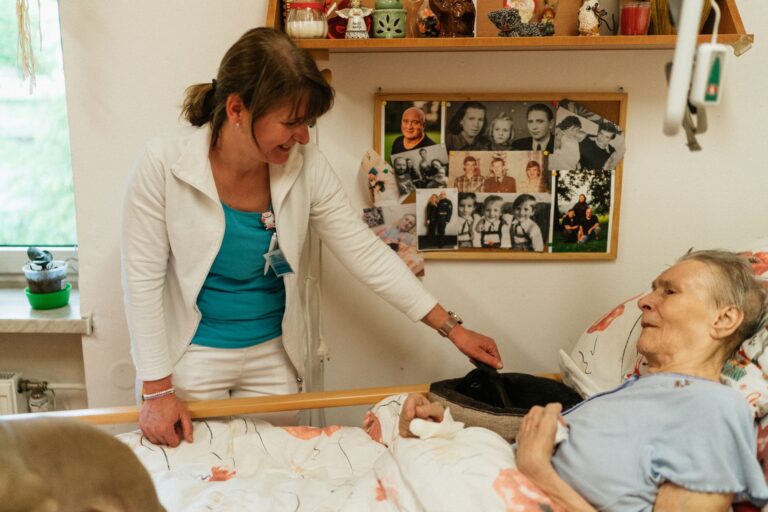
Speech is fleeting; a written word or photograph stays put and can be re-read. That is why the Alzheimer's Association recommends written notes when spoken words seem confusing, along with demonstrated visual cues, as core middle-stage strategies — this stage brings word-finding trouble, lost trains of thought, and growing reliance on non-verbal communication, none of which a phone supports. The strongest research here is Michelle Bourgeois's work on memory books and memory wallets — small collections of labelled photos and one-sentence facts ("This is my daughter Anne. She lives in Ohio.").
Across her studies, people with moderate-to-severe dementia using these aids made more on-topic factual statements and fewer ambiguous utterances than at baseline, with gains achieved after minimal training. Written cues also combine well with calls. A card by the phone reading "Anne calls Sundays at 4" turns a startling ring into an expected event. During a video call, holding a photo up to the camera gives the conversation a shared, visible subject.
Matching the method to the stage
Treat these as a menu, not a ladder. A person with strong hearing but poor tech tolerance may do better on the phone with written prompts beside them; someone with severe hearing loss may need video and lip-reading much earlier.
- Early stage: ordinary phone calls usually still work. Call at a consistent time, keep calls short, and put a note by the phone naming who calls and when.
- Middle stage: shift to video where a helper is available. Add written and pictorial supports — a memory book, labelled photos, a printed call schedule.
- Later stages: video with hands-on support, kept brief and warm. Expect the helper to do the setup and gently redirect; a familiar face and voice can land even when words no longer do.
Making an audio-only call work when it's the only option
Sometimes phone is all there is. Caregiver guidance collected by Liana Living offers a few habits that substitute for the missing visual channel: If calls repeatedly end in distress or confusion, that is information, not failure: it usually means the phone has fallen behind the condition, and it is time to move to supported video or to letters, cards and photos that can be held, kept, and revisited.
- Identify yourself by name immediately — "Hi Mom, it's David, your son" — rather than asking "do you know who this is," which turns the greeting into a test.
- Speak slowly, in short sentences, with one idea per sentence, and pause longer than feels natural for a reply.
- Describe scenes vividly — what you can see, where you are, what the weather is doing — to paint the visual context the call can't show.
- Ask someone at the other end to turn off the television and hand over the phone already connected, so the hardest steps are done.
Frequently Asked Questions
Does the person need to operate the video call themselves?
Usually not — in the TOVID survey nearly 95% of video-call users needed assistance, so plan for a helper on their end from the start.
Are video calls worth it if the person no longer recognises faces reliably?
Often yes. Familiar voices, expressions and surroundings can still bring comfort and moments of recognition, and the Swedish nursing-home study found some video calls were more focused than in-person visits.
What goes in a memory book?
Labelled photos of family, places and routines, each with a short factual sentence. Bourgeois's research found these increase on-topic statements even in moderate-to-severe dementia.