Exercises specialists sits at the center of this dementia and brain health question.
Specialists treating sacroiliac (SI) joint pain typically prescribe a focused set of eight core exercise categories that target the muscles and movement patterns underlying the condition. Rather than random stretching or general fitness work, these rehabilitation exercises address specific deficits in gluteus strength, core stability, and neuromuscular control that contribute to SI joint dysfunction. The eight primary exercise types include gluteal strengthening (particularly glute bridges and clamshells), core stabilization work (transverse abdominis activation and dead bugs), balance and proprioception training, dynamic motor control exercises like quadruped bird dogs, piriformis and hip flexor stretching, posterior chain activation (Superman holds and prone hip extension), sacroiliac joint self-mobilization, and functional integration exercises that combine stability with movement.
If you’ve experienced sharp pain in the lower back, buttocks, or hip that worsens with running, sitting asymmetrically, or climbing stairs, these exercises have significant research backing their effectiveness. Research shows that this multi-exercise approach works better than any single intervention. A randomized controlled trial of 120 patients found that combining motor control exercises with balance training produced substantial improvements in pain scores, functional disability, and quality of life after just 12 weeks—better outcomes than either approach alone. This article explores each of the eight exercise categories specialists use, when they work, and how to recognize whether you need professional guidance.
Table of Contents
- What Muscles and Movement Patterns Do SI Joint Specialists Target?
- Gluteal Strengthening Exercises—The Foundation of SI Joint Stability
- Core Stabilization and Motor Control Exercises
- Stretching and Soft-Tissue Mobility for Hip Mobility
- Balance Training and Proprioceptive Control
- Progressive Loading and Dynamic Movement Integration
- Long-Term Management and Functional Recovery
- Conclusion
What Muscles and Movement Patterns Do SI Joint Specialists Target?
The sacroiliac joint depends on stability from eight major muscle groups working in coordination: the gluteus maximus and medius, piriformis, long head of the biceps femoris, erector spinae, multifidus, transverse abdominis, and pelvic floor muscles. When one or more of these muscles becomes weak, tight, or uncoordinated, the SI joint loses its dynamic stabilization, and the joint surfaces shift slightly during normal movement—creating inflammation and pain. Specialists assess which muscles are underperforming by observing movement patterns, testing strength and flexibility, and sometimes using imaging to rule out structural damage. The weakness is rarely in all muscles equally; some patients have strong glutes but poor core activation, while others have tight hip flexors that pull the pelvis into misalignment.
This is why a cookie-cutter exercise program often fails. A person with anterior pelvic tilt and tight hip flexors may actually worsen their symptoms with aggressive glute strengthening until the hip flexors are first lengthened. Conversely, someone with excessive spinal mobility might need stabilization work before adding dynamic movement. Specialists structure programs by first identifying which muscles are contributing to dysfunction, then progressing in a specific order: typically stabilization and motor control first, then strengthening, then balance and dynamic work. The goal is to restore the coordinated contraction pattern that keeps the SI joint stable without conscious effort.
Gluteal Strengthening Exercises—The Foundation of SI Joint Stability
The gluteus maximus is the primary muscle stabilizing the SI joint during weight-bearing and movement. A 10-visit targeted strengthening program for gluteus maximus dysfunction showed statistically significant increases in both strength and function, alongside decreased pain. This means that if you have SI joint pain, there is a high probability your glute strength is compromised. The most fundamental glute-strengthening exercise is the glute bridge: lying on your back with knees bent and feet flat, you drive through your heels to lift your hips until your body forms a straight line from knees to shoulders, holding for 1-2 seconds at the top before lowering. For someone with severe SI joint pain, even this simplified version might cause discomfort initially, which is why specialists often begin with supine pelvic tilts or quadruped hip extension rather than full bridges.
Clamshells are the primary exercise for the gluteus medius, which stabilizes the pelvis side-to-side during single-leg activities like walking or standing on one leg. In this exercise, you lie on your side with hips and knees bent at 45 degrees, keep your feet together, and lift your top knee while maintaining hip alignment. However, many people perform clamshells incorrectly, allowing their trunk to roll backward or letting the bottom hip hike—compensation patterns that defeat the exercise’s purpose. A specialist will watch you perform these movements and correct your form because poor form trains the wrong muscle groups. The progression from simple bridges and clamshells moves to variations like single-leg bridges, bridge holds with alternating leg lifts, and lateral band work once the basic patterns are established.
Core Stabilization and Motor Control Exercises
Core stability differs from core strength; you can have strong abdominal muscles yet poor core stability if those muscles don’t activate in a coordinated, anticipatory way. Motor control exercises teach your deep core muscles—particularly the transverse abdominis and multifidus—to contract before and during movement, preventing unwanted motion at the SI joint. The foundational motor control exercise is the dead bug: lying on your back with hips and knees bent at 90 degrees (shins parallel to the floor), you slowly lower one arm overhead while straightening the opposite leg, moving slowly and keeping your low back neutral against the floor. The exercise sounds simple but requires intense focus; the moment your lower back arches, you’ve lost core control and the exercise is ineffective.
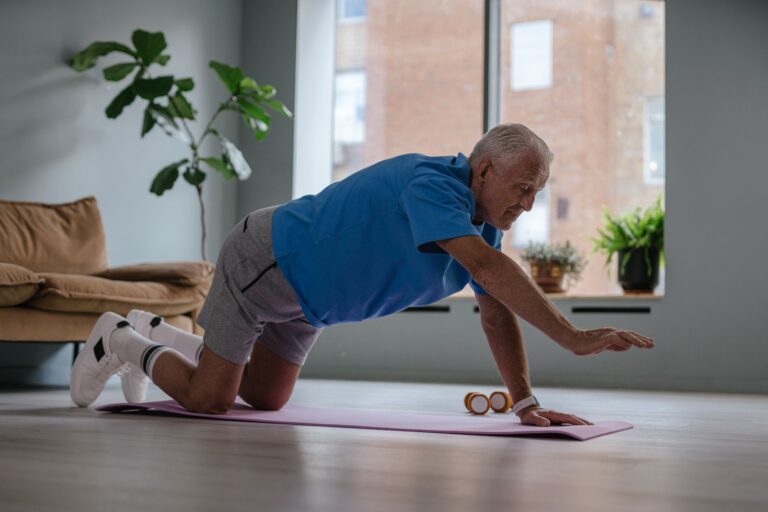
Quadruped bird dogs build on this principle: starting on hands and knees, you extend one arm and the opposite leg simultaneously, creating a straight line from fingertips to toes while maintaining a neutral spine. This exercise is particularly valuable because it trains core stability during movement patterns more similar to real-world activities than dead bugs. Specialists often use real-time feedback—either verbal cues, tactile feedback with their hands on your spine, or sometimes biofeedback with pressure sensors—to help you feel the difference between correct and incorrect activation. A limitation of these exercises is that they are genuinely difficult to perform correctly in isolation; many people report that they don’t “feel” anything in their abs when performing them, which is sometimes accurate (the muscles are contracting but not creating soreness) and sometimes a sign of poor form.

Stretching and Soft-Tissue Mobility for Hip Mobility
Hip flexor tightness, particularly in the iliopsoas, often accompanies SI joint dysfunction because tight hip flexors pull the pelvis into an anterior tilt that destabilizes the SI joint. Stretching is typically done after strengthening has restored some core control; stretching before addressing muscle weakness can sometimes increase SI joint laxity and pain. The most effective hip flexor stretch for SI joint patients is the half-kneeling hip flexor stretch: in a half-kneeling position with the affected leg extended behind you, you gently drive your hips forward, focusing on the sensation in the front of the hip and thigh. Hold this stretch for 30-60 seconds, three to five times per leg, as part of a cool-down after exercise or at separate times during the day.
Piriformis stretching is equally important because the piriformis, a deep hip muscle, can refer pain throughout the buttock and leg when tight or in spasm. The figure-four stretch (lying on your back with one ankle crossed over the opposite knee, then gently pulling the bottom knee toward your chest) is accessible and effective. However, if your pain is actually coming from the SI joint itself rather than the piriformis, aggressive stretching might temporarily make symptoms worse because it increases mobility in an already-unstable joint. This is why specialists assess whether your dysfunction is primarily mobility-limited or stability-limited—stretching is appropriate only for the former group.
Balance Training and Proprioceptive Control
Balance training activates smaller stabilizer muscles and improves neuromuscular coordination—the brain’s ability to automatically fire stabilizing muscles in response to balance perturbations. The research showed that adding balance training to motor control exercises enhanced outcomes more than motor control exercises alone. Single-leg stance is the foundational balance exercise: simply standing on one leg for 30-60 seconds. This is more challenging than it sounds; people with SI joint dysfunction typically have poor proprioceptive feedback from that leg and struggle to maintain a vertical posture.
Progression includes standing on one leg while performing upper-body movements (like reaching forward or across your body), standing on a balance board, or standing on a compliant surface like foam. A limitation of balance training is that it carries a minor fall risk, particularly for older adults, so it should be performed near a wall or counter. Additionally, excessive balance training without concurrent strengthening can reinforce compensation patterns; the body will find creative ways to maintain balance that don’t actually recruit the necessary stabilizers. For example, someone might stabilize their balance by tensing their neck and shoulders rather than recruiting their glutes and core. This is why balance exercises are typically introduced after foundational strengthening, and specialists monitor you for these compensations.
Progressive Loading and Dynamic Movement Integration
Once basic stability and strength are established (typically within 3-4 weeks), specialists introduce dynamic movement exercises that challenge stability while performing functional tasks. These include exercises like single-leg deadlifts (standing on one leg while bending forward at the hips), step-ups onto a low platform, lunges, and resisted walking patterns. A single-leg deadlift combines gluteal activation, balance, and core stabilization in a movement pattern resembling real-world bending and reaching. The exercise requires the hip of the standing leg to internally rotate and abduct slightly, combined with hip extension, activating multiple gluteal fibers simultaneously.
For someone with SI joint pain, the progression to single-leg deadlifts typically occurs in weeks 6-8 of a structured program, not week 1. Resistance bands are frequently used to add load without requiring barbells or complicated equipment. Standing with a band looped around your thighs just above the knees, side-stepping 10-15 steps activates the hip abductors and glutes against resistance, simulating the lateral pelvic control needed during walking. The advantage of resistance band work is that it’s scalable—you can vary band stiffness and add loops to increase resistance—and it can be performed at home. Specialists often prescribe specific rep ranges and progressions; for example, starting with 10 repetitions of unloaded clamshells, progressing to 15 repetitions, then adding light band resistance, and eventually advancing to 20 repetitions with moderate band resistance over several weeks.
Long-Term Management and Functional Recovery
The goal of SI joint rehabilitation is not indefinite exercise dependence but rather restoration of automatic stabilization. After the initial 12-week intensive phase, most patients transition to a maintenance program that involves two to three sessions per week of key exercises, integrated into regular physical activity. This is where real-world outcomes matter: the research showed that combined motor control and balance training produces substantial improvements in pain and function, meaning most people achieve significant symptom relief without surgery. However, this assumes adherence to the program; individuals who completed the initial 12 weeks but abandoned exercises afterward typically experience recurrent symptoms within 2-3 months.
For those with persistent or recurrent SI joint pain, specialists may recommend manual therapy in combination with exercises. Research shows that adding specific exercises to sacroiliac joint manipulation further increases effectiveness compared to manipulation alone. This suggests that if you’re considering manual therapy (such as chiropractic adjustment or osteopathic manipulation), it’s most effective when combined with your exercise program rather than as a standalone treatment. Some patients benefit from pelvic girdle belts that provide external stability during high-demand activities, though these are typically viewed as temporary aids rather than permanent solutions—wearing a belt indefinitely without concurrent strengthening can lead to long-term muscle atrophy.
Conclusion
The eight categories of exercises specialists use for SI joint rehabilitation—gluteal strengthening, core stabilization, motor control, hip mobility work, stretching, balance training, progressive loading, and dynamic integration—form a systematic approach grounded in research and clinical experience. A randomized trial of 120 patients demonstrated that this multi-modal approach, particularly when combining motor control exercises with balance training, produces substantial improvements in pain, disability, and quality of life within 12 weeks. The key insight is that SI joint pain is not a mysterious condition requiring surgery or indefinite management; it’s a biomechanical problem with a biomechanical solution—restoring strength, coordination, and control to the muscles stabilizing the joint.
If you’re experiencing SI joint pain, consult with a board-certified clinical specialist physical therapist or someone with additional training in pelvic health or orthopedic physical therapy. They’ll assess which muscles are contributing to your dysfunction and structure a progressive program tailored to your specific deficits, rather than applying a generic exercise routine. The research suggests that most people see meaningful improvement within 12 weeks if they adhere to a well-designed program, making professional evaluation a worthwhile investment in long-term symptom resolution.
You Might Also Like
- 6 Stabilization Exercises Physical Therapists Use to Improve SI Joint Stability
- 6 Exercises Used in Physical Therapy for SI Joint Pain
- 10 Physical Therapy Exercises Specialists Use to Stabilize Herniated Discs Without Surgery
For more, see CDC — Alzheimer’s and Dementia.