Five exercises that reliably build spine strength are the bird-dog, the dead bug, the glute bridge, the cat-cow, and the farmer’s carry. These movements target the deep stabilizers of the lumbar and thoracic spine without placing excessive compressive load on the vertebral discs, making them suitable for most adults, including older individuals managing cognitive decline or early-stage dementia. A 2019 study published in the Journal of Aging and Physical Activity found that older adults who performed structured spinal stabilization exercises three times per week for twelve weeks showed measurable improvements in both postural control and walking confidence, two factors that directly reduce fall risk in people living with neurodegenerative conditions. This matters more than most people realize for brain health.
The relationship between spinal integrity and cognitive function runs deeper than simple fall prevention. Poor spinal stability leads to reduced physical activity, chronic pain, social withdrawal, and disrupted sleep, all of which accelerate cognitive decline. A person with dementia who develops back pain often cannot articulate the problem clearly, leading to behavioral changes that get misattributed to disease progression rather than a treatable physical issue. This article breaks down each of the five exercises in detail, explains proper form for older adults, addresses when modifications are necessary, and covers the specific connection between spinal health and brain function. The following sections also address common mistakes, when to avoid certain movements, how caregivers can safely assist with these exercises, and what the research says about exercise intensity for people at different stages of cognitive impairment.
Table of Contents
- Why Do Spine-Strengthening Exercises Matter for Brain Health and Dementia Care?
- The Bird-Dog and Dead Bug — Two Foundational Exercises for Spinal Stability
- The Glute Bridge and Its Role in Lower Spine Support
- Cat-Cow for Spinal Mobility — How Flexibility and Strength Work Together
- The Farmer’s Carry — A Functional Exercise Most Programs Overlook
- How Caregivers Can Safely Guide Spine Exercises for Someone with Dementia
- What Current Research Suggests About Exercise and Cognitive Decline
- Conclusion
- Frequently Asked Questions
Why Do Spine-Strengthening Exercises Matter for Brain Health and Dementia Care?
The spine is the structural foundation for nearly every movement a person makes throughout the day. When the muscles surrounding the spinal column weaken, the body compensates with poor posture, reduced mobility, and guarded movement patterns that shrink a person’s world. For someone living with dementia, this shrinking is particularly dangerous. Reduced physical activity is one of the strongest modifiable risk factors for accelerated cognitive decline, according to a 2020 Lancet Commission report that identified physical inactivity among twelve key dementia risk factors. Spine weakness does not just cause back pain. It triggers a cascade: less movement, less social engagement, more falls, more hospitalizations, and faster neurological deterioration. The comparison to cardiovascular exercise is worth noting. While walking and aerobic activity receive the most attention in dementia prevention literature, spinal stability work addresses a different and equally critical problem.
Aerobic exercise improves blood flow to the brain. Spine-strengthening exercises preserve the ability to do aerobic exercise in the first place. A person who cannot stand upright without pain or who fears falling because their trunk muscles have atrophied is not going to walk for thirty minutes a day, no matter how motivated they are. Spinal strength is the prerequisite, not the afterthought. Research from McGill University, led by spine biomechanist Stuart McGill, has demonstrated that endurance in the spinal stabilizers, not raw strength, is the best predictor of back health and functional independence in older adults. This is an important distinction. The goal is not to build a powerful back capable of heavy lifting. The goal is to build a back that can sustain ordinary activity, standing at the kitchen counter, getting in and out of a car, bending to pick something up, without fatigue or failure. The five exercises outlined here were selected with that endurance principle in mind.

The Bird-Dog and Dead Bug — Two Foundational Exercises for Spinal Stability
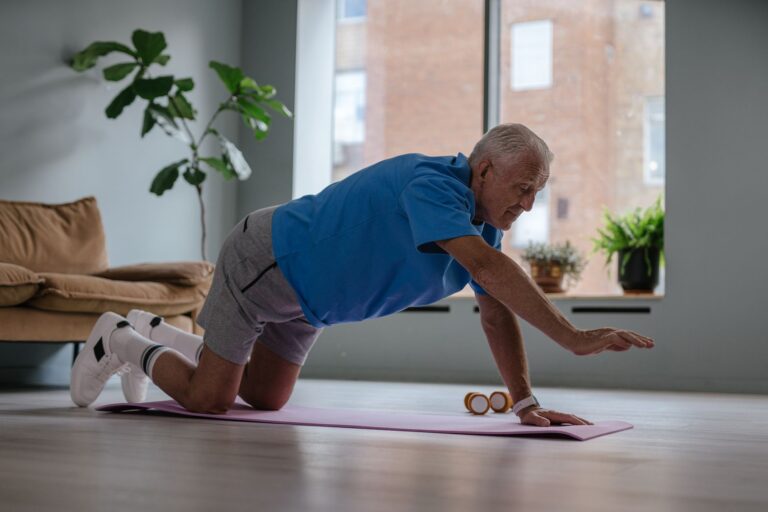
The bird-dog is performed on hands and knees. You extend the right arm forward and the left leg backward simultaneously, hold for five to ten seconds, then return to the starting position and switch sides. The dead bug is performed lying face-up with arms extended toward the ceiling and knees bent at ninety degrees. You lower the right arm overhead while extending the left leg toward the floor, then return and alternate. Both exercises train the deep stabilizing muscles of the spine, particularly the multifidus and transverse abdominis, without compressing the discs or requiring the spine to bear heavy load. What makes these two exercises particularly useful for older adults and dementia care settings is their low injury risk. Neither exercise involves standing, which eliminates fall risk during the movement itself. Neither requires equipment. Both can be modified for people with limited range of motion.
For example, a person who cannot fully extend their leg during the bird-dog can simply lift the knee an inch off the ground and hold. The stimulus to the spinal stabilizers is still meaningful. However, if a person has significant knee osteoarthritis, the hands-and-knees position of the bird-dog may be uncomfortable. In that case, the dead bug, performed entirely on the back, is the better starting point. One common mistake with both exercises is rushing through repetitions. The value comes from controlled, slow movement with deliberate bracing of the abdominal wall. When performed quickly, the body recruits larger, superficial muscles and bypasses the deep stabilizers entirely. For caregivers assisting someone with cognitive impairment, verbal cues like “reach slowly” and “hold still” are more effective than counting reps. The focus should be on quality of each repetition, not quantity. Three sets of five slow, controlled repetitions per side is a reasonable starting point.
The Glute Bridge and Its Role in Lower Spine Support
The glute bridge is performed lying on the back with knees bent and feet flat on the floor. You press through the heels, lift the hips toward the ceiling until the body forms a straight line from shoulders to knees, hold briefly, and lower back down. This exercise strengthens the gluteus maximus and hamstrings, two muscle groups that directly support the lumbar spine. Weak glutes are one of the most common and most overlooked contributors to lower back pain in older adults. When the glutes cannot do their job, the small muscles of the lumbar spine take over, and they are not built for that workload. A specific example illustrates the point. Consider an eighty-year-old woman with mild cognitive impairment who reports increasing low back stiffness every morning.
Her physician finds no disc pathology or fracture on imaging. The problem, identified by a physical therapist, is gluteal inhibition. Her glutes have essentially stopped firing during basic activities like standing from a chair or climbing stairs. After six weeks of daily glute bridges, her morning stiffness resolves and her walking endurance improves noticeably. This scenario plays out regularly in geriatric rehabilitation settings. The glute bridge is also one of the safest exercises to perform independently because the person is lying on the floor with minimal fall risk. For someone with moderate dementia who can still follow simple one-step instructions, a caregiver can guide the movement by placing a hand lightly on the person’s knees and saying “push up.” The tactile cue often works better than verbal instruction alone. One caution: people with active hip replacements should confirm with their surgeon that the bridge movement is cleared, as the degree of hip flexion at the bottom of the movement may need to be monitored depending on the surgical approach used.

Cat-Cow for Spinal Mobility — How Flexibility and Strength Work Together
The cat-cow is performed on hands and knees. In the cow position, you drop the belly toward the floor and lift the head and tailbone. In the cat position, you round the back toward the ceiling, tucking the chin and pelvis. You alternate slowly between these two positions, coordinating with breath. Unlike the other exercises on this list, which emphasize stability and strength, the cat-cow primarily targets spinal mobility. Including it alongside the strength exercises reflects an important tradeoff: a strong but rigid spine is almost as problematic as a weak one. The comparison between mobility and stability is worth understanding clearly. Stability exercises like the bird-dog and dead bug teach the spine to resist unwanted movement.
Mobility exercises like the cat-cow restore the spine’s ability to move through its normal range. Both are necessary. An older adult who only performs stability work may develop a stiff, braced movement pattern that actually increases fall risk because the body cannot adapt to unexpected perturbations like stepping off a curb or being bumped in a crowd. The cat-cow counterbalances this by keeping the spinal segments supple. For people with dementia, the rhythmic, repetitive nature of the cat-cow can have a calming effect beyond the physical benefits. Occupational therapists working in memory care settings have noted that the slow, breath-linked movement often reduces agitation in residents who struggle with more complex or unfamiliar activities. That said, the hands-and-knees position requires adequate wrist and knee health. A seated version, performed in a sturdy chair by rounding and arching the back, provides a reasonable alternative for those who cannot get to the floor or who lack the wrist strength to support their body weight on all fours.
The Farmer’s Carry — A Functional Exercise Most Programs Overlook
The farmer’s carry involves holding a weight in each hand and walking with upright posture for a set distance or time. It trains the entire trunk musculature, grip strength, shoulder stability, and postural endurance simultaneously. Of the five exercises on this list, it is the most functional, meaning it most closely replicates the demands of daily life. Carrying grocery bags, moving a laundry basket, holding a grandchild’s hand while walking — these are all farmer’s carry variations. Despite its simplicity, this exercise is frequently absent from programs designed for older adults, often because trainers underestimate what their clients can handle. The limitation that must be addressed honestly is balance. The farmer’s carry requires walking under load, which introduces fall risk that the other four exercises avoid.
For someone with moderate to advanced dementia, this exercise may not be appropriate without direct supervision and a clear, obstacle-free walking path. A reasonable modification is the suitcase carry, holding a weight on one side only, performed while walking beside a wall or railing that can be grabbed if needed. The unilateral load actually increases the demand on the lateral spinal stabilizers, particularly the quadratus lumborum, making it an effective variation even at lighter weights. Weight selection is another area where caution matters. Starting too heavy is an obvious risk, but starting too light is a subtler problem. If the weight is so light that the body does not need to brace against it, the exercise provides no spinal training benefit. A general starting point is five to ten pounds per hand for a deconditioned older adult, progressing based on the ability to maintain upright posture for thirty to sixty seconds of walking. If the person leans to one side, shrugs a shoulder, or bends forward, the weight is too heavy regardless of what the number says.

How Caregivers Can Safely Guide Spine Exercises for Someone with Dementia
Caregivers should approach exercise facilitation with two principles: simplify the instruction and prioritize consistency over intensity. A person with mid-stage Alzheimer’s disease may not be able to follow a three-step verbal cue like “lie down, bend your knees, and push your hips up.” Breaking that into single steps with pauses between each one, and demonstrating the movement yourself first, dramatically improves compliance. Mirror neurons are powerful. Doing the exercise alongside the person, rather than standing over them giving directions, often triggers imitation even when verbal comprehension is limited.
One practical example comes from a memory care community in Minnesota that incorporated a ten-minute “spine time” routine into its morning programming. Staff performed bird-dogs and glute bridges alongside residents in a group setting, using simple music as a pacing cue rather than complex verbal instructions. Over four months, the facility reported a measurable reduction in fall incidents and an unexpected decrease in behavioral disturbance reports during the hours following the exercise session. The physical therapist who designed the program attributed the behavioral improvement partly to pain reduction and partly to the social engagement the group format provided.
What Current Research Suggests About Exercise and Cognitive Decline
The evidence connecting physical exercise to slower cognitive decline continues to strengthen, though important nuances remain. A 2023 systematic review in Neurology found that resistance and balance training, categories that include all five exercises discussed here, were associated with a slower rate of decline in executive function among adults with mild cognitive impairment. The effect sizes were modest but consistent, and notably, the benefits appeared even when exercise was initiated after diagnosis rather than only as a preventive measure.
Looking ahead, researchers are increasingly interested in whether specific types of exercise produce different neurological benefits. Preliminary work suggests that exercises requiring coordination and balance, such as the bird-dog and farmer’s carry, may stimulate cerebellar and prefrontal cortex activity in ways that simple repetitive movements do not. This is still early-stage research, and no one should claim that spine exercises cure or reverse dementia. But the trajectory of the evidence supports a clear message: maintaining spinal strength and mobility is one of the most practical, low-cost interventions available for preserving quality of life and functional independence in people living with cognitive decline, and it is never too late to start.
Conclusion
The five exercises outlined here, the bird-dog, dead bug, glute bridge, cat-cow, and farmer’s carry, address spinal strength from multiple angles: deep stabilization, gluteal support, mobility, and functional endurance. None of them require a gym membership or expensive equipment. All of them can be modified for varying levels of physical ability and cognitive function. The key is consistency. Three sessions per week of ten to fifteen minutes each is enough to produce meaningful change in postural stability, pain levels, and movement confidence within a matter of weeks.
For caregivers and families navigating dementia, these exercises offer something beyond the physical benefits. They provide a structured, shared activity that preserves dignity, creates routine, and reinforces the person’s identity as someone who is still capable of growth and effort. Starting is simpler than most people expect. Pick two of the five exercises, do them together for one week, and build from there. If pain, balance issues, or uncertainty about form arise, a single session with a physical therapist can provide enough guidance to continue safely on your own.
Frequently Asked Questions
Can someone with moderate dementia do these exercises safely?
Yes, with supervision and simplified instruction. Floor-based exercises like the glute bridge and dead bug are the safest starting points because they eliminate fall risk during the movement. A caregiver should be present to guide positioning and provide single-step verbal or tactile cues.
How often should these spine exercises be performed?
Three times per week is the most commonly recommended frequency in the research literature. Daily performance of the cat-cow for mobility is generally safe, but the strengthening exercises benefit from rest days between sessions to allow tissue adaptation.
What if the person cannot get down to the floor?
Several of these exercises have seated or standing modifications. The cat-cow can be performed in a chair. The glute bridge can be approximated with a seated hip thrust using a sturdy chair. The farmer’s carry is already a standing exercise. A physical therapist can design a fully chair-based spine program if floor work is not feasible.
Are these exercises safe after a spinal compression fracture?
That depends on the fracture location, severity, and healing stage. The cat-cow, which involves spinal flexion, is typically contraindicated in the acute phase of a vertebral compression fracture. Consult the treating physician or a physical therapist before beginning any exercise program after a spinal fracture.
Will these exercises help with the stooped posture common in older adults?
They can help slow and partially reverse postural changes related to muscle weakness, which is the most common cause of age-related stooping. However, postural changes caused by structural issues like vertebral wedging from osteoporotic fractures or degenerative disc disease will not be fully corrected by exercise alone. Exercise still helps in those cases by reducing pain and preventing further deterioration.
Should someone with back pain avoid these exercises?
Not necessarily. Many of these exercises are prescribed as treatment for back pain, not despite it. The bird-dog and dead bug in particular are staples of physical therapy for low back pain. However, any exercise that increases sharp or radiating pain should be stopped immediately, and a medical professional should evaluate before continuing.
You Might Also Like
- 7 Exercises for Lower Back Strength
- 6 Exercises for Spine Stabilization
- 9 Exercises for Pelvic Stability
For more, see Alzheimer’s Association — clinical trials.