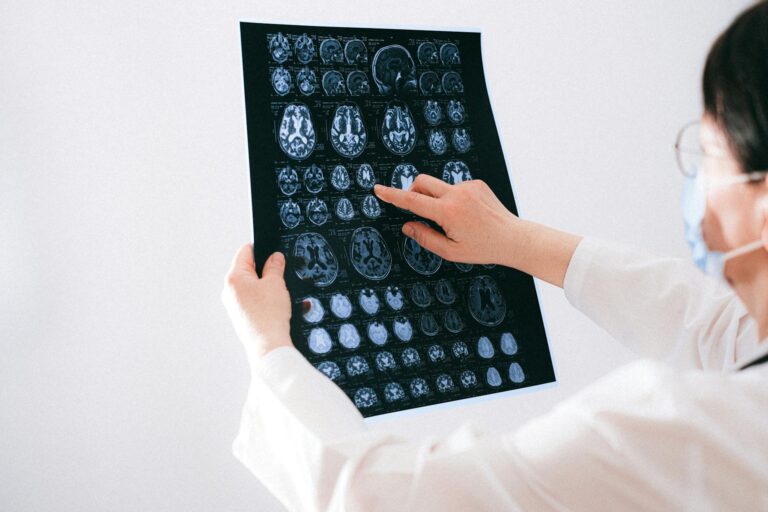
Cortical thinning on a brain MRI refers to a measurable reduction in the thickness of the brain’s outer gray matter layer — the cortex. When a radiologist or neurologist notes cortical thinning in an MRI report, it means that the distance between the gray-white matter boundary and the outer surface of the brain has decreased in one or more regions compared to what is expected for a person’s age. This is measured on T1-weighted MRI scans, and normal cortical thickness in healthy adults typically ranges from approximately 1.5 mm in thinner regions to about 4.5 mm in thicker ones. The finding can be significant or entirely unremarkable, depending on where the thinning occurs, how extensive it is, and the patient’s age and medical history.
Not all cortical thinning is cause for alarm. Some degree of thinning is a well-established part of normal aging, particularly in the frontal and temporal lobes. However, when thinning appears in specific patterns or progresses more rapidly than expected, it can serve as an early biomarker for neurodegeneration — including Alzheimer’s disease, Parkinson’s-related dementia, and the effects of cerebrovascular disease. This article explains what cortical thinning means in plain terms, which brain regions matter most, how doctors interpret the finding, and what it may or may not imply for long-term brain health.
Table of Contents
- What Does the Brain’s Cortex Do, and How Is Thinning Measured on MRI?
- Normal Aging Versus Pathological Thinning — How Doctors Tell the Difference
- Which Brain Regions Matter Most for Dementia Risk?
- What Systemic Health Conditions Contribute to Cortical Thinning?
- Cortical Thinning as a Biomarker — What Machine Learning Is Revealing
- What to Do If Your MRI Report Mentions Cortical Thinning
- Where the Science Is Heading
- Conclusion
- Frequently Asked Questions
What Does the Brain’s Cortex Do, and How Is Thinning Measured on MRI?
The cerebral cortex is the outermost layer of the brain, composed primarily of neurons and their connections. It is responsible for the most complex aspects of human cognition — language, memory, decision-making, perception, and voluntary movement. Different regions of the cortex handle different functions: the prefrontal cortex governs executive function and planning, the temporal lobe is central to memory and language, and the parietal regions integrate sensory information and spatial reasoning. When cortical tissue is lost or shrinks, these functions can be affected. On a T1-weighted MRI, the distinction between gray matter (the cortex) and white matter (the underlying nerve fiber tracts) appears as a clear contrast boundary. Specialized software can automatically trace this boundary and measure cortical thickness at thousands of points across the brain’s surface.
The result is often displayed as a color-coded map, with thinner regions highlighted in cooler colors and thicker regions in warmer ones. A radiologist comparing your scan to a normative database can identify which areas deviate meaningfully from what is expected at your age. An important caveat applies in younger populations. In children and adolescents, what appears as cortical thinning on MRI may actually reflect increased myelination — the process by which nerve fibers develop a fatty sheath that speeds up signal transmission. Research published in PNAS found that apparent MRI-detected thinning in childhood often represents this normal developmental process rather than tissue loss. This is a reminder that interpreting cortical thickness data always requires age-appropriate context.

Normal Aging Versus Pathological Thinning — How Doctors Tell the Difference
The brain does naturally lose cortical volume with age. Studies tracking healthy adults across decades show that thinning is most pronounced in the frontal and temporal lobes, and this process accelerates somewhat after age 60. This is why radiologists compare a patient’s cortical measurements to age-matched norms rather than to a universal standard. A 75-year-old with mild frontal lobe thinning may be entirely within the expected range for their age group. What distinguishes pathological thinning from normal aging is primarily the pattern and the rate. Alzheimer’s disease, for example, tends to produce thinning that begins in very specific areas — particularly the precuneus and inferior temporal regions — before spreading more broadly.
Research published in Brain by Oxford Academic demonstrated that lower mean cortical thickness in these areas could predict progression from cognitively normal status to clinical symptom onset within seven years. This kind of spatially specific, progressive pattern is not what you would expect from ordinary aging alone. However, interpreting a single MRI scan in isolation is difficult. A one-time measurement tells you where a person stands right now, but not how quickly they got there or whether the process is ongoing. Serial imaging — comparing scans taken months or years apart — provides far more meaningful information. If a radiologist flags cortical thinning in an older patient’s report, that finding should be discussed with a neurologist who can evaluate it alongside cognitive testing, medical history, and other biomarkers rather than treating the MRI result as a standalone diagnosis.
Which Brain Regions Matter Most for Dementia Risk?
The spatial distribution of cortical thinning is arguably more informative than the presence of thinning alone. In Alzheimer’s disease, the earliest detectable changes tend to appear in the entorhinal cortex, the hippocampal region, and the precuneus — areas closely tied to episodic memory and spatial navigation. By the time a patient notices memory problems, thinning in these regions may already be well established. This is why researchers are increasingly interested in cortical thickness as a preclinical marker, not just a diagnostic one. Parkinson’s disease presents a different spatial signature.
For patients with Parkinson’s who also have mild cognitive impairment (MCI), thinning in posterior regions such as the angular gyrus and in frontal olfactory areas has been shown to predict conversion to full dementia. A study published in Radiology found that cortical thickness measurements could help clinicians identify which Parkinson’s patients with MCI were at highest risk of progressing — a finding with direct implications for how aggressively those patients should be monitored and treated. Cerebrovascular disease, including cerebral small vessel disease, produces yet another pattern. Here, thinning tends to result not from direct cortical damage but from the disruption of white matter tracts that connect cortical regions to one another. Research published in Brain found that this mechanism contributes specifically to impairments in processing speed — the cognitive domain most sensitive to disrupted connectivity. A patient with extensive white matter lesions and mild cortical thinning may not have traditional dementia but may struggle significantly with tasks that require quick information processing.

What Systemic Health Conditions Contribute to Cortical Thinning?
Cortical thinning is not solely a brain disease phenomenon. Several systemic medical conditions have been associated with measurable reductions in cortical thickness, which helps explain why cardiovascular and metabolic health matter so much for long-term cognitive outcomes. Diabetes and chronically elevated blood glucose are among the best-studied culprits. Research published in the Medicine Journal found that diabetes is associated with global cortical thinning through multiple mechanisms, including disruption of the blood-brain barrier and the accumulation of advanced glycation end-products — proteins and lipids damaged by prolonged exposure to high glucose. The thinning associated with diabetes is not limited to one region; it tends to be diffuse, meaning it affects the cortex broadly rather than following the pattern seen in Alzheimer’s disease.
This distinction matters: a person with poorly controlled diabetes who shows diffuse thinning on MRI is in a different clinical situation than someone with focal thinning in Alzheimer’s-typical regions, even if the MRI report uses similar language. The practical implication is that managing systemic health conditions is not separate from protecting brain health — it is the same project. Blood pressure control, glucose management, and cardiovascular fitness all influence the rate at which the cortex thins over time. Patients often focus on medications for these conditions, but lifestyle factors including exercise, diet, and sleep also affect cortical volume directly. The tradeoff to acknowledge here is that these interventions require sustained commitment over years and decades; there is no short-term intervention that meaningfully reverses established cortical thinning.
Cortical Thinning as a Biomarker — What Machine Learning Is Revealing
One of the most significant recent developments in neuroimaging is the use of cortical thickness data as input for machine learning algorithms designed to predict disease progression. Rather than relying on a single measurement or region, these models analyze thousands of cortical thickness data points simultaneously, looking for patterns that human eyes would miss. A study published in the Journal of Translational Medicine demonstrated that individualized cortical thickness assessment — comparing a single patient’s profile against large normative databases — can meaningfully improve prediction of who will convert from mild cognitive impairment to dementia. This approach represents a shift from group-level statistics to individualized medicine.
Historically, research findings about cortical thinning were expressed as group averages: patients with Alzheimer’s have, on average, thinner cortex in region X compared to healthy controls. Machine learning allows clinicians to ask a different question: given this individual patient’s cortical thickness map across all regions, what is their personal probability of cognitive decline over the next five years? The answer is not yet definitive, but it is becoming more actionable. A significant limitation, however, is that these models are only as good as the data they are trained on. Most normative databases used in cortical thickness research have historically overrepresented certain populations — white adults from Western countries, for example — and may not accurately predict risk for individuals from other demographic backgrounds. Clinicians should be cautious about applying algorithmic predictions without considering whether the normative data is appropriate for the specific patient.

What to Do If Your MRI Report Mentions Cortical Thinning
Receiving an MRI report that mentions cortical thinning can be frightening, particularly if the language is technical and no one has explained what it means. The first step is context: was the MRI ordered because of cognitive symptoms, or was it done for another reason — a headache, for example — and the finding was incidental? An incidental mention of mild cortical thinning in an older adult being scanned for something unrelated may be entirely consistent with normal aging.
If the finding is clinically relevant, the appropriate next step is a referral to a neurologist or neuropsychologist for comprehensive evaluation. This typically includes formal cognitive testing, a detailed medical history review, and often additional imaging or biomarker studies such as amyloid PET scanning or cerebrospinal fluid analysis. Cortical thinning on MRI is a starting point for investigation, not a diagnosis on its own.
Where the Science Is Heading
Research in cortical thickness is moving toward earlier detection and more precise characterization. Advances in MRI hardware and acquisition protocols are improving the resolution at which cortical thickness can be measured, allowing researchers to detect subtle changes that would have been invisible a decade ago. Combined with genetic risk profiling, blood-based biomarkers such as plasma phosphorylated tau, and longitudinal imaging, cortical thickness measurement is becoming one piece of a broader mosaic that may eventually allow genuinely preclinical intervention — treating neurodegenerative disease before symptoms appear.
The field is not there yet. But the trajectory is clear: cortical thickness, once a research curiosity requiring specialized analysis, is increasingly part of routine clinical neuroimaging interpretation. As standardized tools become more widely available, the conversation between radiologists, neurologists, and patients about what these measurements mean will need to become more nuanced — and more honest about the difference between what imaging can confirm and what it can only suggest.
Conclusion
Cortical thinning on a brain MRI is a measurement of how thick the brain’s outer gray matter layer is in specific regions. Some degree of thinning is normal with age, particularly in the frontal and temporal lobes, while other patterns — especially in the precuneus, inferior temporal cortex, and angular gyrus — are associated with specific diseases including Alzheimer’s and Parkinson’s-related dementia. Systemic conditions like diabetes also contribute to global cortical thinning through mechanisms that are increasingly well understood.
The key to interpreting this finding lies in the pattern, the rate of change over time, and the clinical context in which the MRI was ordered. If you or someone you care for has received an MRI report mentioning cortical thinning, resist the impulse to read it as a definitive prognosis. Bring the report to a neurologist who can place the finding in context, order appropriate follow-up if needed, and explain what the measurement does and does not mean. Brain imaging is a powerful tool, but it tells one part of a larger story — and that story requires clinical expertise to interpret accurately.
Frequently Asked Questions
Is cortical thinning the same as brain shrinkage?
They are related but not identical. Brain shrinkage, or atrophy, is a broader term that can include loss of white matter volume, enlargement of the brain’s fluid-filled spaces, and reductions in overall brain size. Cortical thinning specifically refers to a reduction in the thickness of the gray matter cortex and is measured differently on MRI. Both can occur together, but a report mentioning cortical thinning is not necessarily reporting overall brain shrinkage.
Can cortical thinning be reversed?
In most cases, established cortical thinning due to neurodegeneration cannot be reversed with current treatments. However, some evidence suggests that lifestyle interventions — particularly aerobic exercise — can slow the rate of age-related thinning and may modestly increase cortical volume in certain regions. Managing conditions like diabetes and high blood pressure may also slow further thinning.
Does cortical thinning always mean dementia is coming?
No. Cortical thinning is a risk indicator, not a diagnosis. Many people with measurable cortical thinning do not develop dementia, particularly when thinning follows the expected pattern for their age group. The pattern, location, and rate of change matter more than the presence of thinning alone.
At what age does normal cortical thinning begin?
Cortical thickness typically peaks in early adulthood and then gradually declines throughout the lifespan. The rate accelerates with advancing age, and thinning in the frontal and temporal lobes is particularly pronounced after age 60. However, there is significant individual variation, and age-matched normative comparisons are essential for meaningful interpretation.
Why does the MRI report mention specific brain regions?
Different cortical regions serve different functions and are associated with different disease processes. When a radiologist specifies which regions show thinning — such as the precuneus or the inferior temporal cortex — it helps neurologists determine whether the pattern is consistent with normal aging, a specific neurodegenerative disease, or vascular damage. Regional specificity is one of the most important aspects of cortical thickness interpretation.