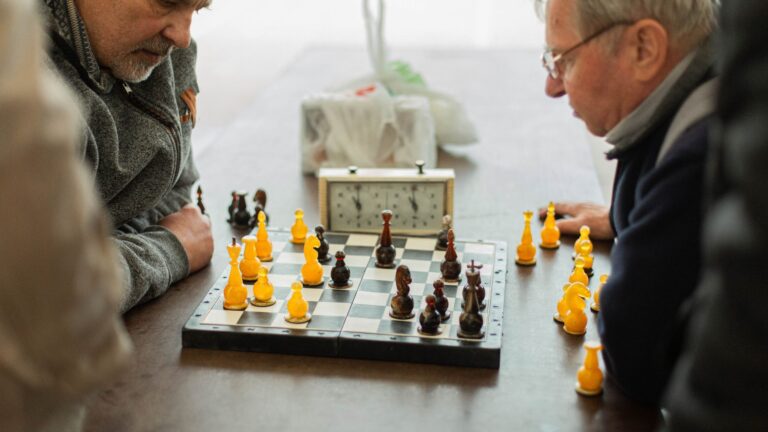
Caregivers introduce a new game best by starting it rather than explaining it: sit down beside the person, make the first move yourself, and cue one step at a time instead of describing the rules. Slot the game into the part of the day the person already spends doing something pleasant, strip out scoring and spare pieces, and expect the game to be learned over several short sessions rather than one sitting. Confusion usually comes from the introduction, not from the game. A set of rules delivered up front asks the person to plan, sequence, and hold instructions in mind — exactly the abilities dementia takes first — while the hand movements and pattern-matching the game actually needs often remain intact.
Medical information disclaimer: This article is for general educational purposes only and does not provide medical advice, diagnosis, or treatment. Always consult a physician or other qualified health professional about symptoms, medications, tests, or treatment decisions.
Table of Contents
- Why explaining the rules is the step that fails
- Picking a time, not just a game
- How to run the first session
- What the evidence says about learning — and what it doesn't
- Can someone with moderate or advanced dementia learn a genuinely new game?
- When to change the game instead of pushing harder
- Frequently Asked Questions
Why explaining the rules is the step that fails
The Alzheimer's Association's Activities at Home guidance tells caregivers to break an activity into simple, easy-to-follow steps, focus on one step at a time, and warns directly that too many directions at once can be overwhelming. It also advises the caregiver to take on the hardest parts of a task themselves — measuring ingredients in a recipe, for example. Applied to a board game, the hardest part is the rules. The reason sits in what dementia damages. The Association notes that most people with dementia keep the energy and desire to do things but lose the ability to organize, plan, initiate, and complete a task.
A rulebook is a planning document. Handing it over, even verbally, asks for the one skill that is gone. So the practical substitution is a demonstration. Place the tiles, make your move, slide the next piece within reach, and wait. The person is copying, not reconstructing a procedure from memory.
Picking a time, not just a game
The National Institute on Aging advises building enjoyable activities into the daily routine at roughly the same time each day. That matters more for a *new* game than a familiar one: if the game arrives inside an established rhythm — after breakfast, mid-afternoon, before the evening unsettles things — it registers as the usual pleasant part of the day rather than an unexpected demand.
The flip side is useful when something goes badly. Association guidance says an activity that fails should be adapted or simply retried later, because the time of day or the complexity may be the problem rather than the activity itself. A game that confused someone at 6pm is not necessarily the wrong game.
How to run the first session
The NIA's guidance on adapting activities asks caregivers to match the activity to what the person can still do, help them get started, watch for frustration, and make sure they end up feeling successful — including letting them watch rather than play if that is what they enjoy. A first session that follows that advice looks roughly like this: Repeat the same setup the next day. Familiar placement does some of the remembering for the person.
- Set up the game completely before the person sits down, so no part of the session is logistics.
- Remove surplus pieces and extra decks. Fewer choices on the table means fewer decisions per turn.
- Drop scoring entirely on the first few runs. Keeping score adds arithmetic and comparison to a task that does not need either.
- Demonstrate the first move. Say what you are doing in one short sentence as you do it.
- Cue the next step physically — point, or push the piece forward — rather than restating the rule.
What the evidence says about learning — and what it doesn't
"Demonstrate, don't explain" has a formal clinical name: errorless learning, meaning feed-forward instruction and cueing designed to stop the learner making mistakes in the first place. It has been trialled as structured relearning of daily tasks in people with Alzheimer's or mixed dementia living at home. The limit is important, and it cuts against the usual advice. In the multicentre REDALI-DEM randomised controlled trial, 161 people with dementia received nine one-hour task-training sessions over eight weeks.
Both groups improved significantly and held their gains for six months — but errorless learning was no better than trial-and-error learning on any outcome measured. The benefit came from structured, repeated practice, not from preventing errors. For a caregiver, that reframes the goal. Shielding someone from every mistake is not what produces competence; coming back to the same game, in the same form, on a regular schedule is. A wrong move that nobody makes a fuss about costs very little.
Can someone with moderate or advanced dementia learn a genuinely new game?
Yes. In a pilot study of a tablet-based serious game reported in JMIR Serious Games, people with moderate and advanced dementia got faster at completing game screens with practice, at a rate that was not statistically different from healthy control participants.
Practice-based learning survives well into the disease, even when the person cannot recall having played before. This is why "they won't remember it" is a poor reason not to try. The skill improves whether or not the episode is remembered, and the enjoyment is in the session itself.
When to change the game instead of pushing harder
The same pilot is candid about poor fit. Twelve of the 24 people with dementia who started it — half the group — dropped out, and the authors note that obtaining meaningful informed consent from people with dementia is itself difficult. Repeated non-participation is information about the game, not a lack of effort from the person. Watch for the signals rather than waiting for a refusal: pushing pieces away, standing up, going quiet, asking to do something else, or needing a cue for every single move several sessions in.
Any of those means the game is too complex, too fast, or simply not interesting to this person. Then swap, don't escalate. The Association's position is that people with dementia need not give up the activities they love, because most can be modified to current ability — a card game cut to one suit, dominoes matched by colour instead of number, or a jigsaw taken down from 100 pieces to 12. If the person would rather watch you play, the NIA counts that as a legitimate outcome of the session.
Frequently Asked Questions
Should I correct a wrong move?
Lightly or not at all. In the REDALI-DEM trial, error prevention gave no measurable advantage over trial-and-error learning, so stopping every mistake buys less than it costs in frustration.
How long should a first session be?
Short enough to end while things are still going well. The Alzheimer's Association's one-step-at-a-time approach works better across several brief sittings than one long teaching session.
Is a tablet game a reasonable choice?
It can be — the JMIR pilot used a tablet-based game with people at moderate and advanced stages. Set it up and hand it over mid-game, so the person never meets a menu screen.